aNDREA MORUCCHIO(Venice 1967) After receiving a degree in Political Science from the University of Padua, Andrea Morucchio began his photographic career in 1989. Since the end of the ’90s, he has expanded his own linguistic research – often based on considerations of a socio-political nature – in various directions, from SCULPTUREto INSTALLATION, from VIDEO to PHOTOGRAPHY, DIGITAL ARTand latelyNFT. Throughout his career, Morucchio has explored a wide range of tools and languages of contemporary art, employing new media of visual communication and combining images, sounds, gestures, and words into coherent works shaped by sustained expressive and conceptual research. Despite the diversity of forms adopted, his work remains anchored in a reflection on the image, nature, and human experience.
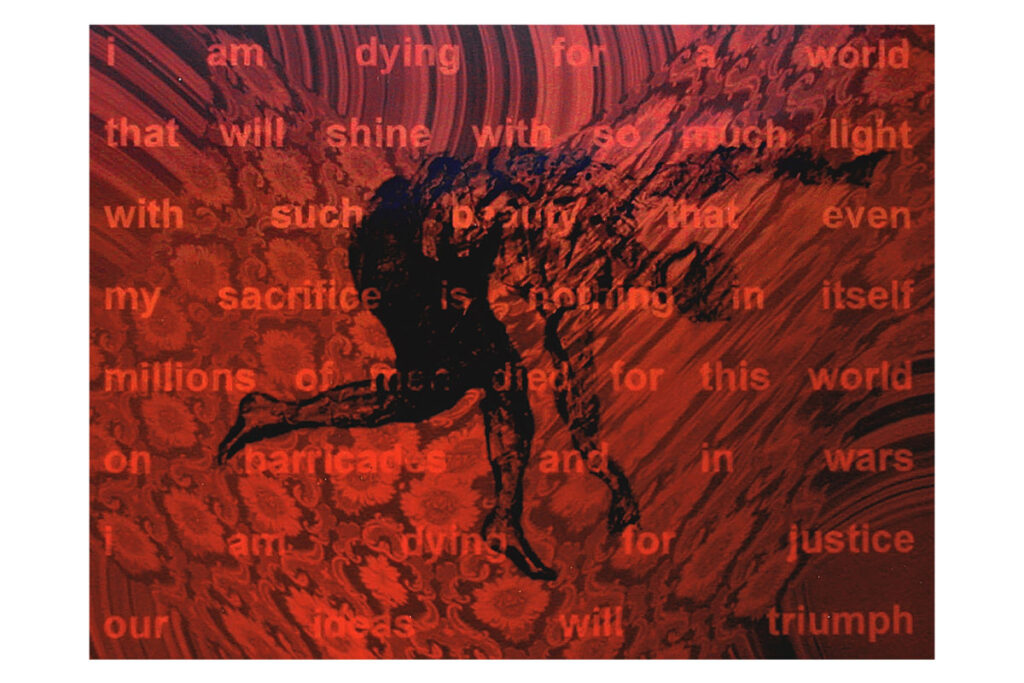
Within the Italian contemporary art scene, Morucchio’s practice is distinguished by its ability to transform visual experience into a critical device, articulating relationships between matter, space, and symbolic dimension. From the late 1990s onwards, he developed a sculptural research based on the tension between contrasting materials—particularly glass and metal— blade (1999) enlightenments (2000) while simultaneously evolving toward immersive installation works that actively engage the viewer within sensorial and perceptual environments. A significant aspect of his practice addresses political and social issues, often revealing a striking anticipatory awareness of the tensions defining the present. Works such as Le nostre idee vinceranno (2002) interrogate the symbolic construction of sacrifice and ideological memory, questioning how narratives of martyrdom and fanaticism persist and re-emerge within contemporary cultural languages.
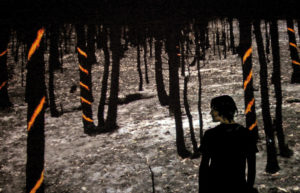
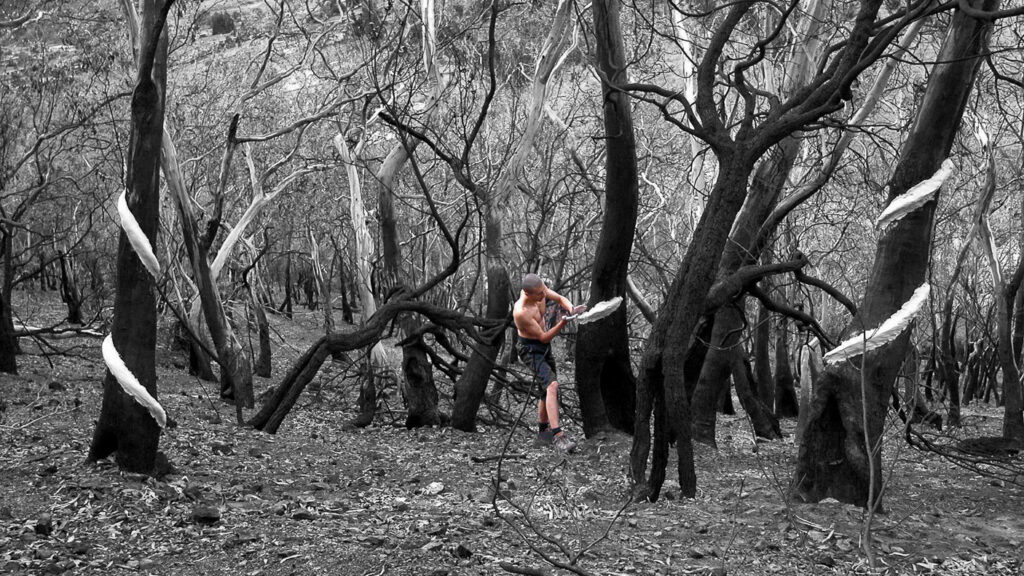
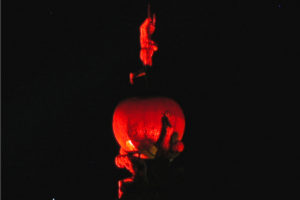
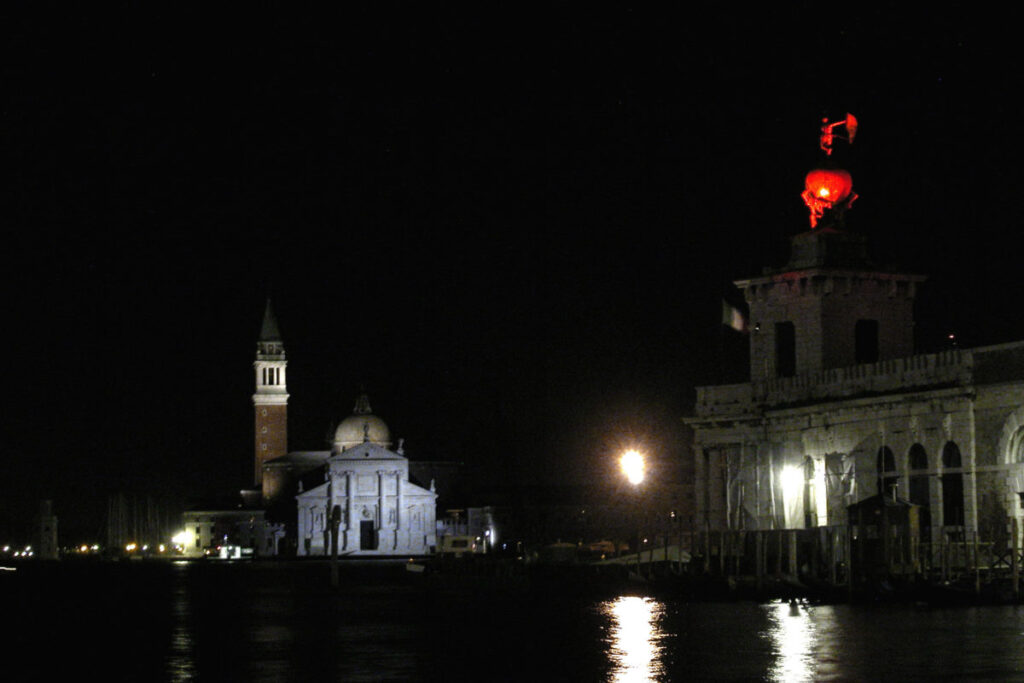
In Eidetic Bush (2003), developed during an artist residency in Tasmania, the destruction of the natural landscape is explored alongside the dynamics of colonial history, contemporary neo-colonial structures of Western power, and the ecological transformations associated with the Anthropocene. The project establishes a dialogue between ritual gesture and digital technology, combining performative interventions in the landscape with their virtual reconfiguration, anticipating current debates on ecology, memory, and global power structures. Pulse Red (2004), a public art intervention at Punta della Dogana in Venice, transforms a historic architectural symbol of trade and exchange into a pulsating light signal, reflecting on the paradoxes of contemporary communication systems—between information overload and the erosion of meaning.
Laudes Regiae (2007) draws on medieval liturgical acclamations as mechanisms of symbolic legitimation of power, revealing the persistence of ritual structures within contemporary political and media communication. The work highlights how processes of authority and consensus continue to rely on ceremonial and symbolic dispositifs that have migrated from sacred tradition into the sphere of mass media and political spectacle.
Verso il Paese dei Fumi e delle Urla (2008) is a public art project developed in Venice through video-sound installations and urban interventions. It reuses identity symbols imposed on prisoners in Nazi concentration camps as visual ready-mades in public space, activating a reflection on historical memory and the resurgence of discriminatory ideologies in contemporary society.
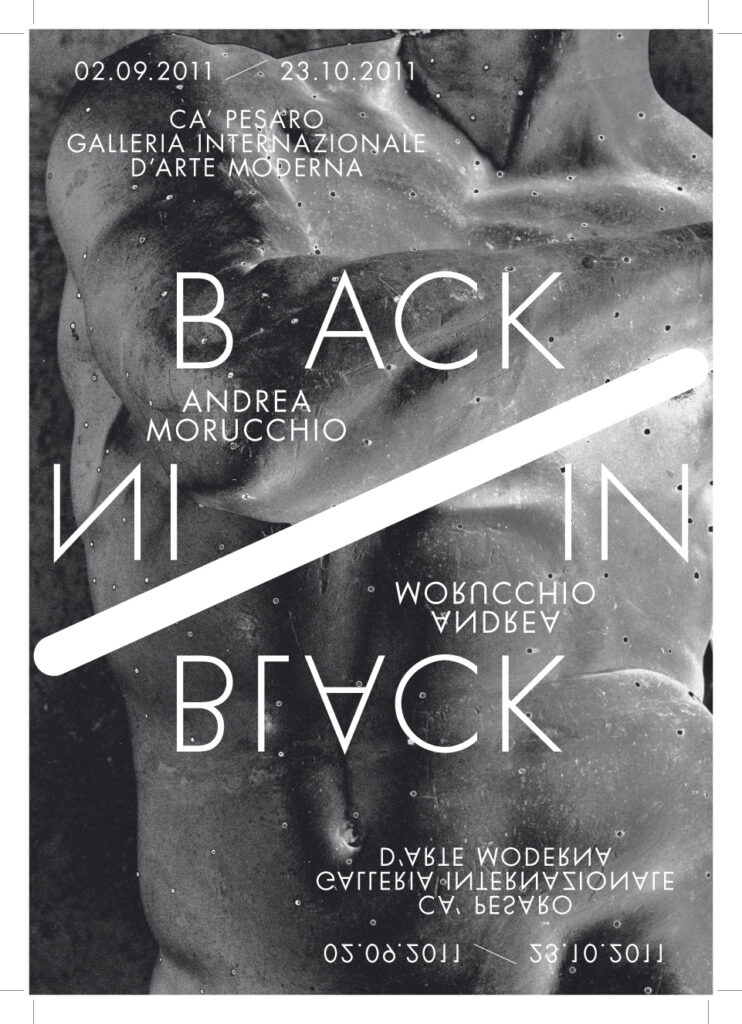
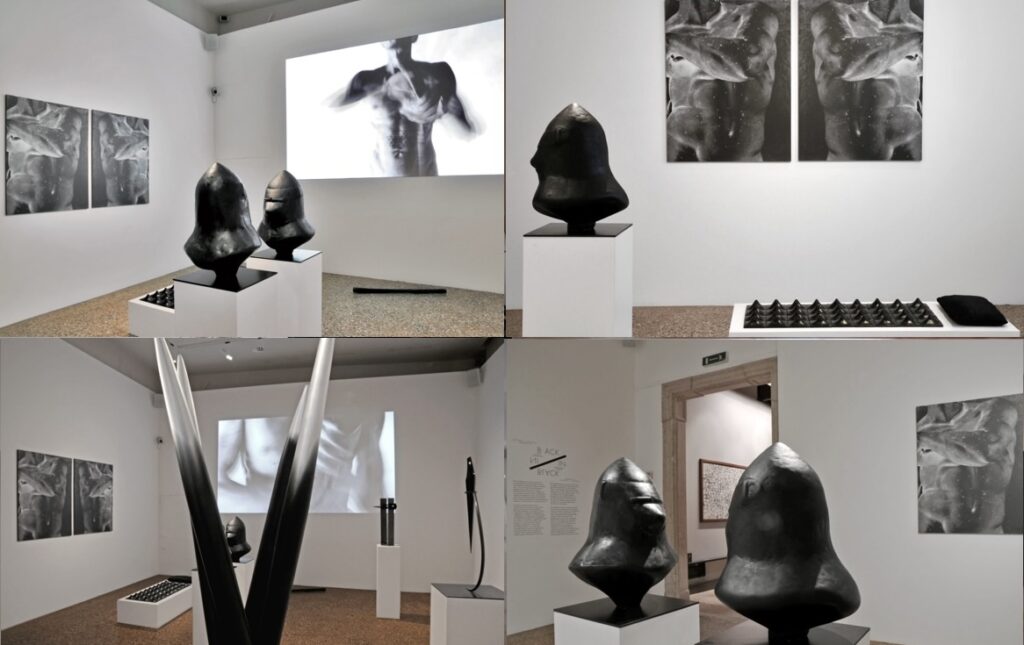
Back in Black (2011),MORUCCHIO’S SOLO SHOW presented at Ca’ Pesaro – International Gallery of Modern Art in Venice, is conceived as a meditation on the symbolic dimension of black and on the relationship between matter, conflict, and transformation, addressing the underlying tensions of contemporary existence. Taken together, these works reveal a consistent ability to anticipate cultural, political, and social phenomena that would later become central, outlining a practice that engages critically—and almost prophetically—with the contradictions of the present.
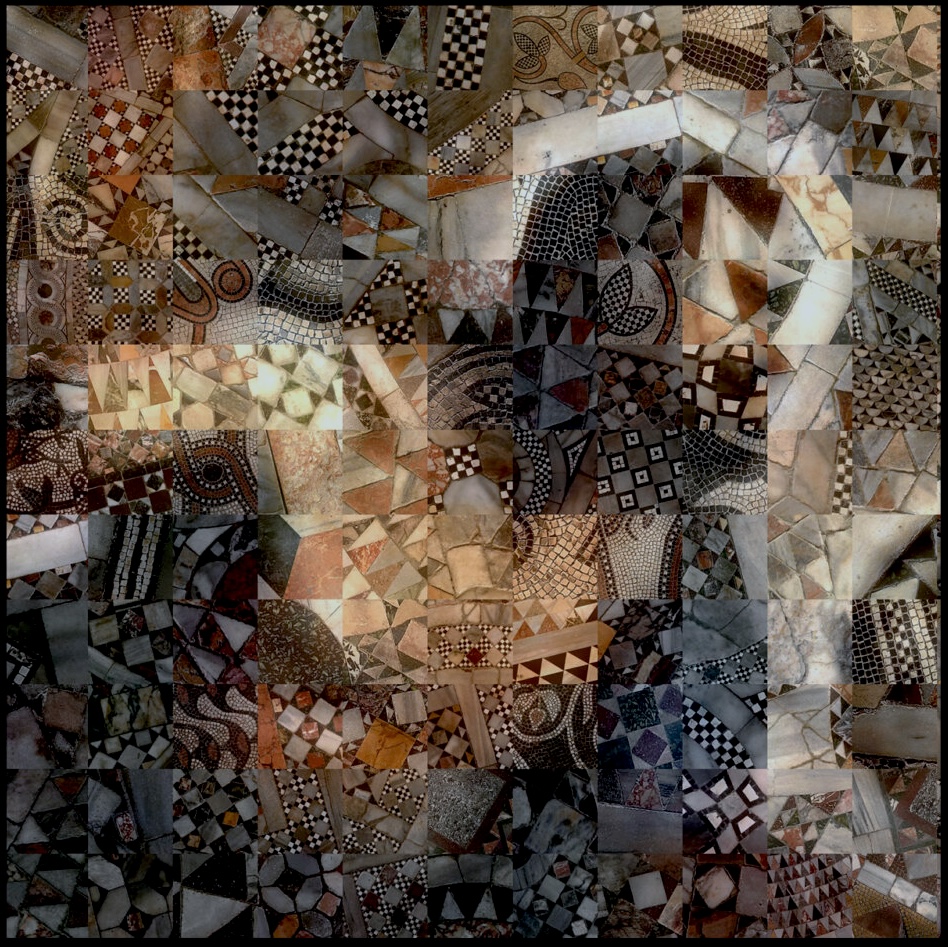
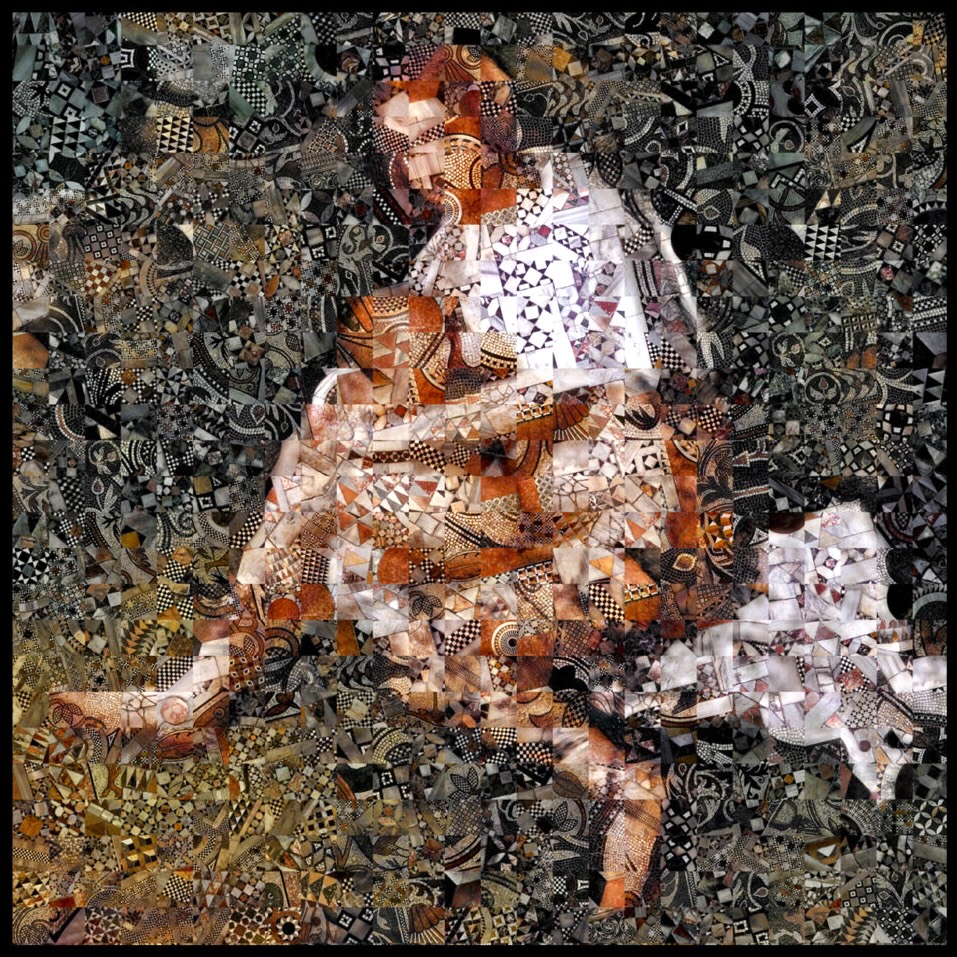
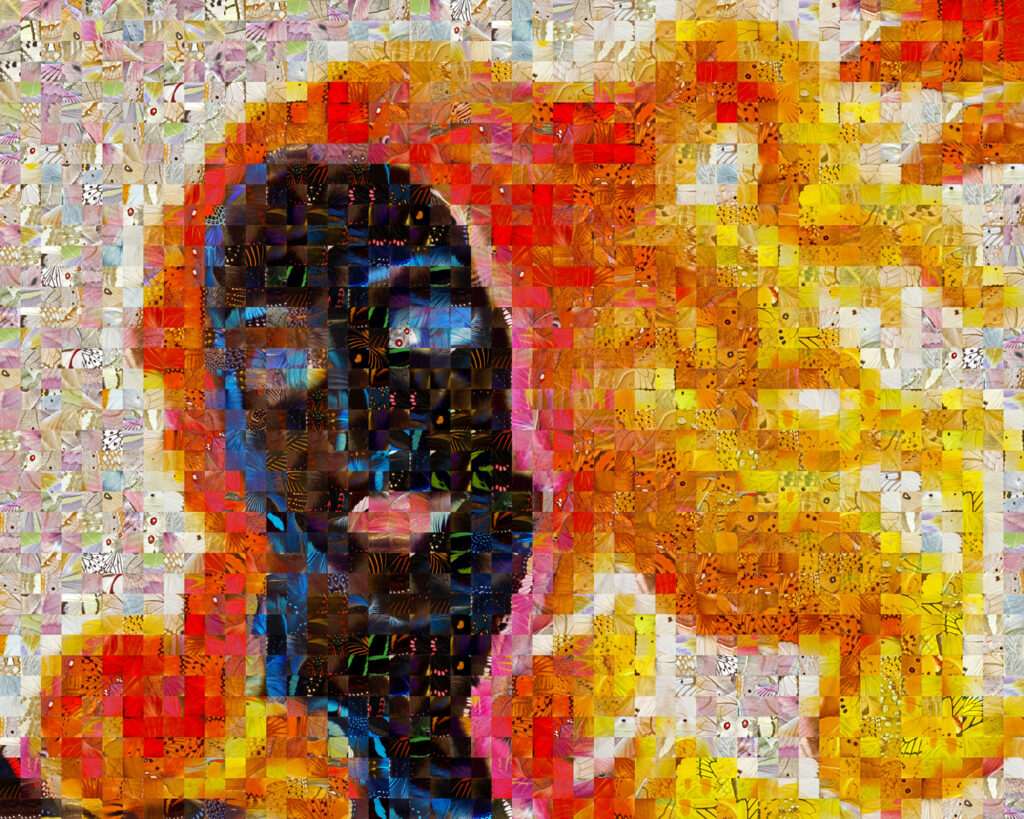
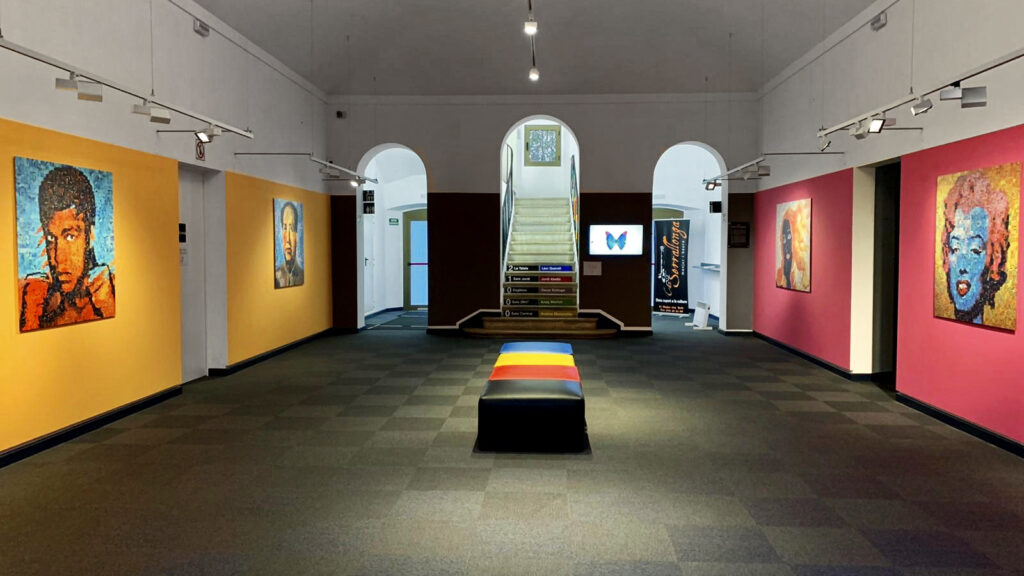
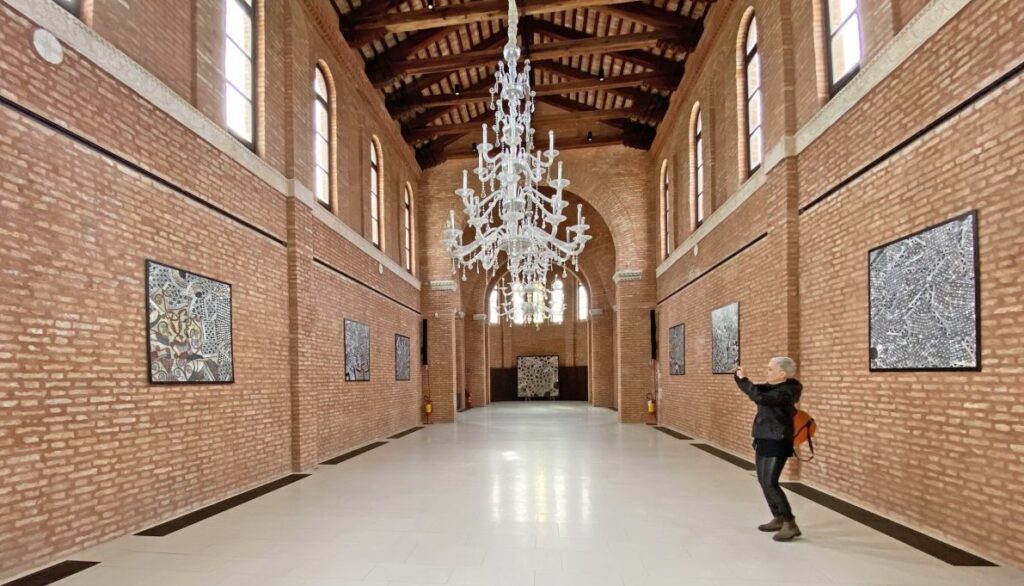
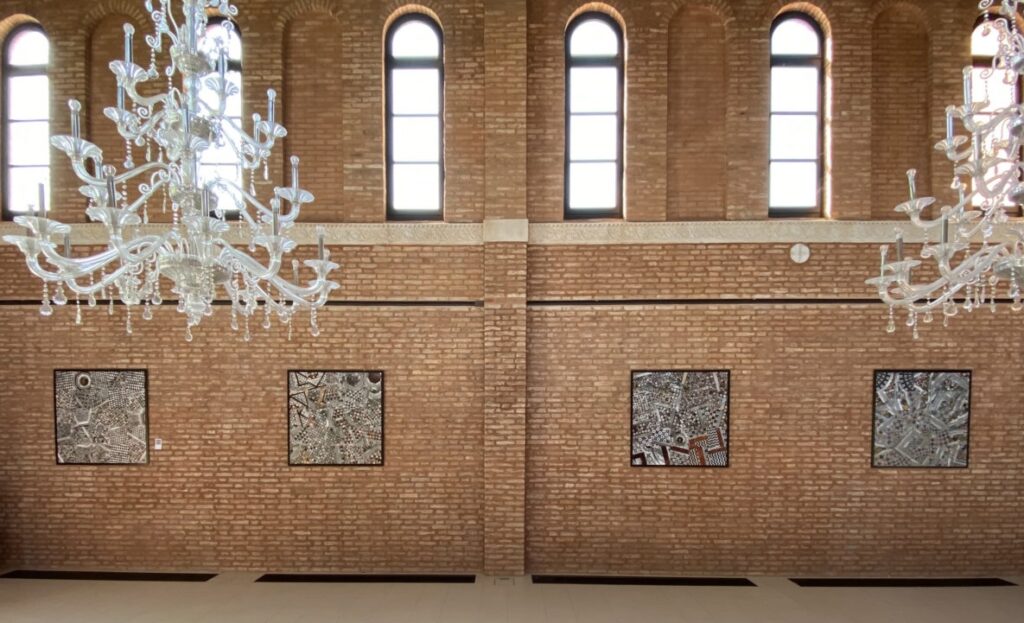
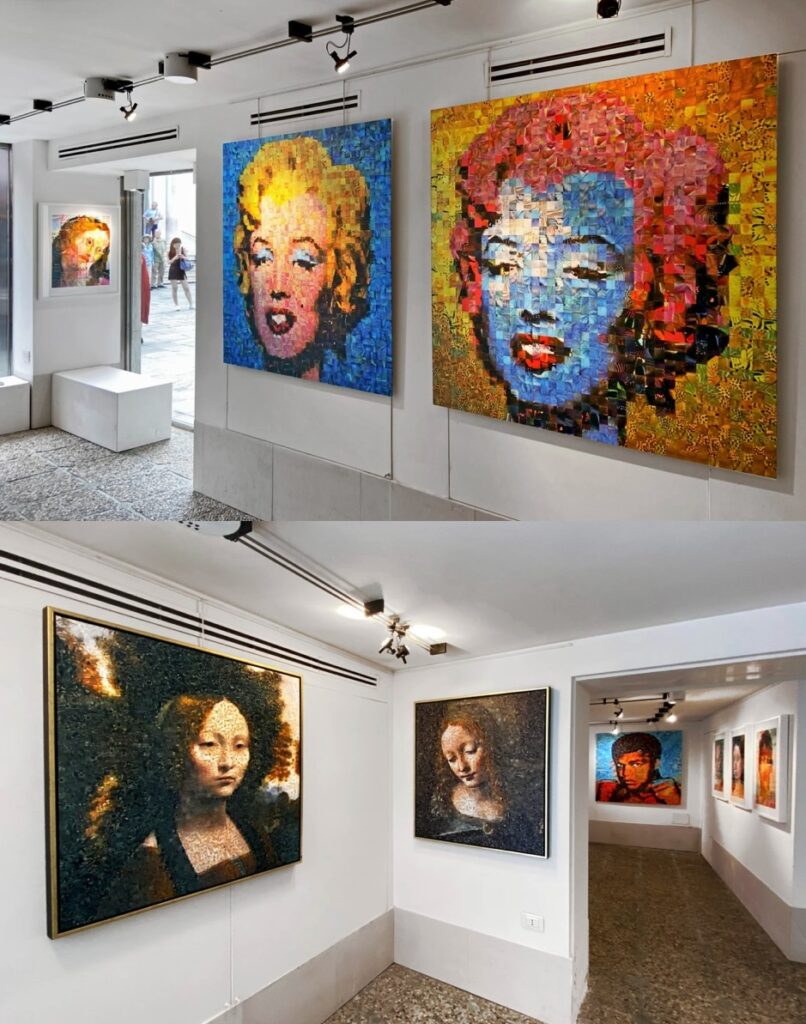
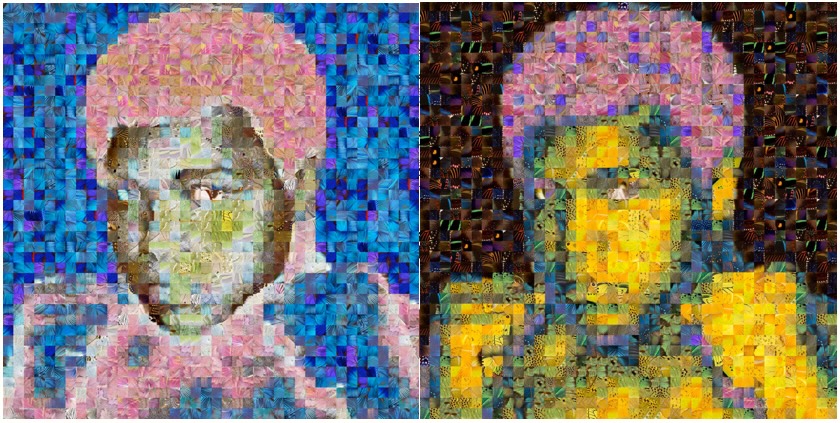
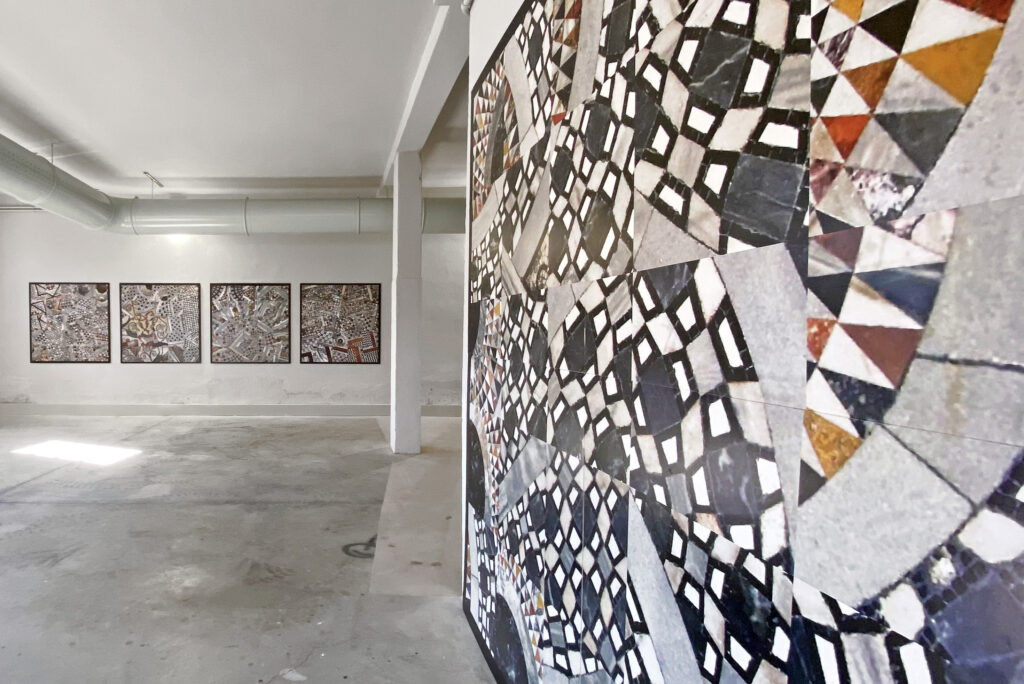
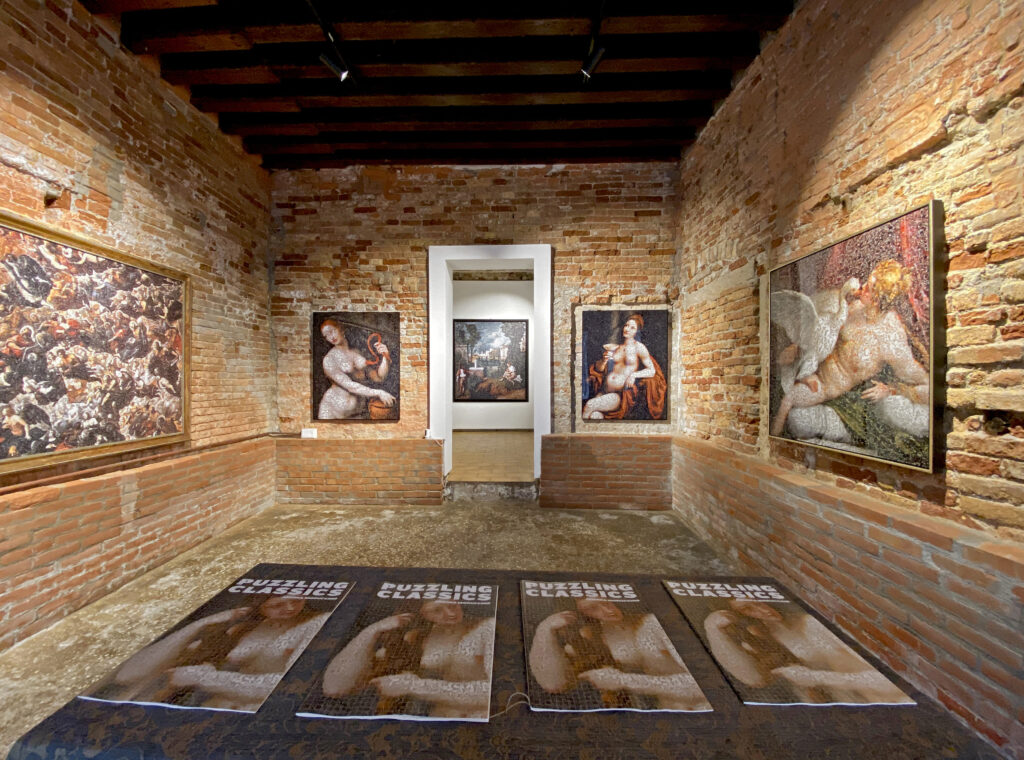
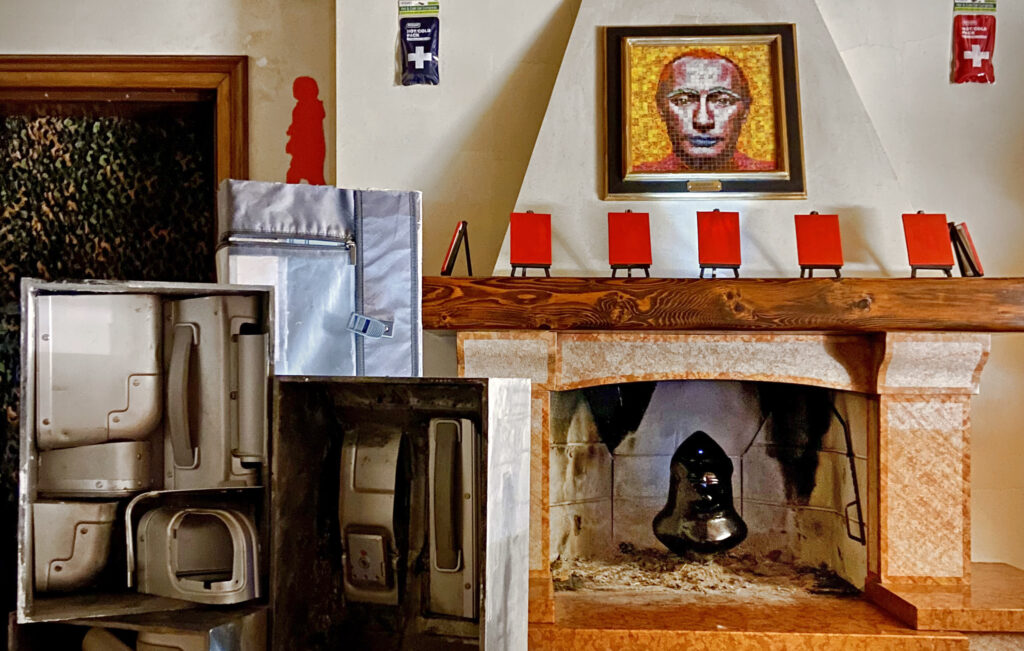
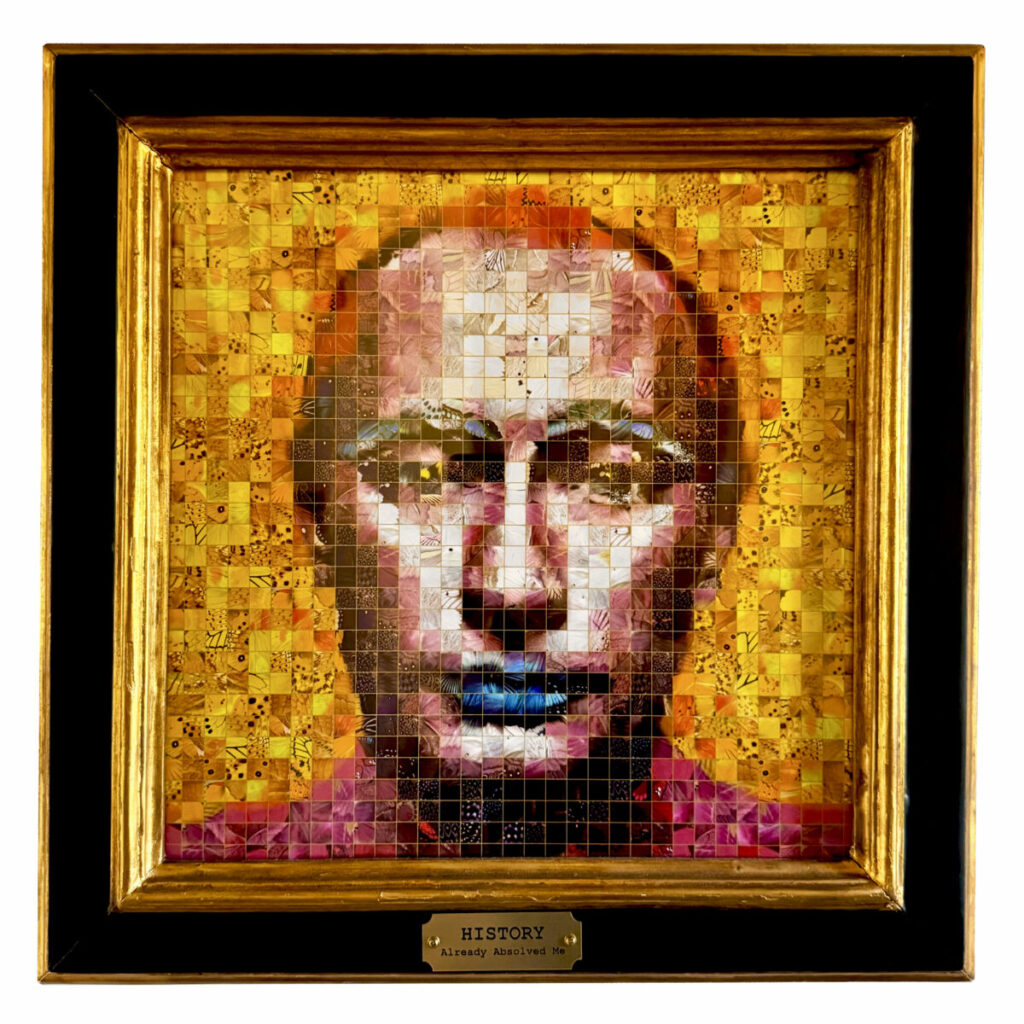
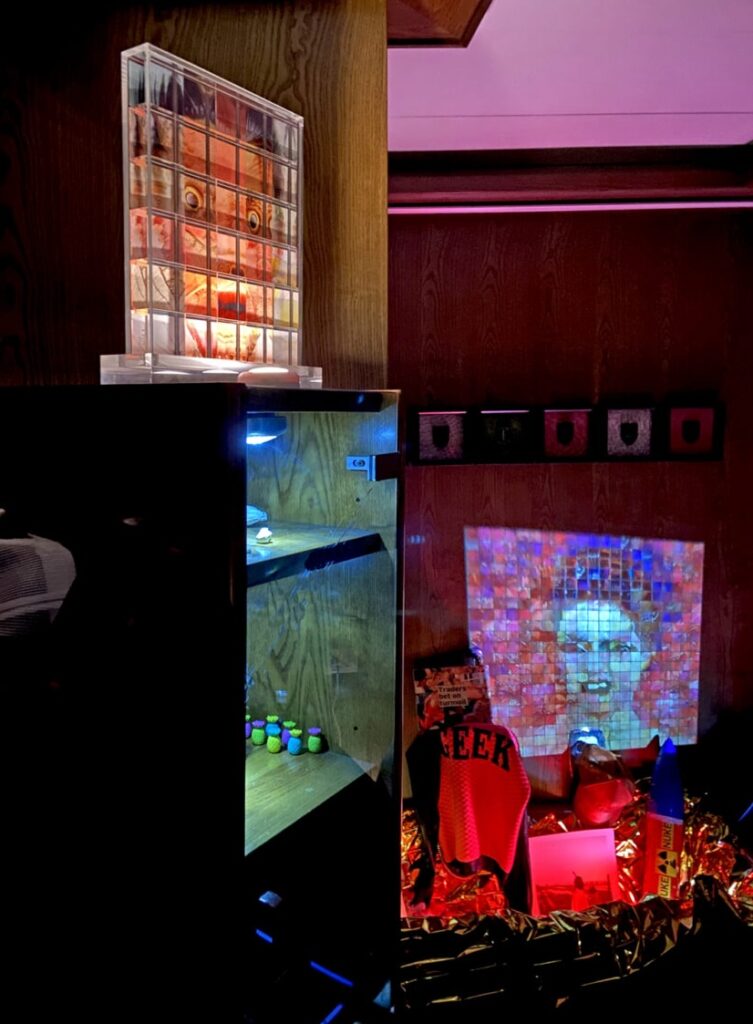
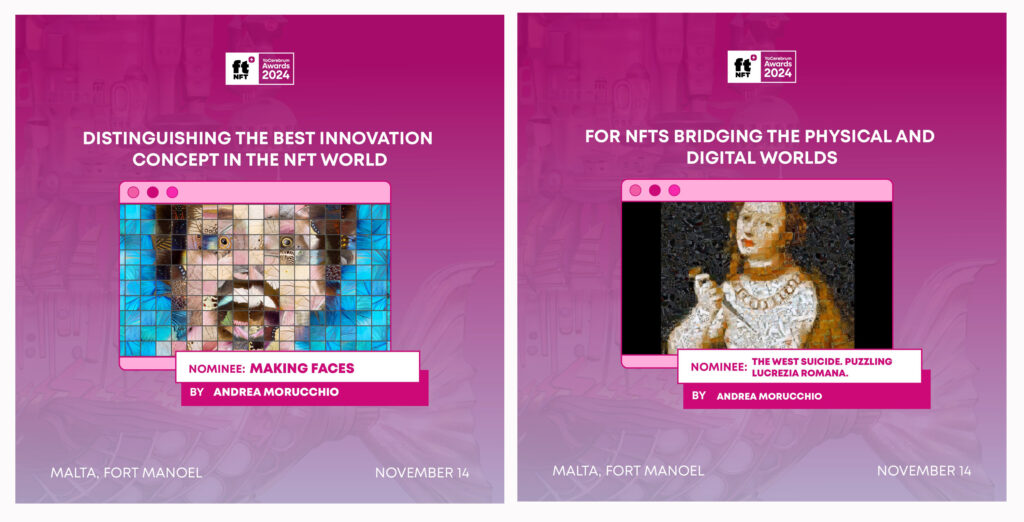
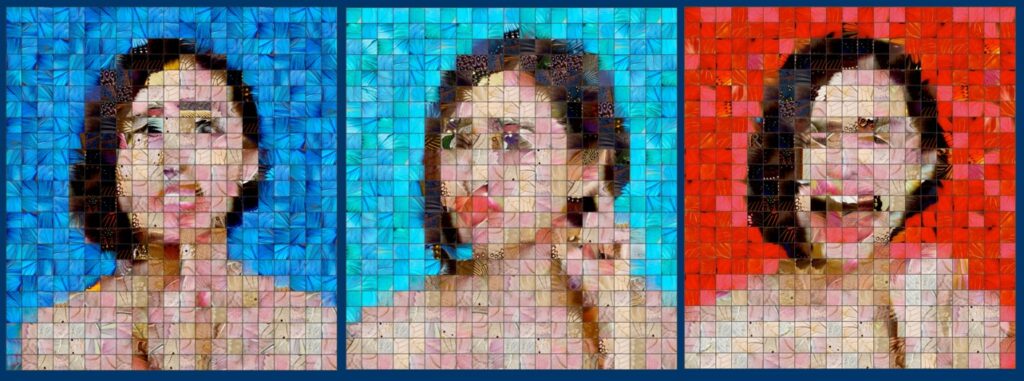
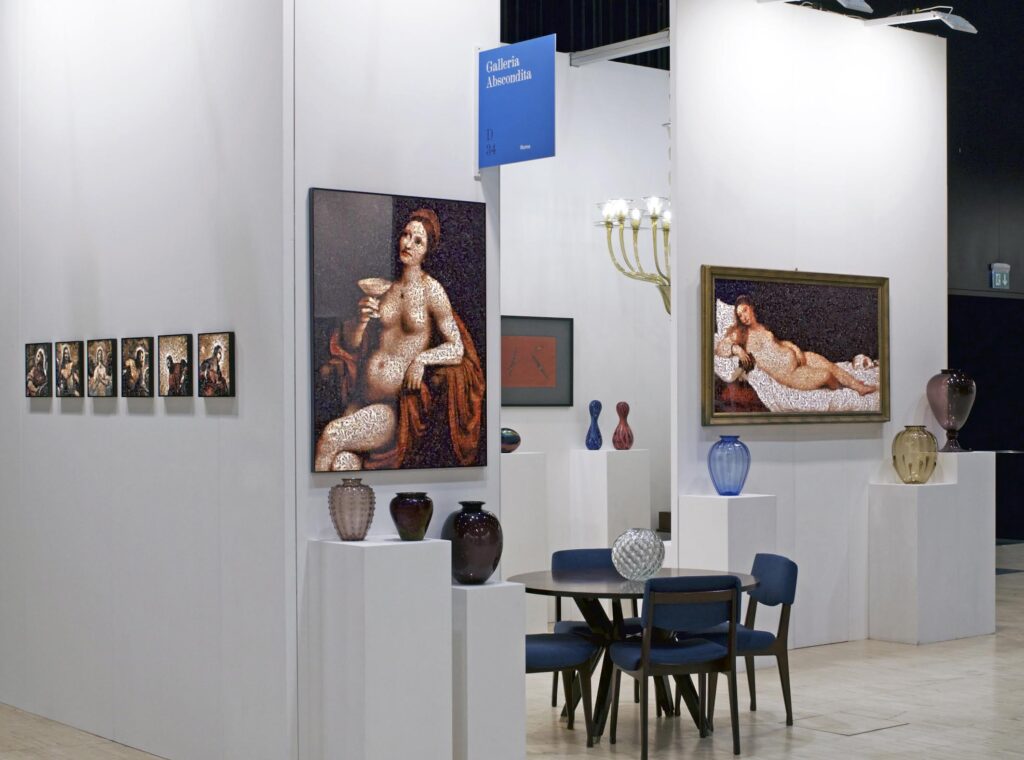
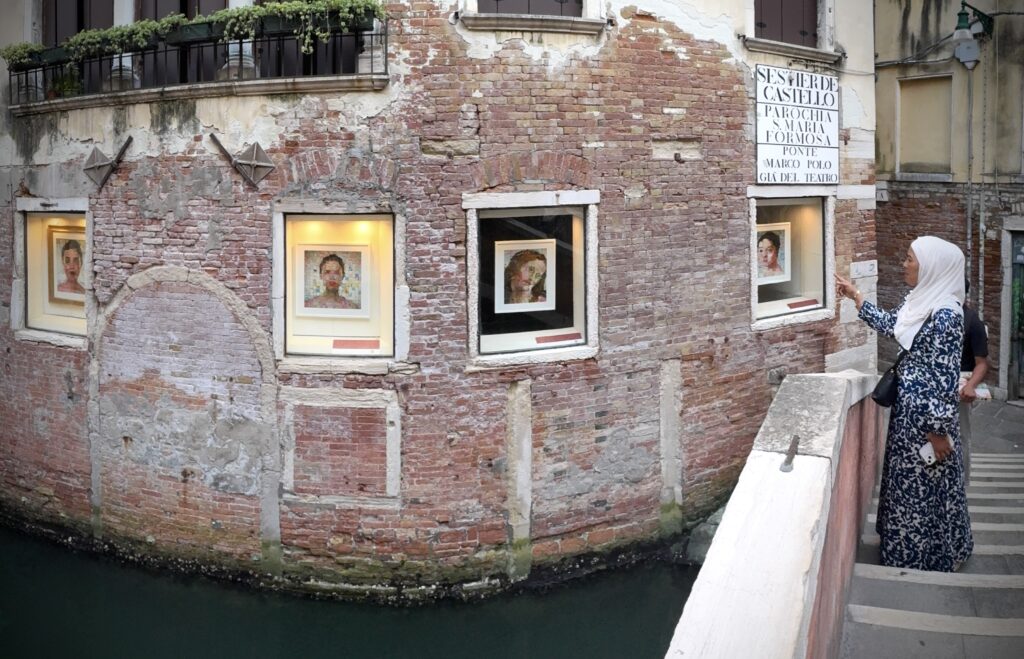
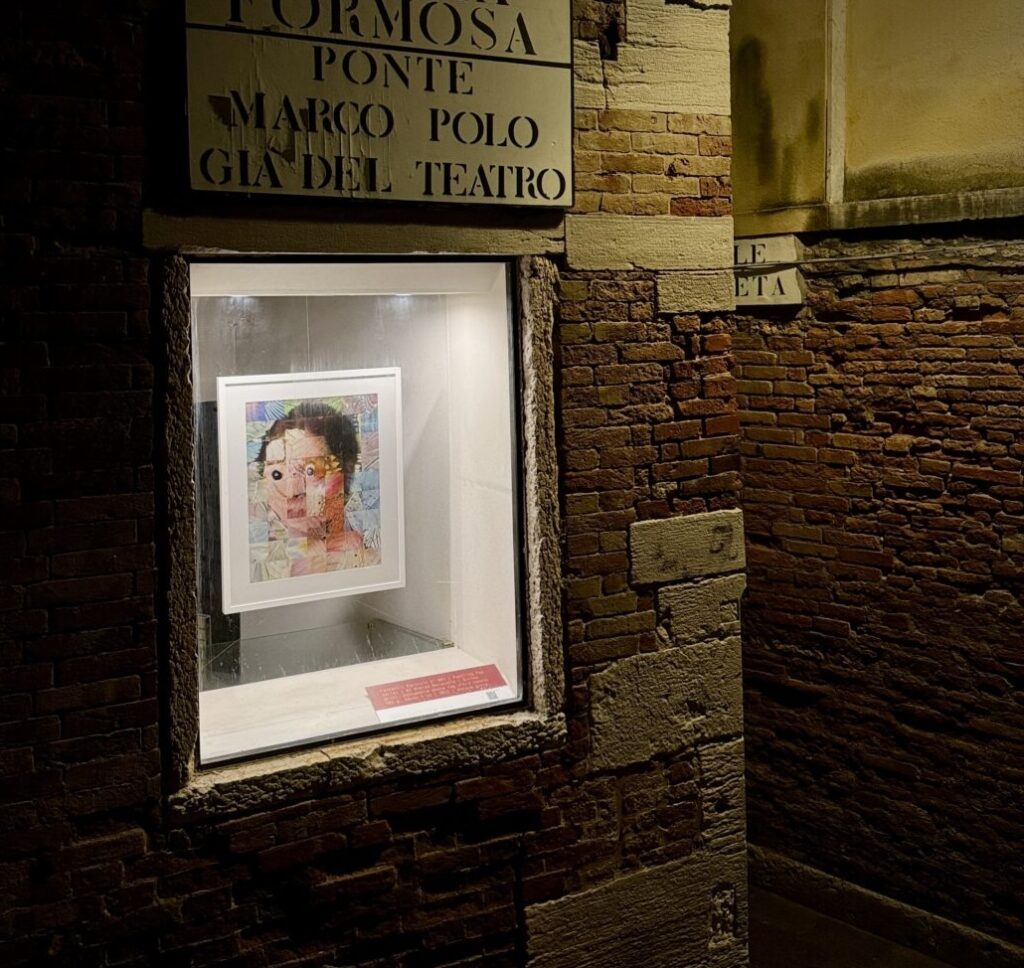
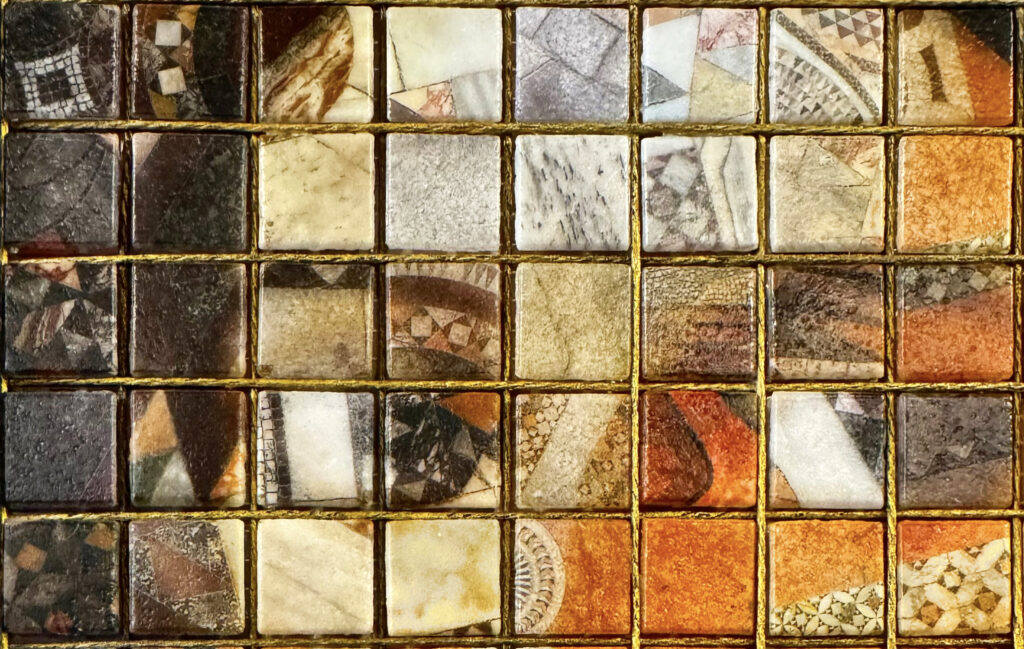
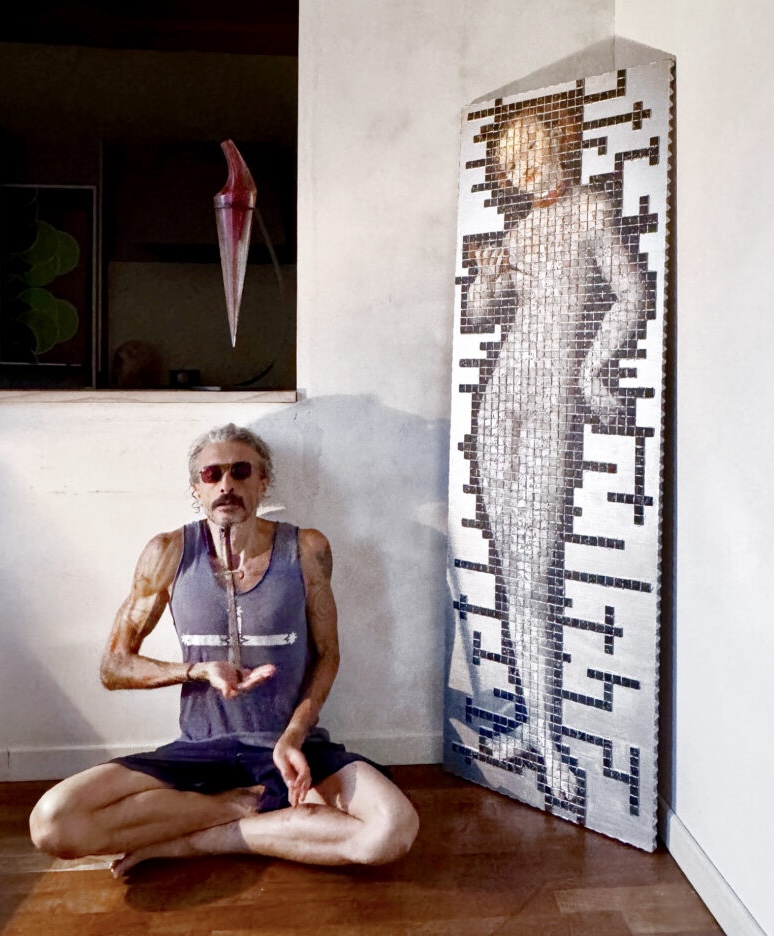
More recently, Morucchio’s interest in digital art and emerging technologies reflects his ongoing engagement with the transformations of the image and with new forms of visual memory. Within the PUZZLING project, this research develops through processes of deconstruction and recomposition of the figurative tradition, in which historical imagery is fragmented and reassembled within contemporary visual and cultural contexts. The PUZZLING project is structured in two complementary cycles: PUZZLING CLASSICS, based on photographic tessellations derived from the mosaic pavement of St Mark’s Basilica in Venice, and PUZZLING POP, constructed from details of butterfly wings. In both cases, thousands of fragments generate bodies and faces in a continuous state of oscillation between construction and dissolution of the image.
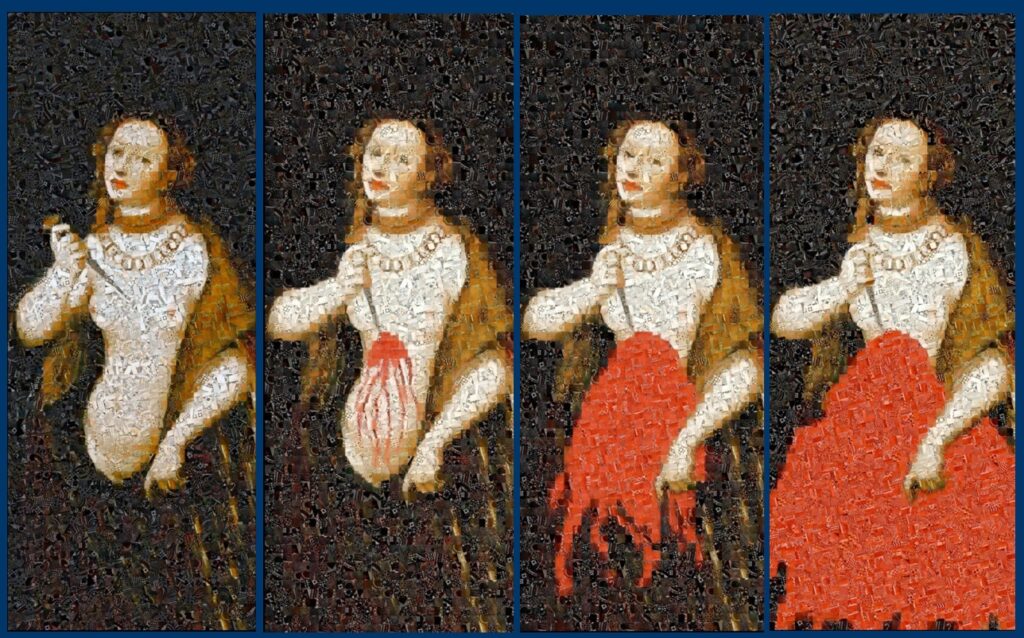
Within PUZZLING CLASSICS, The West Suicide. Puzzling Lucrezia Romana reinterprets Renaissance iconography through photographic tessellations and NFT animation. Starting from Lucas Cranach’s Lucretia, the static image is activated in time through a progressive substitution of tesserae, transforming the body into a field of continuous mutation. The suspended gesture of self-inflicted violence is reactivated until the body dissolves into a cascade of red marble fragments, turning myth and image into a metaphor of historical and cultural implosion.
Within PUZZLING POP, History Already Absolved Me constructs digital collage portraits made of butterfly-wing fragments, combined with neo-pop aesthetics and classical framing devices. The portrait of Vladimir Putin is paired with a brass plaque engraved with the phrase “History will absolve me,” derived from Fidel Castro. The work tensions visual seduction and ideological construction, questioning the fragility of historical judgment and political narrative formation. Also part of PUZZLING POP, APOTI develops animated portraits composed of thousands of butterfly-wing fragments, generating shifting expressions and unstable identities. The figures move through states of laughter, anger, irony, and distortion, accompanied by the subtle sound of wings in motion. The title, from the Greek “those who do not drink,” refers metaphorically to a condition of resistance to ideological intoxication and mediated perception. Together, these works define the most explicitly critical dimension of PUZZLING project, where fragmentation and recomposition of the image become tools to interrogate how historical and political reality is constructed, distorted, and continuously rewritten within the contemporary visual regime.
♠ 1 9 9 9 – 2 0 0 9 ♠
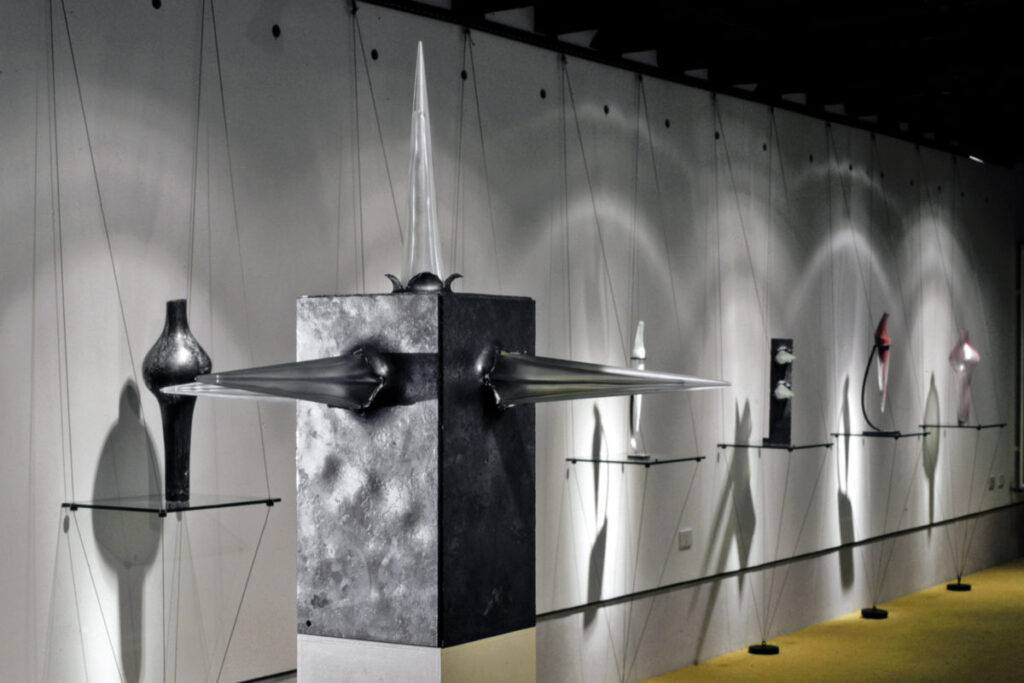
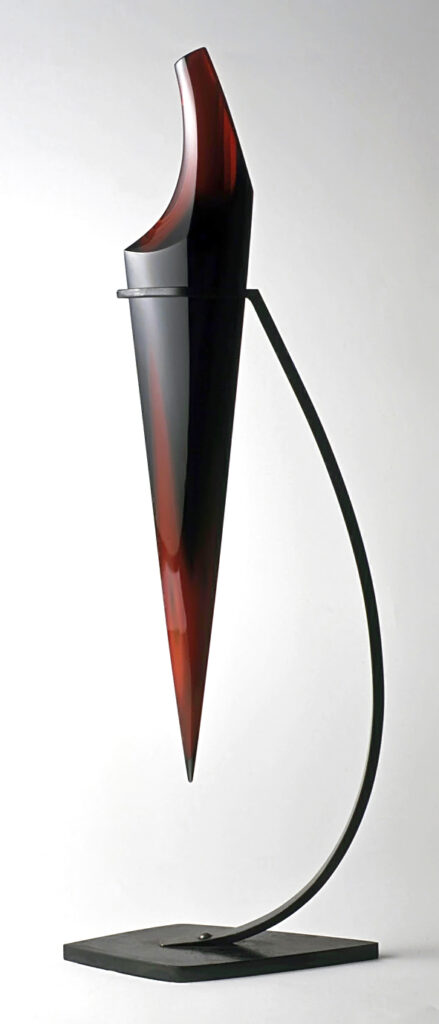
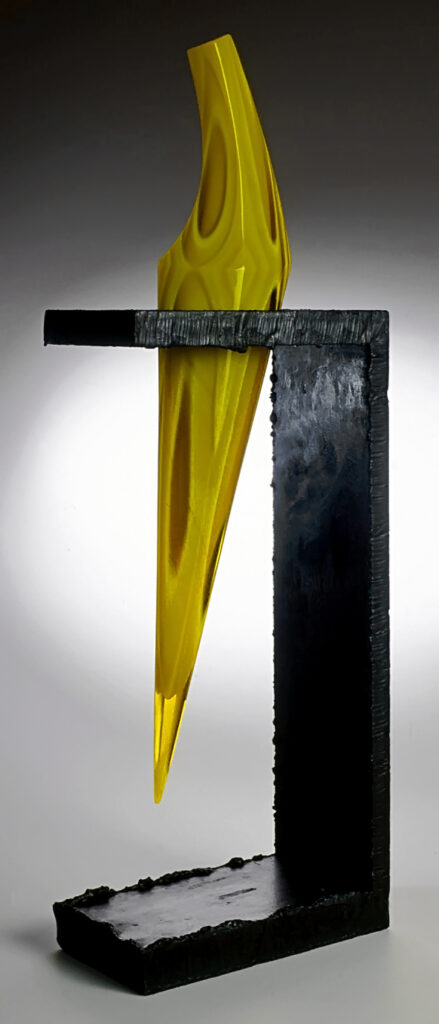
approaching Andrea Morucchio’s work is to enter a fluid and subtly disorienting creative dimension, shaped through an expansive and long-term horizon of inquiry. For over a quarter of a century, the artist has engaged photography, sculpture, installation, video, performance, and digital art in a sustained process of experimentation, continually probing the possibilities of expression, experience, and the construction of meaning. While photography was his initial medium of choice, from the late 1990s Morucchio began to probe the spatial implications of sculpture, starting with the realization of a series of works in glass and iron, BLADE(1999) and ENLIGHTENMENTS(2000).
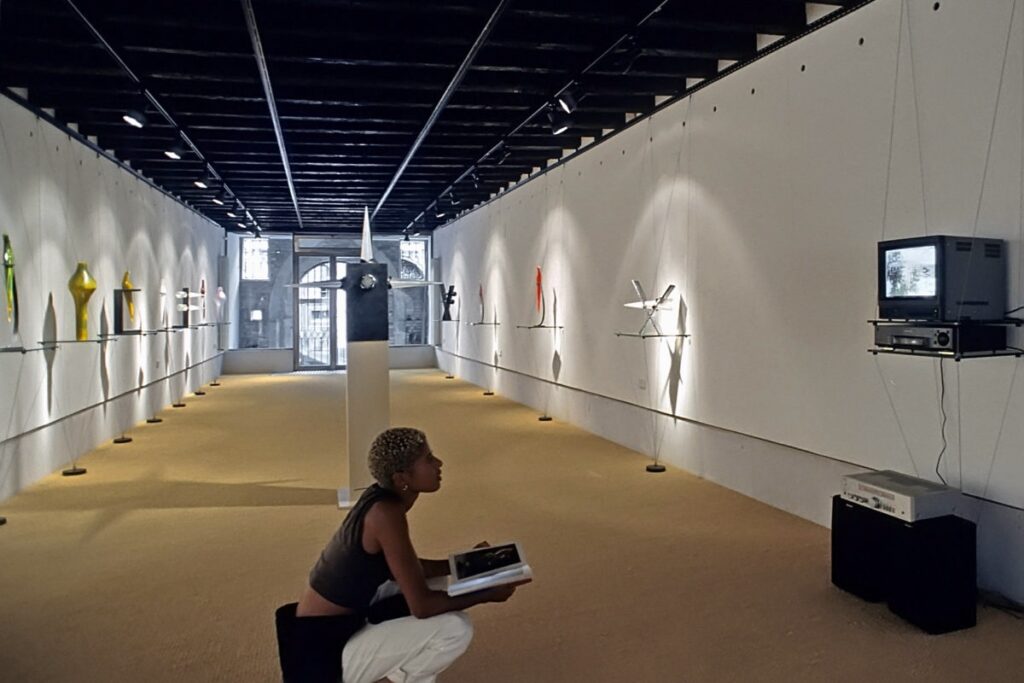
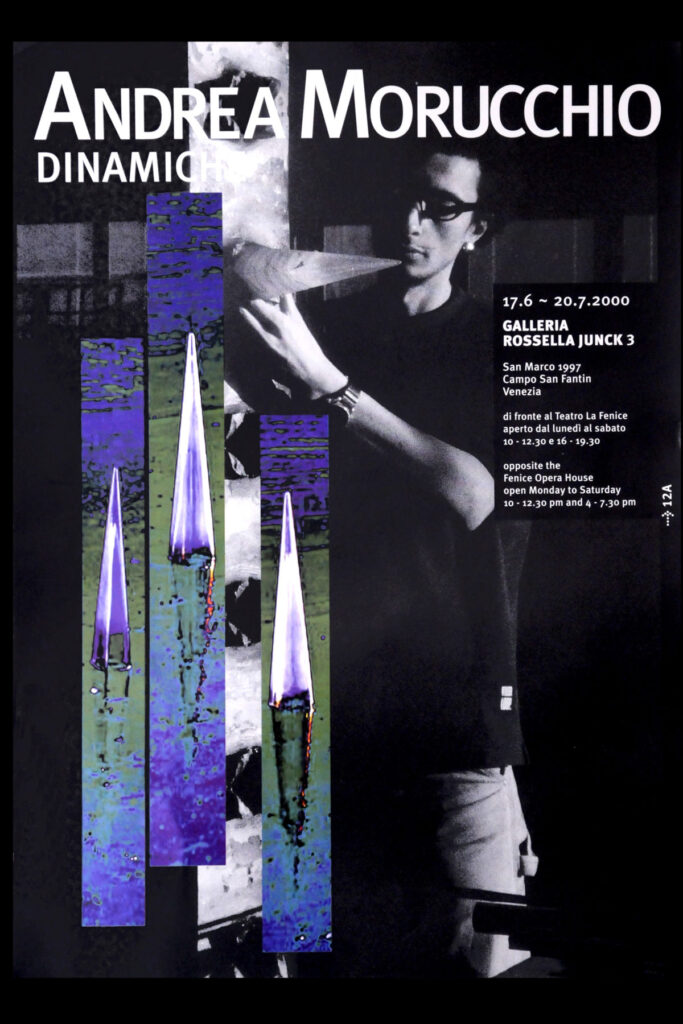
DINAMICHE | 2000, Solo Show, Galleria Rossella Junck, Venezia.
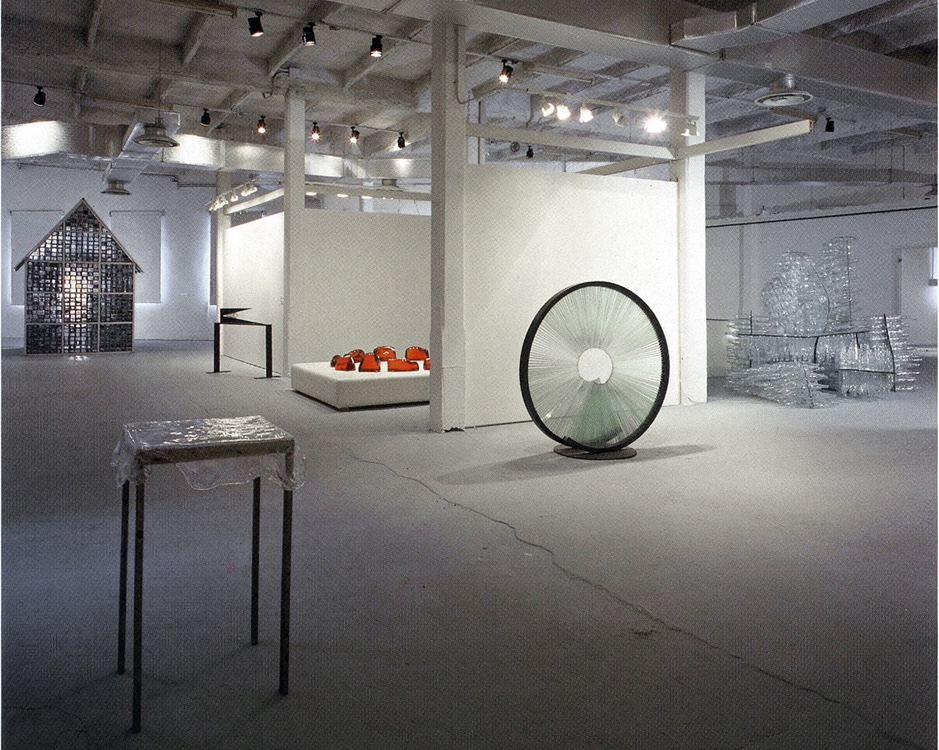
presentd on the occasion of his first solo exhibition DINAMICHe (Galleria Rossella Junck, Venice, 2000)—which, in their dynamic interplay between antithetical elements, already articulate one of the central and recurring nuclei of his poetics. With the solo exhibition DINAMICHE, Andrea Morucchio — who until now had expressed himself exclusively through photography — makes his debut in the world of contemporary art. This exhibition project is a purely aesthetic investigation into the nature of the material itself: glass. The rigorous and extreme forms he has created for this first solo show mark a break from traditional Murano glassmaking, even though he employs its most common techniques and glass types. By experimenting with the material’s inherent unpredictability — caused by various glass lifting and removal methods — Morucchio achieves an informal organic quality within rigid, geometric structures obtained through an exacting glass-grinding process.
DINAMICHE | 2000, Solo Show, Galleria Rossella Junck, Venezia.
This approach reveals his intent to treat glass as a noble material. As critic Andrea Pagnes notes in exhibition catalogue, Morucchio’s relationship with glass is deeply intellectual: he explores its expressive potential as a sculptural medium, often combining it with iron to evoke ritualistic, almost sacred presences. The originality and strength of his work stem from a disciplined respect for the intrinsic nature of his materials, transforming objects into entities that seem to manifest their own inner essence.
For this exhibition project Morucchio created a video artwork, DYNAMO(2000)based on hundreds of photographs he took during the complex production phases of his sculptural works, both in the Murano furnace and the blacksmith’s workshop, set within various contexts. The scanned negatives and slides were digitally processed to create a unique video piece, accompanied by a specially composed soundtrack. This work fully embodies Morucchio’s creative hybridity, highlighting his abilities as a sculptor, photographer, and digital artist. DYNAMO showcases his expressive versatility, establishing a dialogue between his sculptures, photographs, and digital reinterpretation, and marks his first experiments in digital art.
Among the works presented in the exhibition, the series Blade represents Andrea Morucchio’s first artistic encounter with glass and the origin of his sculptural exploration into spiritual dynamism. His interest in the material arose from years of experience as a still-life photographer, documenting glass works by modern and contemporary artists and designers. Through this prolonged visual engagement, he gradually gave form to an image long present in his imagination:BLADE. In an original critical text by Chiara Casarin, Morucchio’s first sculptural work is described in the first person: Drawn by a force determined largely by my own weight, by my mass, I feel restrained, halted an instant before impact with the ground. I am fragile, even if it does not appear so. My surface is sealed, perfect, entirely concentrated on containing my form, my imperturbability, my being the object of a certain force and blunt resistance.
BLADE N°1| 1999, ground glass, forged iron, 53x10x20 cm.
The series consists of glass “blades” that cut through space, embodying a dialogue between light and matter, fragility and precision, stillness and latent energy. BLADE acts as a clarifying image within Morucchio’s creative process—thought as light that pierces darkness, divides, and moves toward synthesis. As Andrea Pagnes writes in catalogue, encountering these sculptures feels like participating in a conversation with something coming from an abstract and remote distance—ineffable, mysterious, yet entirely contemporary. the essential element that defines Morucchio’s aesthetic language, conferring on the object-sculpture an aura of clarity and spiritual intensity that transcends material experimentation.
BLADE N°10| 2000, ground glass, forged iron., 60x11x20 cm | Museum Old New Art Collection, Hobart.
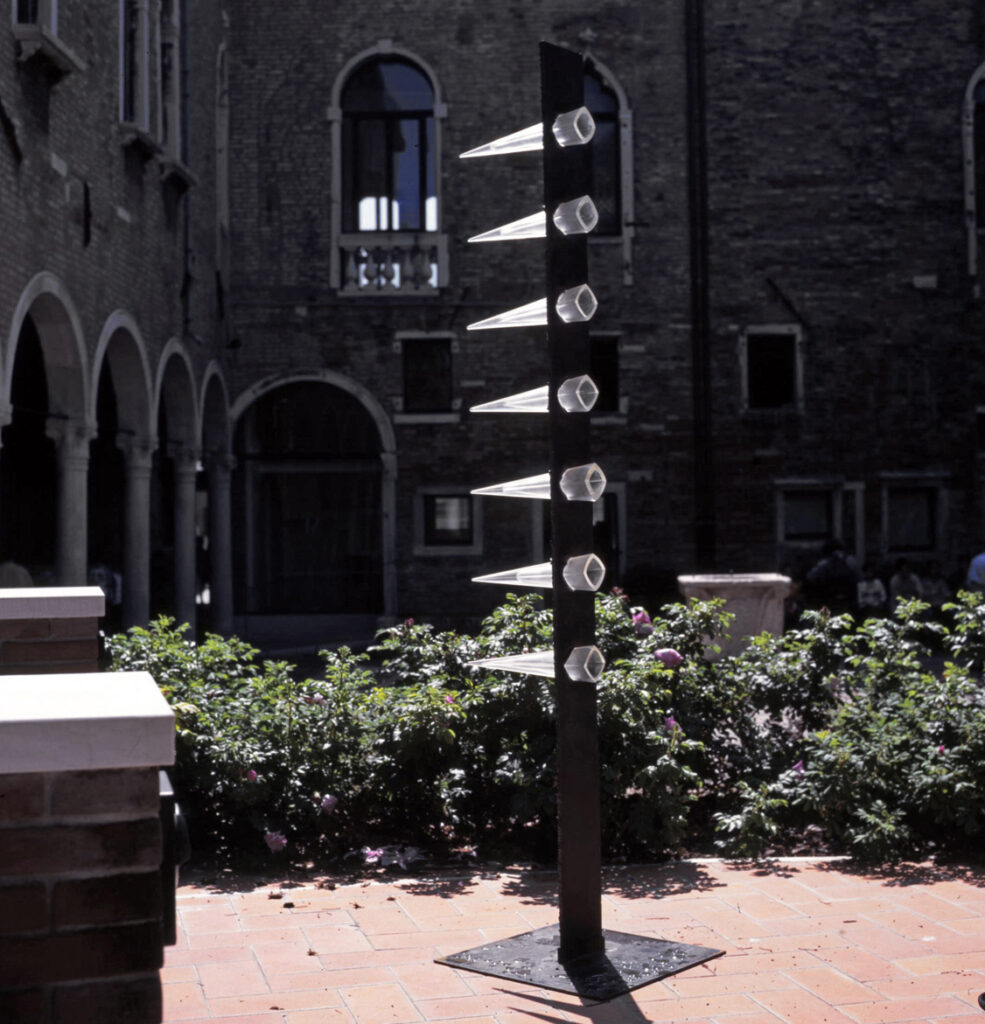
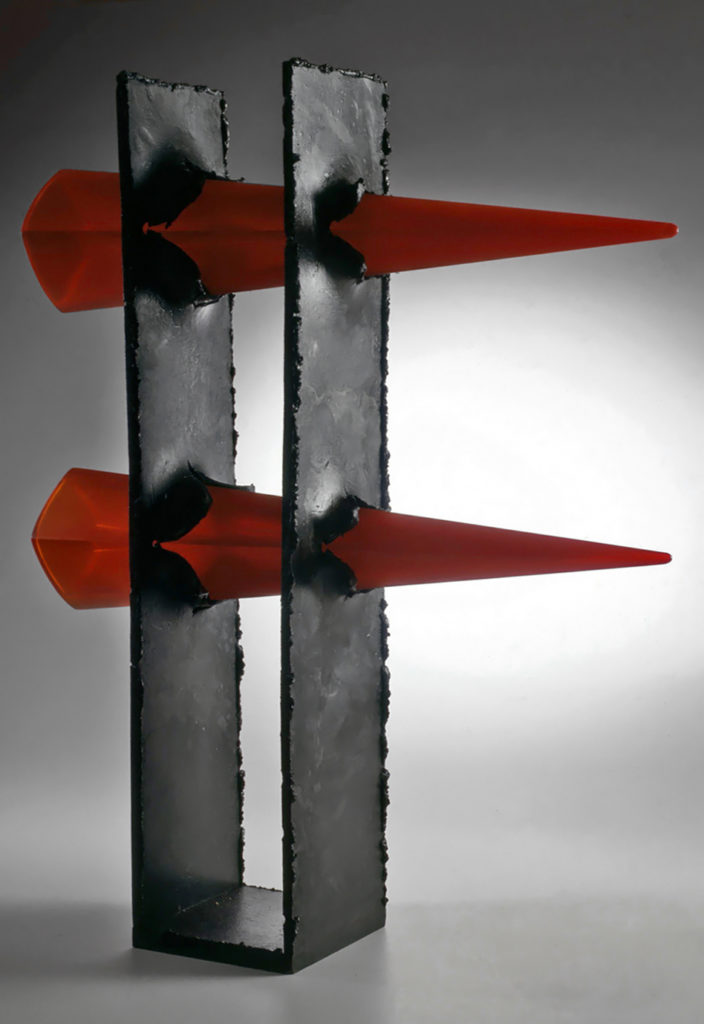
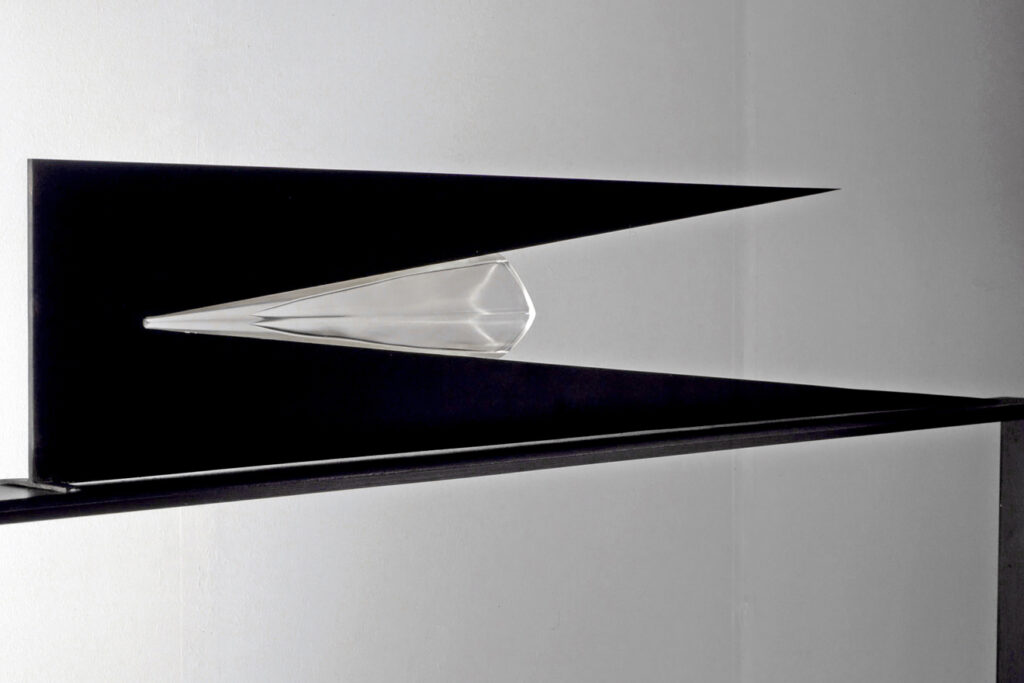
Within the exhibition, Blade works are set in dialogue with the sculptural series Enlightenments: glass wedge-points that pierce iron barriers, tracing horizontal lines and “crystallizing a sense of continuous motion”. these works convey a strong kinetic tension through the mere interaction of materials. By inserting glass tips into iron holes, Morucchio activates a contrast between fragility and strength, transparency and opacity, mobility and stasis. This dynamic opposition—central to his artistic language—generates a vibration that charges the sculpture with both physical and spiritual energy. Rooted in a deep understanding of glass and its expressive potential, ENLIGHTENMENTS reveals the artist’s ability to balance material precision with symbolic resonance.
ENLIGHTENMENTS N°5| 2000, blown ground glass, forged iron., 220x40x40 cm | Museo del Vetro Collection, Murano.
In ENLIGHTENMENTS sculptures glass cuts through the density of metal, bringing light into darkness. Beyond their aesthetic investigation, they embody an ethical impulse—a desire for clarity, discernment, and liberation from confusion and heaviness. While the material tension recalls the sensibility of Arte Povera, Morucchio transforms raw matter into precise, disciplined forms that preserve rather than suppress its inner vitality. The result is a body of work that evokes archetypal, almost ritual images, charged with symbolic and spiritual echo.
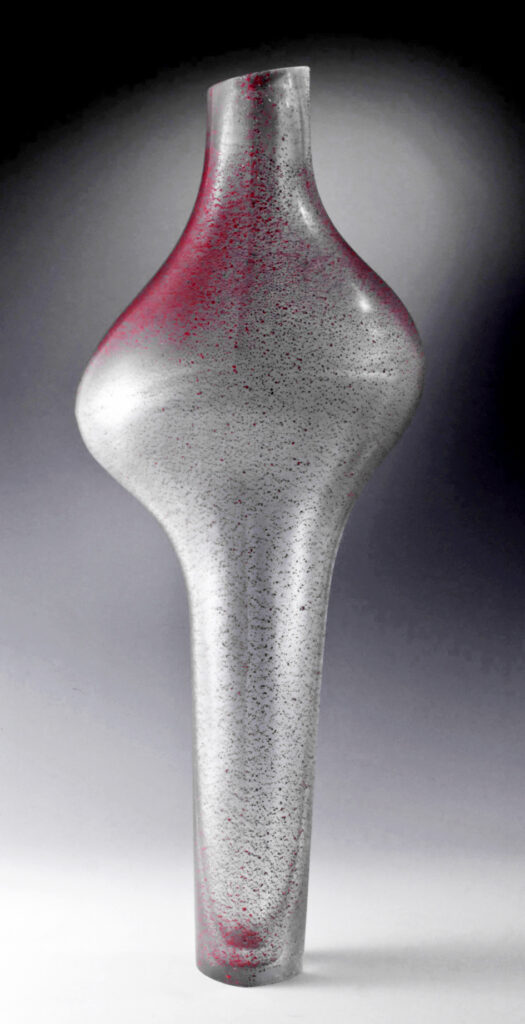
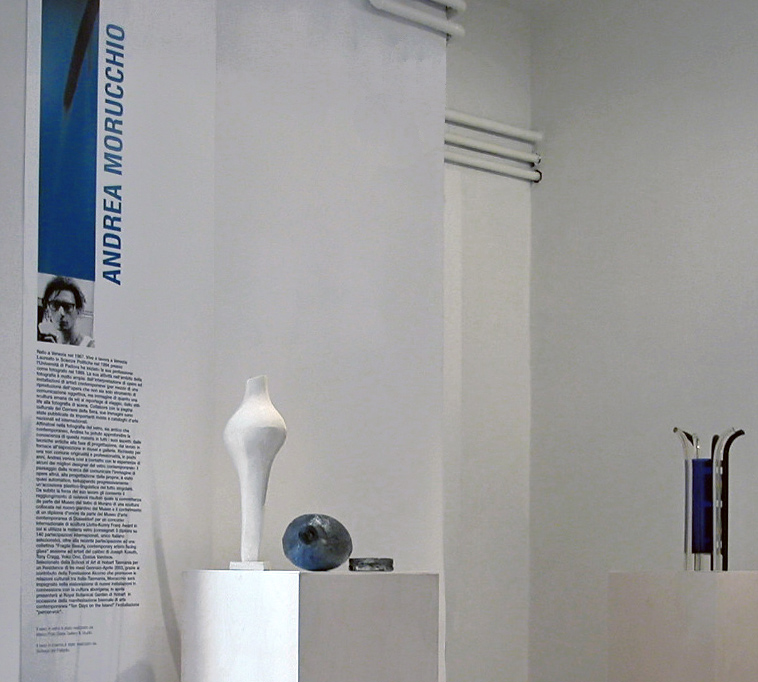
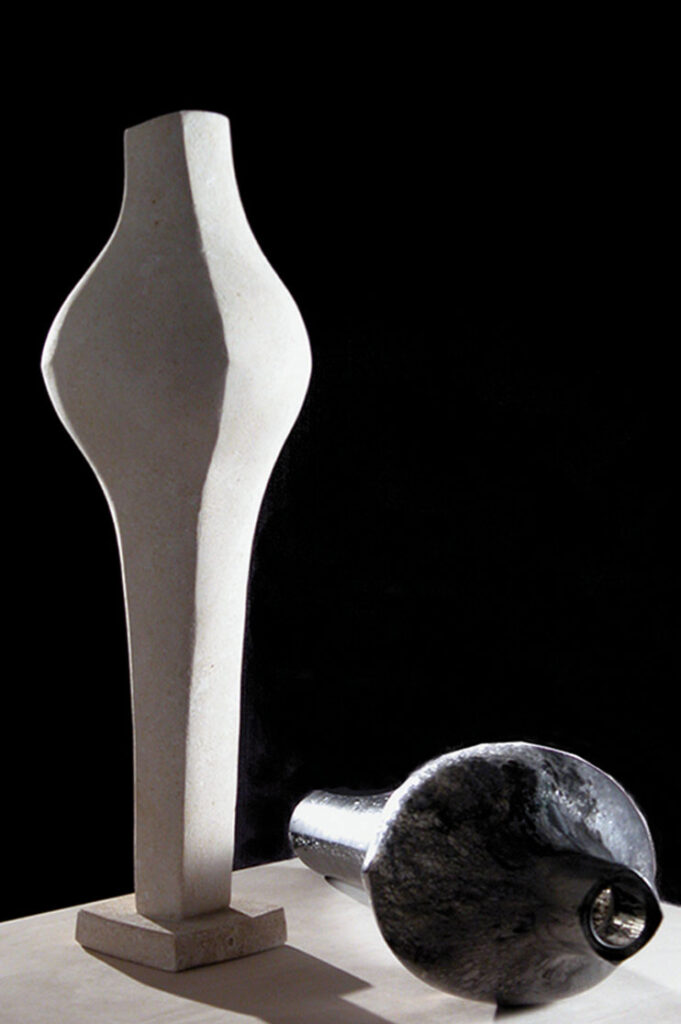
Also part of the exhibition project Dinamiche is the series entitled Vessel, which is literally what its name suggests: vessels that Morucchio created with the intention of engaging with the most classical form produced in the Murano tradition, namely the glass vase in all its many variations. The aim is to produce original objects/works characterized by slender, ‘ascending’ forms, in contrast — yet at the same time in complementary dialogue — with the sharp, hard forms of the other sculptural works, namely the Enlightenments and the Blades.
VESSEL | 2000 | Glass, Bronze | 60x24x18 cm
Only one year after his debut with the exhibition Dinamiche, and confirming the exceptional nature of his artistic trajectory, Morucchio was invited to take part in an unprecedented exhibition that brought together leading contemporary artists—including Yoko Ono, Joseph Kosuth, Tony Cragg, Markus Schaller, Dean Jokanovic Toumin, and Loris Cecchini—around the theme and material of glass. Curated by Giovanni Iovane and Andrea Pagnes, Fragile Beauty pays tribute to the beauty and mystery of glass, exploring its expressive potential through the works of fourteen international artists from different generations and artistic languages, united by an intense poetic research.
For this occasion, Morucchio created Side Enlightenment, a development of the Enlightenments series, in which the antithetical relationship between iron and glass is resolved into a formal and geometric synthesis. The iron loses its plasticity, while the glass point traces a linear projection that opens a horizontal fissure within the metal structure, inserting itself into it and simultaneously dematerializing, ultimately merging with the surrounding void.
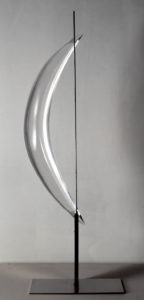
Shortly after creating his first sculptural works, Morucchio, driven by the expressive potential of glass, began developing new projects that deepened his exploration of the material’s formal and conceptual possibilities. The first of these is the WAVE series (2001), composed of curvilinear elements in ground glass whose extremities are inserted into vertical iron or steel structures. Although seemingly simple and almost two-dimensional, these immobilized, bent forms appear to “pulsate” with latent energy—frozen at the peak of movement -I n the same way as the Enlightenments works – as if caught in a moment of dynamic tension. This reflection on balance and suspended motion would later evolve into ACCUMULO, where the dialogue between fragility and stability, order and tension, becomes the central focus of Morucchio’s sculptural language.
WAVE N°2 | 2001, ground glass, steel, 85x20x25 cm.
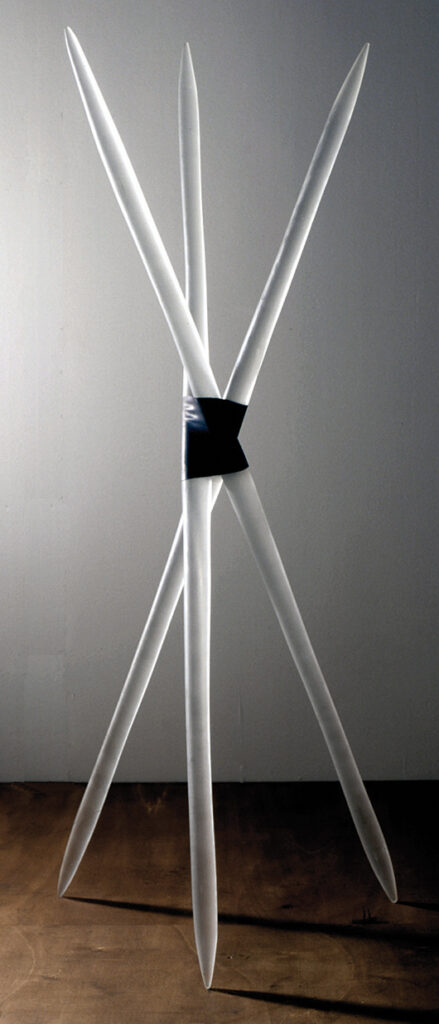
ACCUMULO (2002) is the title of a series of sculptures made of ground-glass lances held together by a central rubber tube. Each element leans and rotates against the others, creating a fragile yet precise equilibrium sustained by tension and interdependence. The contrast between the brittle rigidity of glass and the elastic resilience of rubber defines the work’s physical and conceptual core. In ACCUMULO, however, balance arises not through conflict but through a delicate cooperation of forces, capturing the instant when instability becomes structure and tension transforms into form.
ACCUMULO N°1| 2002, ground crystal glass, rubber, 185x60x60 cm
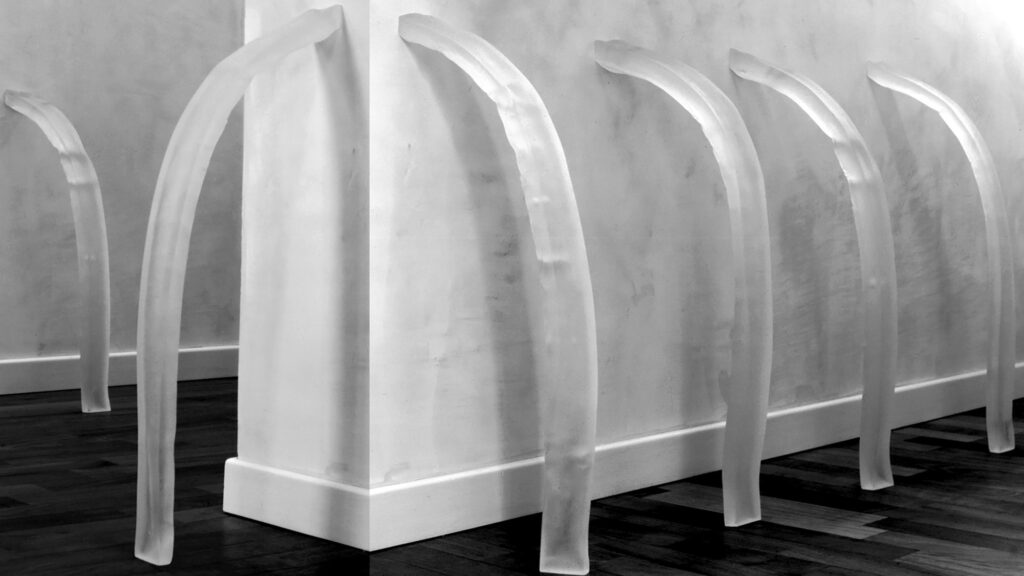
HYPERBOLIZE (2002) is an installation proje. As in ACCUMULO, the piece quite literally “sustains itself” through a delicate balance of opposing forces. In HYPERBOLIZE, its stability — and very existence — depend on the precise contact of each curved glass element resting simultaneously on the horizontal and vertical planes. Composed of a sequence of curved, sandblasted crystal glass pieces shaped like a hyperbola, the work unites wall and floor in dynamic tension. The frosted glass captures and holds the light, creating the impression of luminous curves — subtle energies made visible, as in the environmental installation PERCER-VOIR (2003)— tracing a path of light between intersecting planes. Adapting to each new space, HYPERBOLIZE transforms with every installation, and can thus be described as a variable work.
HYPERBOLIZE| 2002, bent, frosted glass elements, 72x22x7 cm each
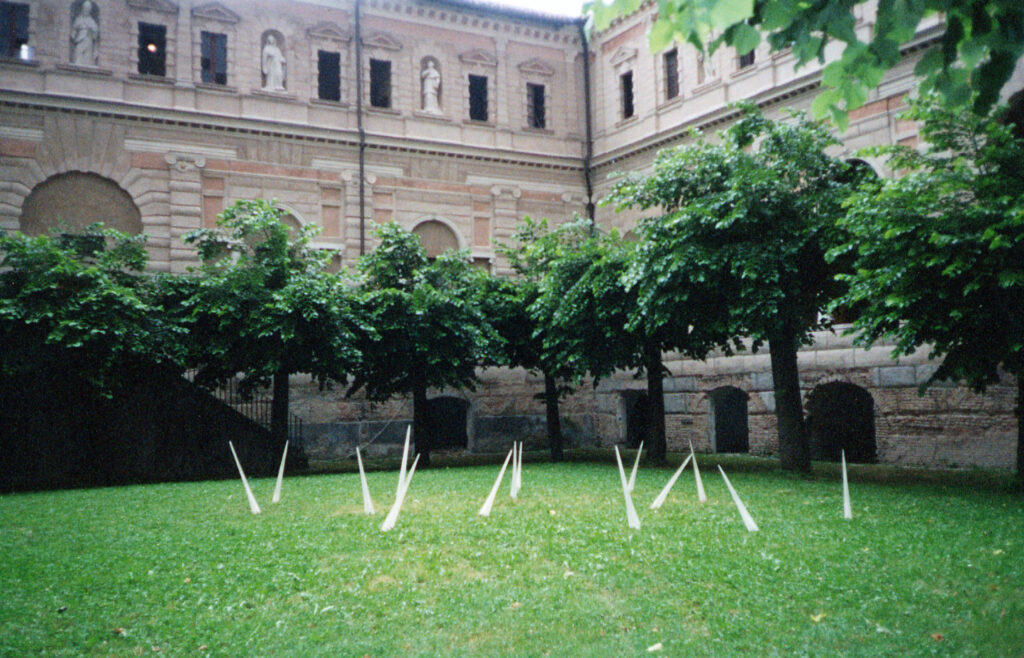
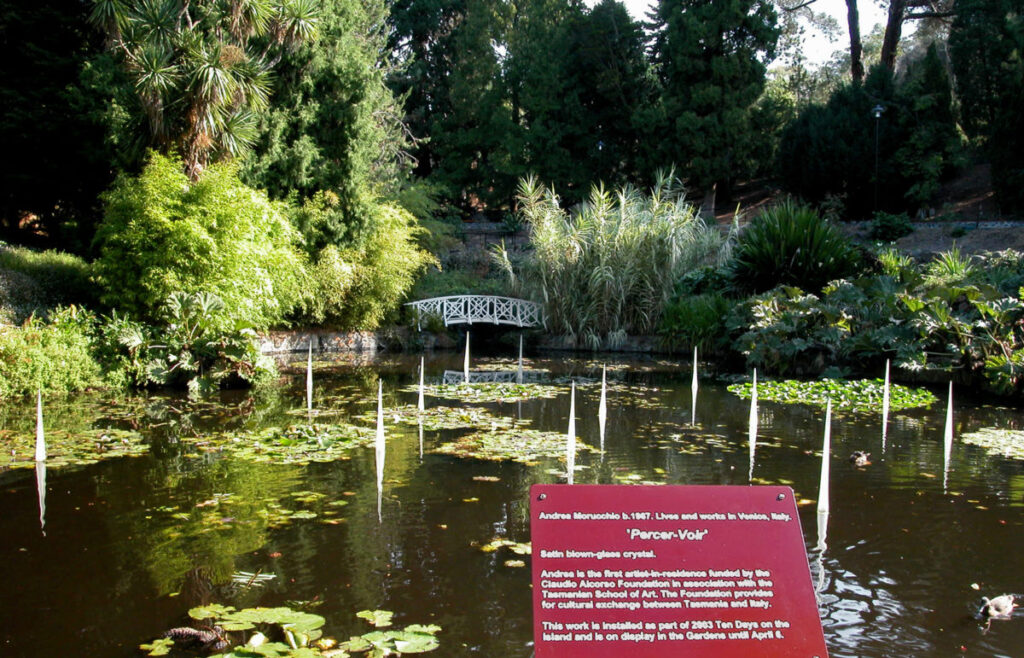
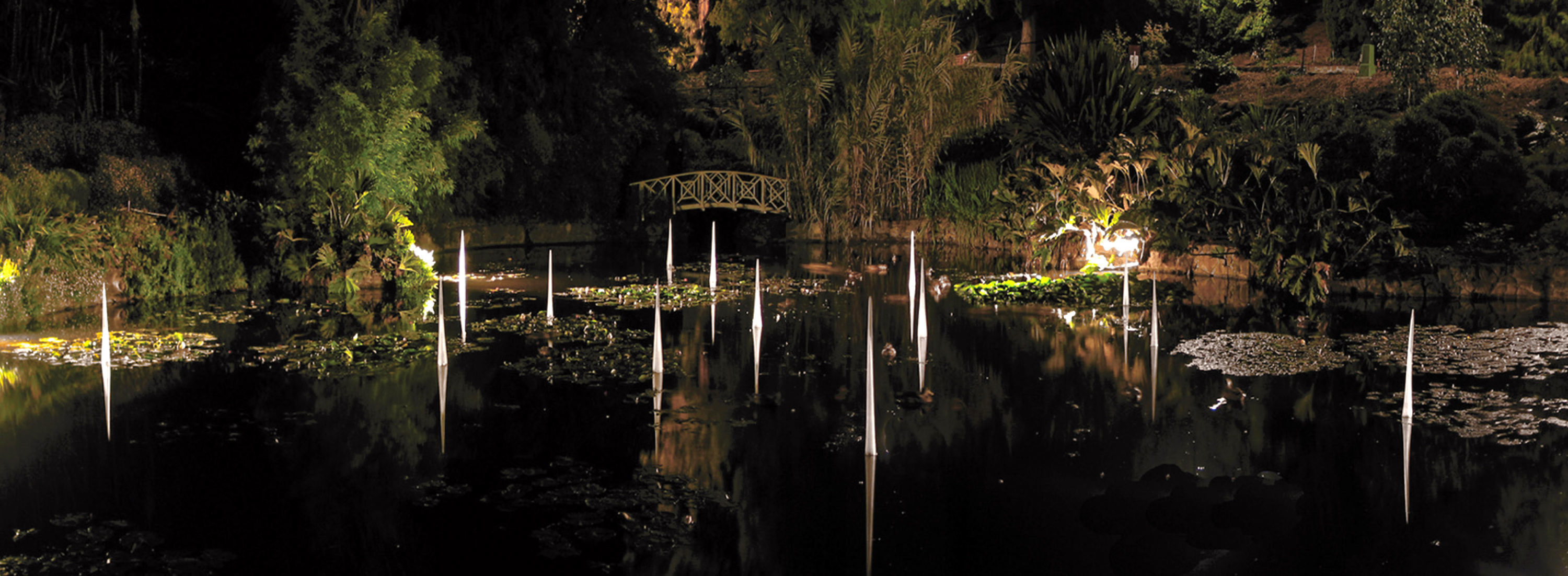
Interest in a development of form and matter in space – clearly identifiable in the ENLIGHTENMENTS series – continues through the environmental interventions produced in 2002 at the Chiostri di San Pietro in Reggio Emilia, PERCER-VOIR n°1 and in 2003 in Australia IN OCCASION OF THE ART FESTIVAL TEN DAYS ON THE ISLAND at the Royal Botanical Gardens in Hobart, PERCER-VOIR n°2. This installation seems to be the “environmental” evolution of the first sculptural attempts combined with an intensified search for avaster sensorial and perceptive space that is always more interactive with the observer.
PERCER-VOIR N°1 | 2002, Chiostri di San Pietro, Reggio Emilia.
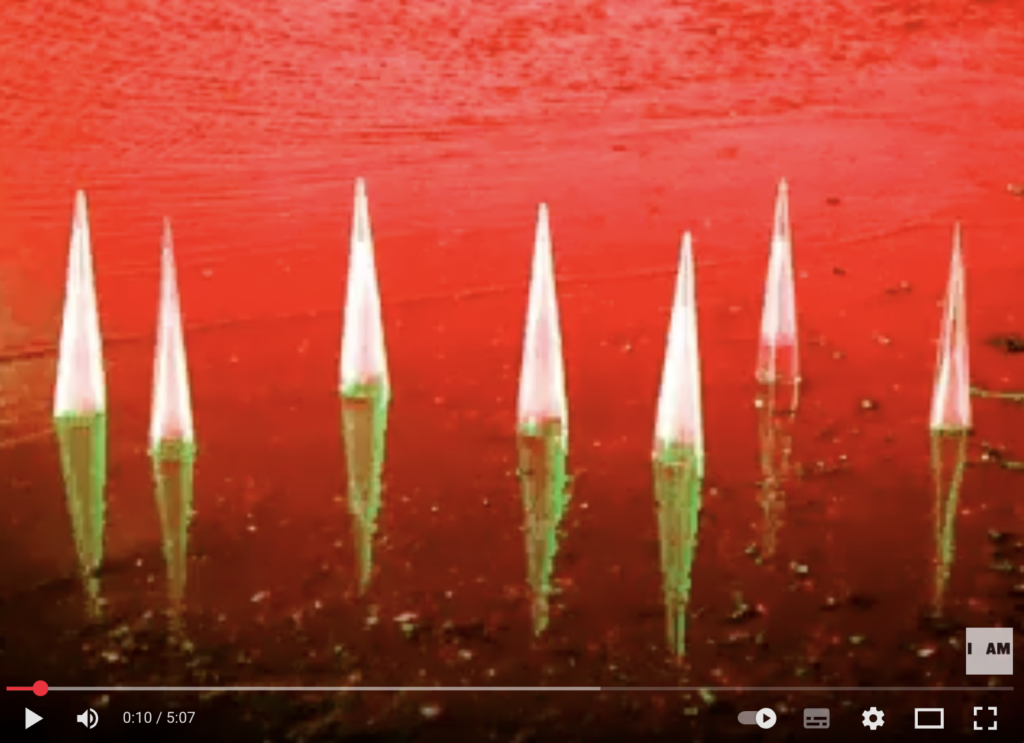
Percer-voir is an environmental installation grounded in a precise study of the site. The glass points rising vertically and diagonally probe and traverse the space, activating it both physically and perceptually. As Morucchio states, the idea of environmental installation as a form of profound artistic expression has accompanied me since my encounter with artists such as De Maria, Long, Christo, Penone, and others. In these practices—where human action unfolds with nature—i recognize a deeply emotional and sacred dimension that has strongly influenced my work. Aware that his sculptures may risk becoming fetishes shaped by the dynamics of the art market, Andrea Morucchio has felt the need to turn to nature in order to reclaim a sense of the “sacred” inspired by Land Art—something that is difficult to achieve within the structural and symbolic limits of the gallery space.
One of the founding principles of the Percer-voir project is the creation of an immersive environment designed to be physically experienced. The understanding of the installation space unfolds through a deep movement of the visual field, producing a rhythmic unveiling of the glass spikes. This process generates a dynamic perception of the environment, as if the space is truly traversed by flows of energy. The linear projections that virtually radiate from the semi-transparent crystal spikes propagate throughout the space, investigating and invading it, creating a symbolic connection between the energy of the earth and the cosmic energy.
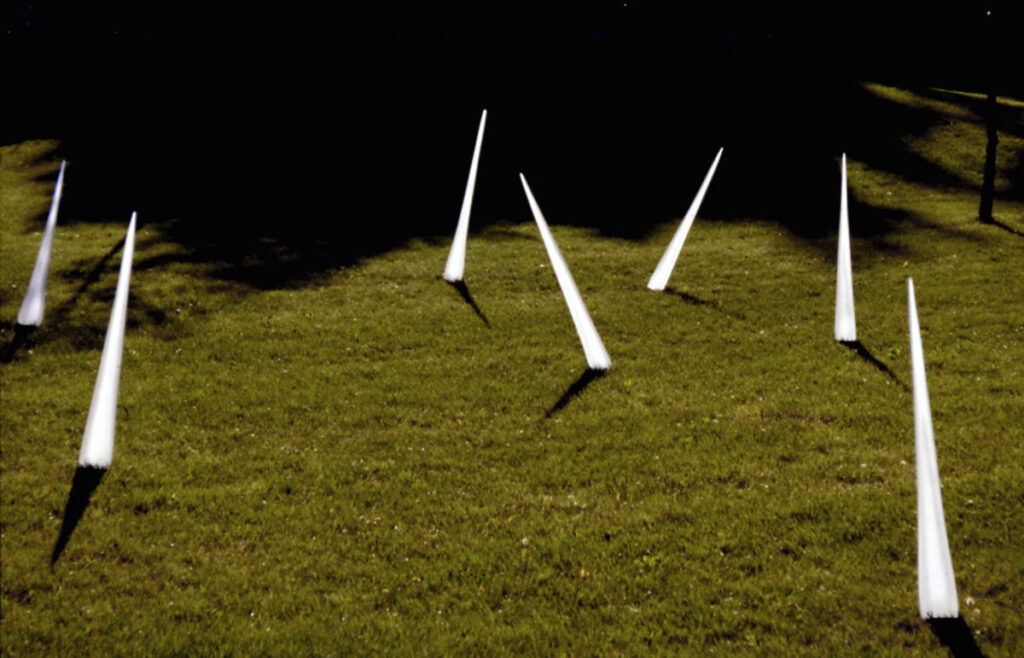
PERCER-VOIR N°2| 2003, Royal Tasmanian Botanical Gardens, Hobart.
The title Percer-Voir, literally (to pierce – to see), is a linguistic play derived from the French verb percevoir, understood as the acquisition of awareness of an external reality through the senses or intuition. Thus, the title of this environmental installation—formed by the terms to pierce and to see, and composed of glass points that pierce the surface—linguistically, aesthetically, and ethically implies an openness toward new possibilities of perception, understanding, and discernment, beyond customary visual, sensory, and intellectual conventions.
PERCER-VOIR N°2| 2003, Royal Tasmanian Botanical Gardens, Hobart.
Inserting a series of crystal glass spikes into a field or onto the mirrored surface of a lake, the artist uses natural reflections of light – and of water – on the vitreous matter in order to generate new contexts of experience, developing theemotional and perceptive qualities of the substance, “opening” the observer’s field of vision to another experience of the space.
IN 2002, MORUCCHIO HAD THE OPPORTUNITY TO ENGAGE WITH THE WORLD OF DESIGN BY PARTICIPATING IN THE EXHIBITION PROJECT VASI COMUNICANTI / COMMUNICATING VESSELS AT PALAZZO MUTILATI, VERONA. HIS INTERVENTION DEVELOPED FROM THE SCULPTURAL SERIES VESSEL, ORIGINALLY PRESENTED IN THE EXHIBITION DINAMICHE. BY COMBINING THE ORIGINAL WORK IN GLASS AND IRON FILAMENTS WITH A NEW VERSION OF THE SAME FORM IN MARBLE, MORUCCHIO EMBODIED THE CORE CONCEPT OF VASI COMUNICANTI—A DIALOGUE BETWEEN MATERIALS, FORMS, AND DISCIPLINES.
The exhibition PROJECT was DESIGNED TO PROMOTE THE MARBLE SECTOR THROUGH THE ENCOUNTER BETWEEN TRADITIONAL CRAFTSMANSHIP AND CONTEMPORARY DESIGN. THIS COLLABORATION LED TO THE CREATION OF TWENTY ARTISTIC VASE PROJECTS IN WHICH MARBLE AND GLASS MERGE INTO COMPLEMENTARY FORMS THAT INTERACT AND COMMUNICATE WITH ONE ANOTHER. THE EXHIBITION BROUGHT TOGETHER IMPORTANT CONTEMPORARY DESIGNERS, INCLUDING RICHARD MEIER, ALDO CIBIC, UGO LA PIETRA, KAZUHIKO TOMITA, AND HENRIQUE PESSOA ALVES, ALL OF WHOM EXPLORED THE THEME OF VASI COMUNICANTI THROUGH THEIR WORKS.
VESSELS/VASI COMUNICANTI, 2002, Vetro, Filamenti di ferro, Marmo.
The use of critical, political and social languages precisely constitutes one of the main nodes of his eclectic practice: from references to terrorist-like “supreme sacrifices”, inherent in the audio-visual installation LE NOSTRE IDEE VINCERANNO (2002), produced aT Museo Mocenigo, to the light installation PULSE RED (2004), an alarm, at Punta della Dogana, Venice, warning against the risks of congestion of mass-media information, from the complex Australian multimedia work EIDETIC BUSH,(2003)which addresses themes such as deforestation, genocide, and the critical capacity and awareness of contemporary humanity. to LAUDES REGIAE (2007) merging historical memory, spirituality, and socio-political reflection, resonating with the monastic austerity of a venetian Convent.
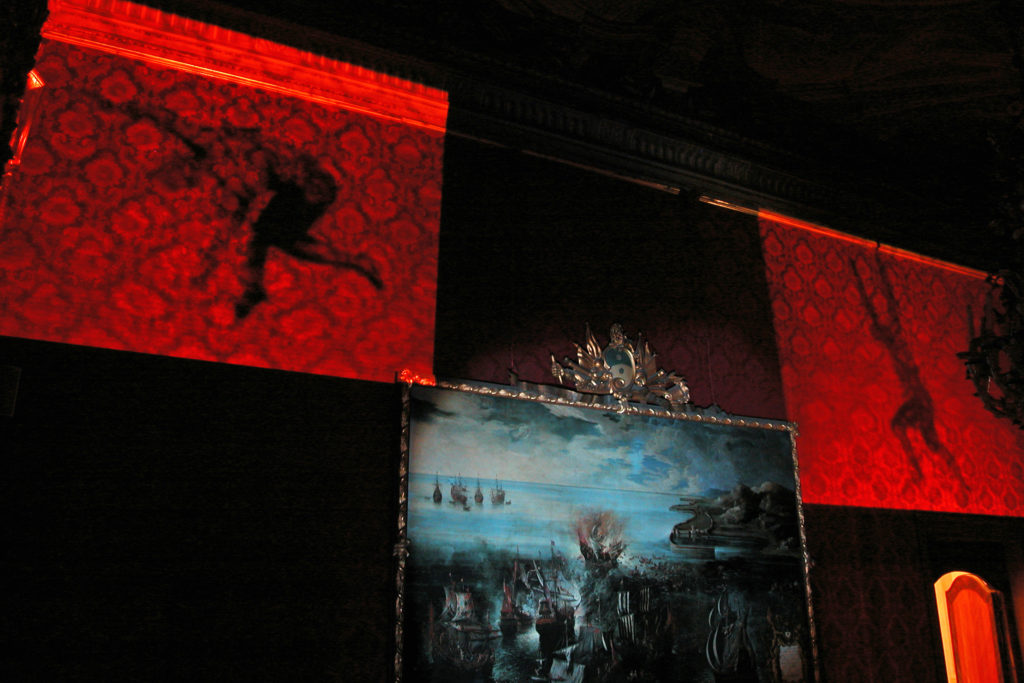
LE NOSTRE IDEE VINCERANNO/Our Ideas Will Win, Museo mocenigo, venice (2002) is a multimedia installation created forGemine Muse, a national project inviting young artists to reinterpret works from Italian museums. In Venice, Morucchio selected La Battaglia Navale / The Naval Battle, which portrays Captain Zaccaria Mocenigo’s self-destruction—blowing up his own ship rather than surrendering. This glorified act of sacrifice gained new relevance in 2002, during the early days of the Second Palestinian Intifada, when suicide attacks dominated global attention. Morucchio’s reinterpretation highlights how narratives of martyrdom continually oscillate between heroism and fanaticism, depending on the historical and cultural frameworks that shape their meaning and reception, thus lending themselves to a “double standard” within Western culture and politics through narratives propagated by mainstream media.
Combining a double video projection with the original painting, transforming The figures of the crewmen from Mocenigo’s vessel, projected and hurled into the sea, into ghostlike silhouettes drifting across a field of lilies, evoking the endless cycle of war and sacrifice. The painting itself, bathed in cool blue light, is stripped of color and rendered hauntingly fragile. Excerpts from Luigi Nono’s Il canto sospeso—choral settings of farewell letters by anti-fascist partisans—fill the space. One letter, declaring “our ideas will win” inspired the title and appeared on red flyers scattered throughout the museum. By weaving together resistance, violence, and sacrifice, Morucchio invites viewers to reflect on the shifting rhetoric of martyrdom. Le nostre idee vinceranno is not merely an artwork to view, but an experience to inhabit—intellectually, emotionally, and politically.
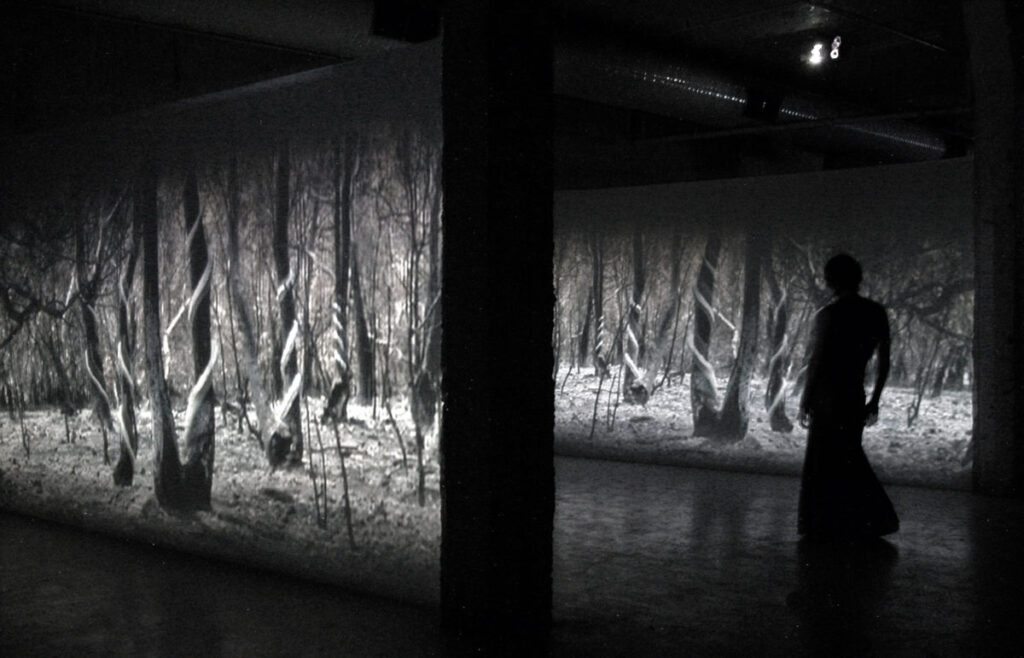
As further proof of the artist’s eclecticism, shortly after creating LE NOSTRE IDEE VINCERANNO, Morucchio moved from the eighteenth-century atmosphere of the Venetian Museum to the fire-ravaged forests of Tasmania, where he conceived a new and remarkable multimedia installation, EIDETIC BUSH (2003), realized at plimsoll gallery, Hobart, Australia in collaboration with university of tasmania. The installation features two large 7×3 mt rear projected screens, suspended in the gallery for a 360 degree immersive experience, evoking a spectral, metaphysical forest. Before entering, visitors see a wall-mounted slideshow of Morucchio’s performative acts in the bush, providing a contextual prelude that grounds the work in lived experience. morucchio touches on one of the region’s most pressing problems – the massive destruction of the wooded areas caused by Caused by increasingly frequent wildfiresand the devastating practices of deforestation Carried out by multinational timber corporations. Through their spectral chromatic abatement, the abandoned scenarios of the blazed woods of Tasmania become the sites of a complex process uniting performance and digital operations.
Morucchio’s interventions in the bush seem capable of reactivating the power of imagination. The marks engraved into the bark and the spirals of clay modeled on the burnt trunks appear like elements of a re-appropriation rite – a re-appropriation of the possibility of existing and imagining again.They present the possibility of “rewriting” one’s own existential perimeters in a space where combustion has cancelled out memory – thus, space and time – following a devastation which inevitably alludes to that inflicted – genocide – by Western people on the tasman aborigine population, pillaged of the territory so inextricably linked to their culture, and therefore completely cancelled. In the video projections, the engraved or clay spirals combine with other digitally constructed ones, appearing and disappearing to the rhythm of venetian composer Luigi Nono’s Caminantes…Ayacucho. a composition resonating with themes of Indigenous resistance, loss, and cultural memory.
In particular, the choral passages—chosen as the soundtrack for Eidetic Bush—are drawn from De la causa, principio et uno by Giordano Bruno, for whom the medieval man, in order to come into contact with the universal spirit (the divine intellect that is everywhere and animates all things), must overcome the Church’s authoritarian mediation by freeing the mind from the constraints of a hierarchical and anthropocentric cosmos. Only in this way can one contemplate—and almost “unite with”—the living infinity that is God-Nature. Luigi Nono’s music alternates whispered pianissimi with sudden fortissimi, mirroring the emotional and temporal volatility of the work. Silence takes shape as a void charged with tension, paralleling Morucchio’s burned forest, conceived as a space of potentiality and vision. Through this fusion of image and sound, the installation generates a “shamanic” dimension in which myth, memory, and perception merge, inviting the viewer into a suspended, meditative realm where archaic spiritual impulses and contemporary artistic strategies converge. The observer thus seems to enter an enigmatic eidetic space in which the “revolt” of a distant memory is reactivated and the first traces of a lost spirituality are rewritten.
In September 2004, THE VENETIAN ARTIST realized PULSE RED, a public art intervention conceived for Progetto Borders and presented at thePunta della Doganain Venice. organized by A+A Gallery in collaboration with IUAV university, the project consisted of an intermittent red light projected onto the Golden Globe crowning the historic Dogana da Mar, generated by four synchronized spotlights. Through a minimal yet powerful gesture, Morucchio transformed one of Venice’s most iconic landmarks into a luminous signal visible across the bacino di San Marco. The golden sphere atop the ancient Customs House symbolizes commerce and exchange. Visible to those arriving in Venice by sea, the building historically functioned as a key point of contact with the wider world—a place for the exchange, storage, and classification of goods, as well as for the circulation of knowledge and information that traveled alongside trade and was then disseminated throughout the city and beyond.
In Morucchio’s interpretation, the golden sphere is transformed into a symbolic device, a kind of “antenna” that intercepts contemporary flows of communication and reduces them to an intermittent pulse of light. The red light beating above the ancient Customs House thus becomes a metaphor for the implosion of the mass media system: a network on the verge of collapse, in which incessant transmission risks suffocating meaning itself. Pulse Red functions as an allegory—an alarm signal—in which the continuous overload of information – information that is moreover widely manipulated, in the narration of reality, by the official mainstream media – undermines the individual’s ability to comprehend and filter messages. It therefore takes shape as a gesture that is at once poetic and political, both warning and reflection: a minimal, site-specific public art intervention that resonates through architecture, history, and the spirit of a place.
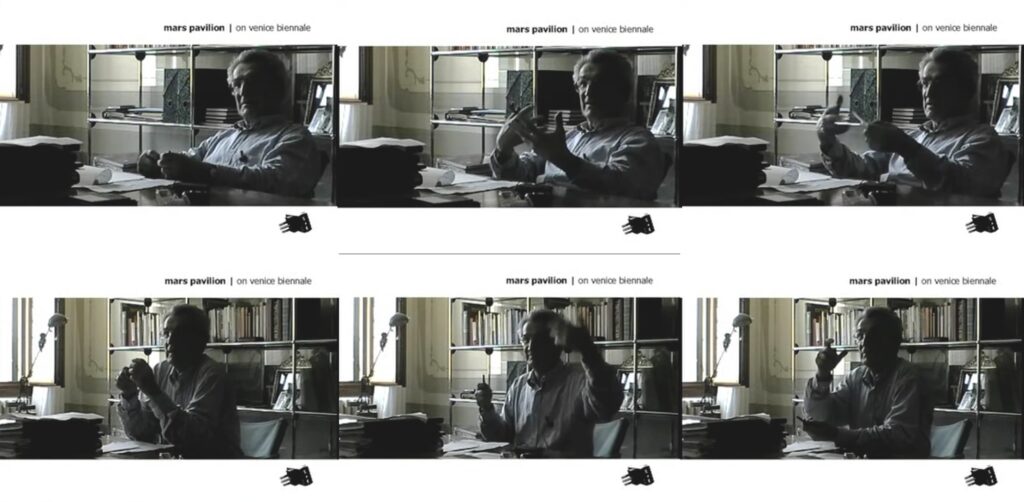
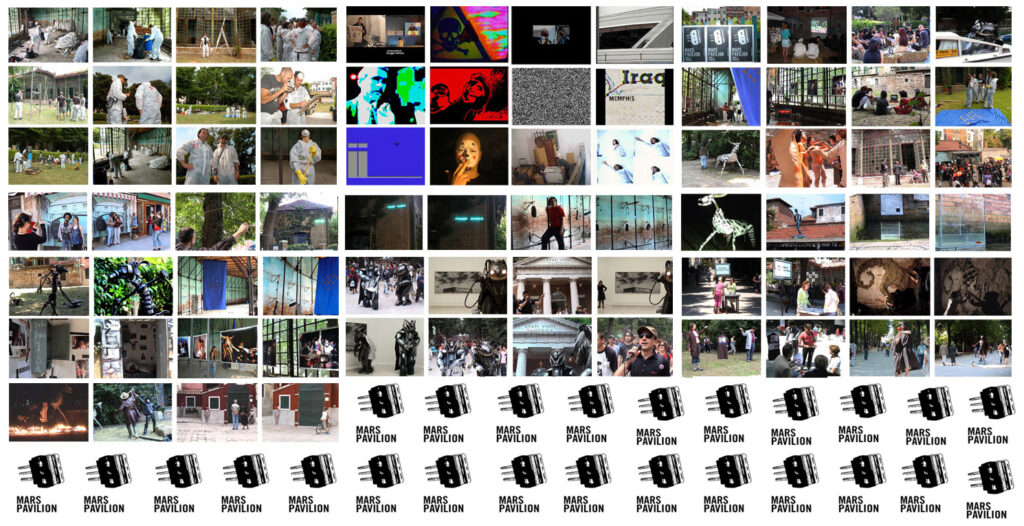
As further evidence of Morucchio’s eclectic language and wide range of references and inspirations, since 2004 he has produced a pair of videos — one more documentary in nature and the other staged — both addressing urgent socio-political themes. Sabato Italiano (2004) marks his first explicitly political work, a sharp response to the rise of Berlusconism in Italy, while Non aprite quella porta / Don’t Open That Door (2005) documents the occupation of the offices of the Magistrato alle Acque by a group of environmental activists opposing the construction of the MOSE project. TALK SHOW (2005) Originating from the Mars Pavilion experience, the video assembles a heated debate among artists and activists, and once again, a project curated by Morucchio has given rise to the short film of the same name, PETROLOGICHE(PART A) (PART B) (2003) and ARTE E MULTITUDO (PART A)(PART B)A conversation with toni negri (2004) produced with manuel frara and marco baravalle in occcasion of Mars Pavilion.
ARTE E MULTITUDO. A CONVERSATION WITH TONI NEGRI | 2005, Video,(PART A) – (PART B).
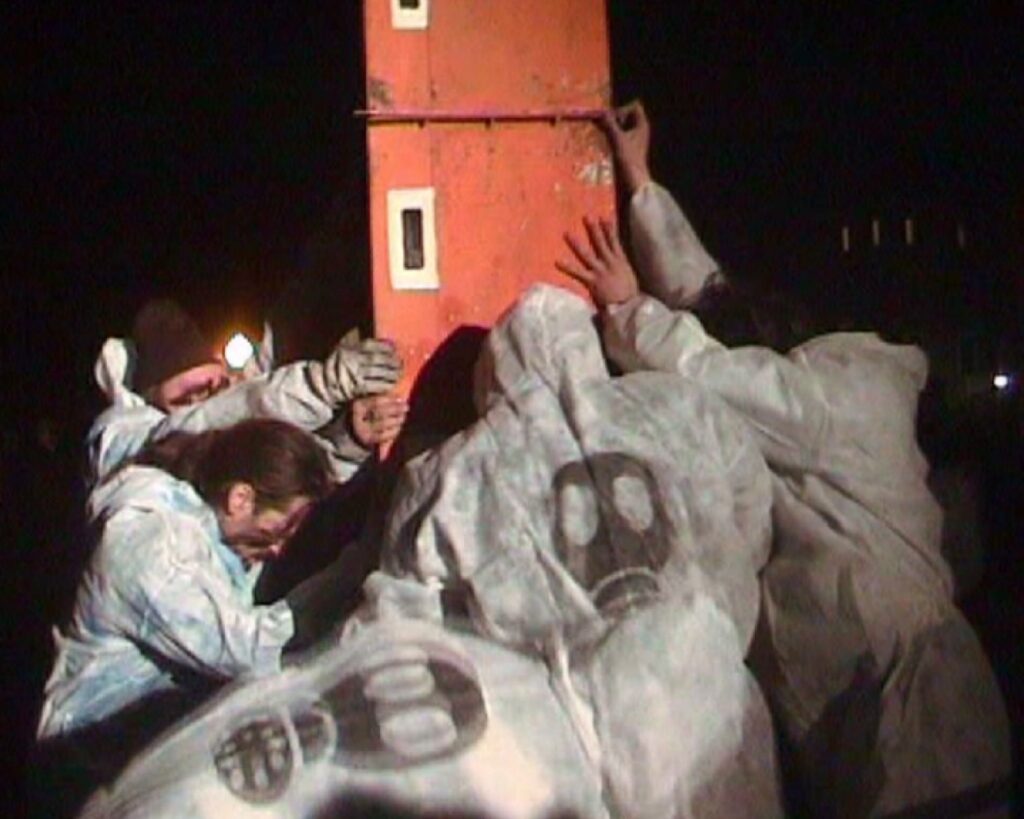
On several occasions, Morucchio has sought to channel his drive to address key social and political dynamics at the core of his practice through curatorial work. In this vein, he curated group projects as Petrologiche/ oil logics (2003) and Mars Pavilion (2005), extending his artistic inquiry into a broader, collective context. Andrea Morucchio conceived and curated PETROLOGICHE / OIL LOGICS (Venice, February 19–24, 2004), an interdisciplinary project developed in collaboration with Interno 3, Galleria A+A, Laboratorio Morion, the City of Venice, and the Assemblea Permanente Contro il Rischio Chimico. Exceptional within Morucchio’s artistic path, this ambitious and complex collective initiative gathered a wide network of artists, performers, and activists to address — through contemporary artistic languages — the environmental and social consequences of the Petrolchimico industrial complex in Porto Marghera.
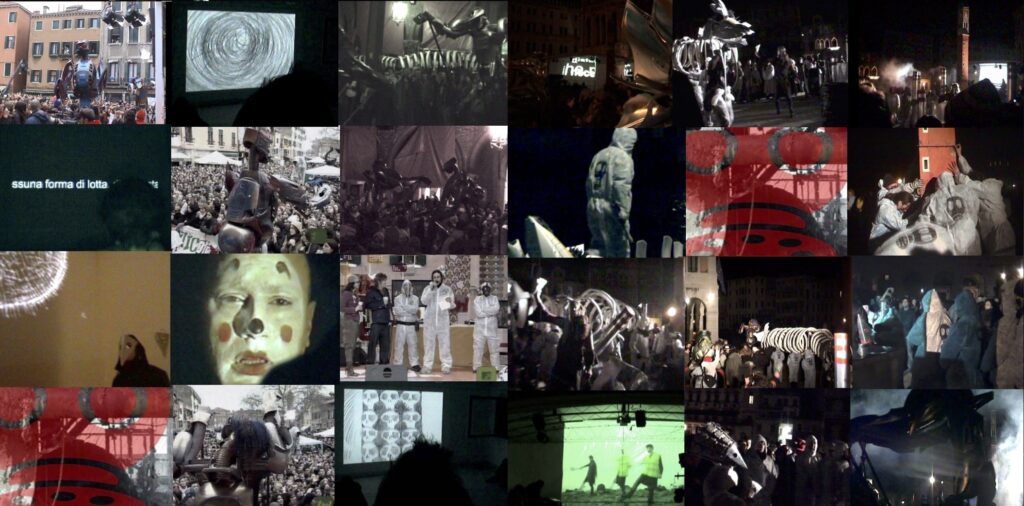
Through performances, video installations, and public interventions, Petrologiche transformed parts of the city of Venice during Carnival into a space for reflection and critical awareness, confronting the “oil logics” that intertwine economic power, political impunity, and ecological devastation.By engaging both local communities and an international audience, the project sought to reactivate civic consciousness around issues of industrial pollution and environmental justice. This demanding curatorial experience stands as a rare moment in which Morucchio extended his artistic practice into the collective sphere, using curation itself as a medium of social and political expression. Petrologiche remains a significant example of how contemporary art can operate as a catalyst for dialogue, resistance, and transformation within the public domain. From the video footage Morucchio recorded during the project’s various events, he later produced the short film PETROLOGICHE (PART A)(PART B) presented at the first edition of the Venice Film Meeting (2004)
PETROLOGICHE, (PART A) (PART B)| 2004, Andrea Morucchio’s short movie, stills from video.
One year after Petrologiche, Morucchio embarked on another ambitious curatorial experiment with Mars Pavilion – Artistic Resistance Laboratory, held at the Giardini di Castello Greenhouse and through urban interventions in Venice from June 8–12, 2005. Curated by Andrea Morucchio, Manuel Frara, and Marco Baravalle in collaboration with Laboratorio Morion, Global Project, and Radio Sherwood, the initiative took place parallel to the 51st Venice Biennale. Mars Pavilionpresented itself as a hyper-pavilion—a collective, self-managed space of artistic and political convergence. More than a traditional exhibition, it functioned as an open laboratory where artists, activists, and cultural producers explored the intersections of art, society, and globalization. Rejecting institutional aesthetics and the elitism of official art circuits, it embraced occupation OF AN ABANDONED PUBLIC SPACE as both political strategy and social action.
Through performances, debates, community services, and interventions—including the now-famous “Martians” protest during the Biennale’s opening—the project questioned neoliberalism’s homogenizing forces and affirmed art’s potential as a tool of resistance and collective imagination. AS ALISON M. GINGERA WRITES IN ArtforumMAGAZINE: Mars Pavilion stood out not for its objects, but for its radical sincerity and commitment to local and global struggles—offering, in the heart of the Biennale, the most genuine critical statement in Venice that year.
MARS PAVILION| 2005, Artistic Resistance Laboratory, logo.
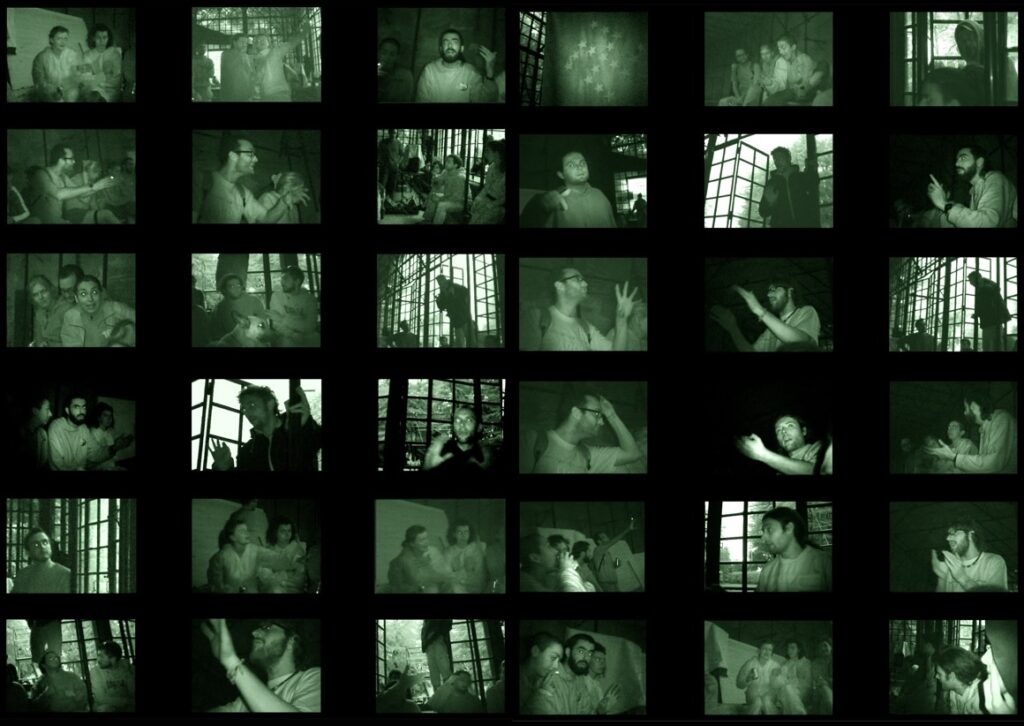
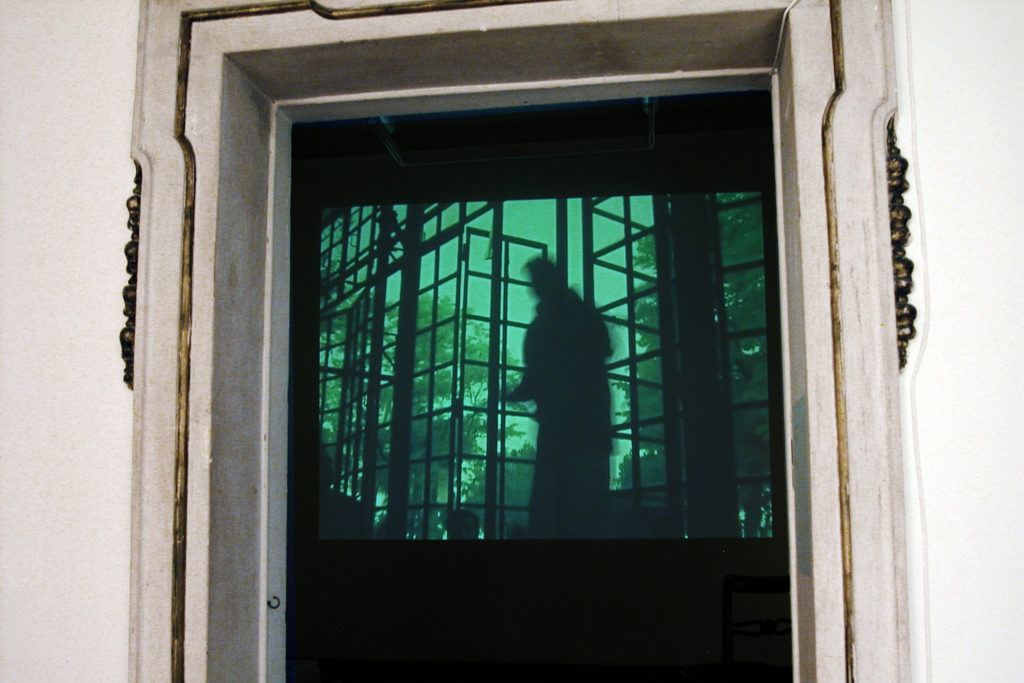
FROM MARS PAVILION EXPERIENCE DERIVES THE VIDEO WORK TALK SHOW (2005) – Conceived for DIS-ORDER exhibition project at Bevilacqua La Masa, Palazzo Tito, venice, Curated by Marco Baravalle – consists of the editing together of footage of a discussion amongst a group of activists and artists which took place within the Municipal Greenhouse of the Giardini of Castello, which had just several hours before been occupied and assigned as the operating and exhibiting base of the “artistic resistance workshopMARS PAVILION(2004). TALK SHOW assembles footage recorded by morucchio of a heated debate among artists and activists sparked by Nemanja Cvijanović’s The Sweetest Dream, a European Union flag whose stars were rearranged into a swastika.
The video documents a raw moment of confrontation between political activism and artistic interpretation, dramatized through the spectral “Martian green” of its infrared imagery. Seen nearly twenty years later,the interpretative key that the work Talk Show provides for The Sweetest Dream acquires an almost prophetic resonance; The EU’s increasing role in restricting individual freedoms, its drive toward military escalation against Russia, and the growing regulation and censorship of media and social platforms make Cvijanović’s flag-sculpture a stark foreshadowing of the contradictions of European democracy. The piece can also be read as a plastic embodiment of the “divide et impera” principle: the subtle but effective strategies of power to fragment society, to pit communities and factions against each other, and to maintain consensus through manipulation of public opinion. At the same time, TALK SHOW reflects the foundational spirit of the MARS PAVILION: the creation of a truly public space of encounter and dissent, where the tensions between art and activism can generate not only conflict but also new forms of collective imagination and critical awareness.
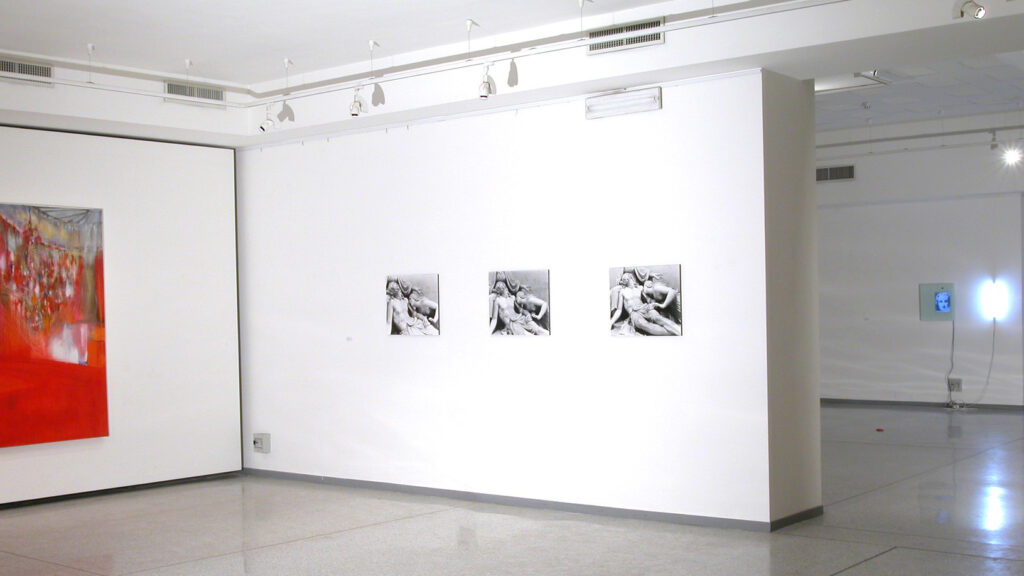
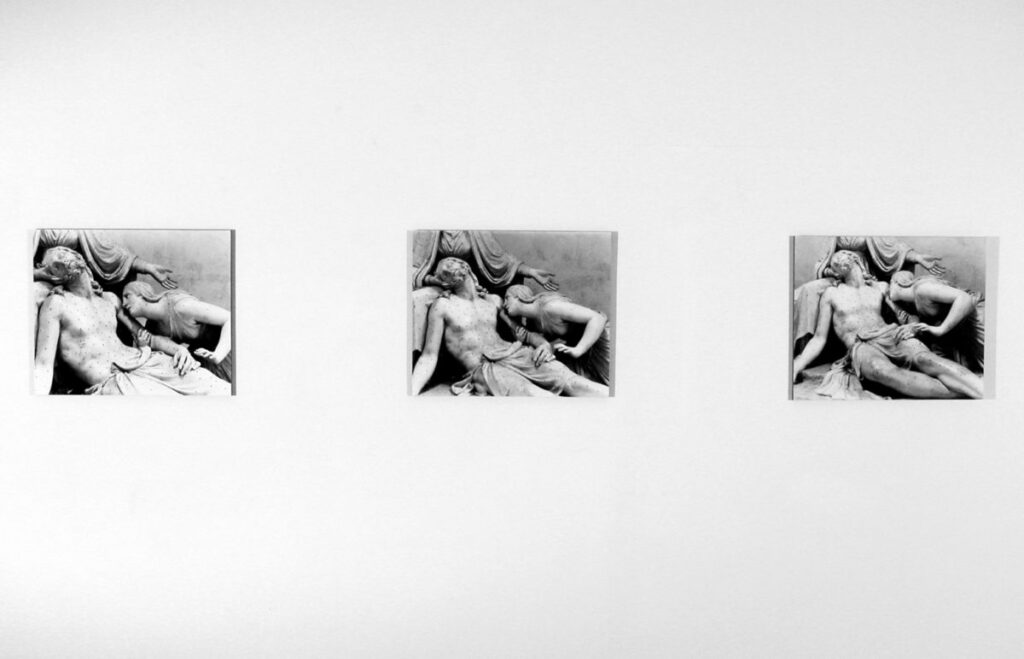
Created for the group exhibition HOLLYWOOD. La Fabbrica dello Spettacolo / The Spectacle Factory at Galleria Contemporaneo, Mestre (2005)—a project co-curated by Andrea Morucchio with Interno3—The Main Show marks a decisive moment in the artist’s practice. For the first time, Morucchio reactivates a sequence of black-and-white photographs taken in 1994 at the Gipsoteca di Possagno, printing them from analog medium-format negatives and recontextualizing them as a contemporary artwork. In doing so, he transforms “pure photography” into a critical reflection on image, perception, and the language of contemporary art.
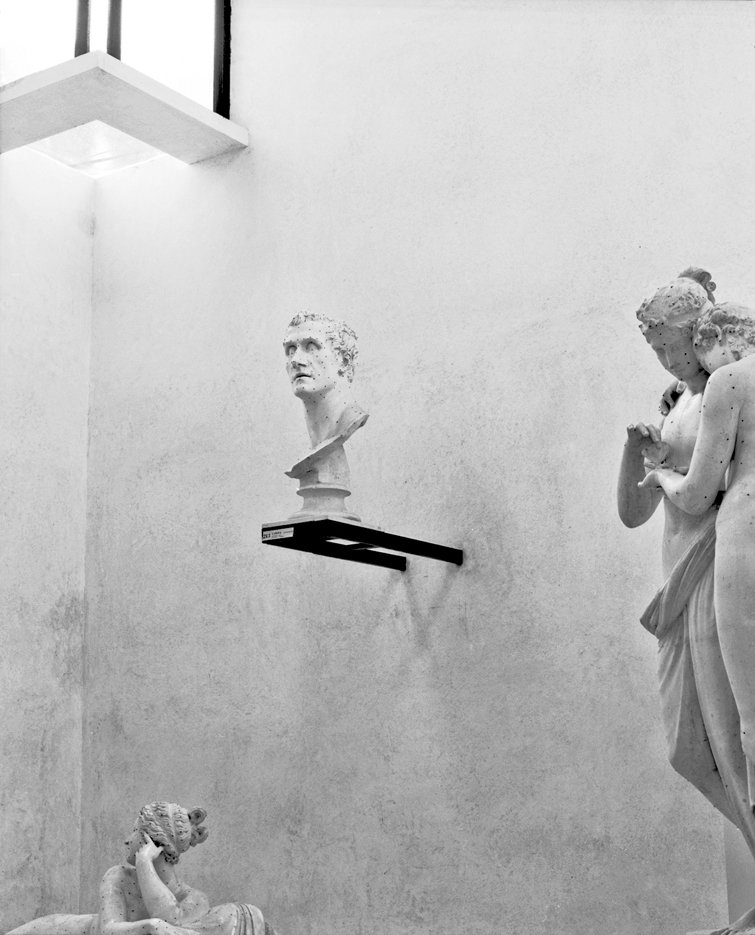
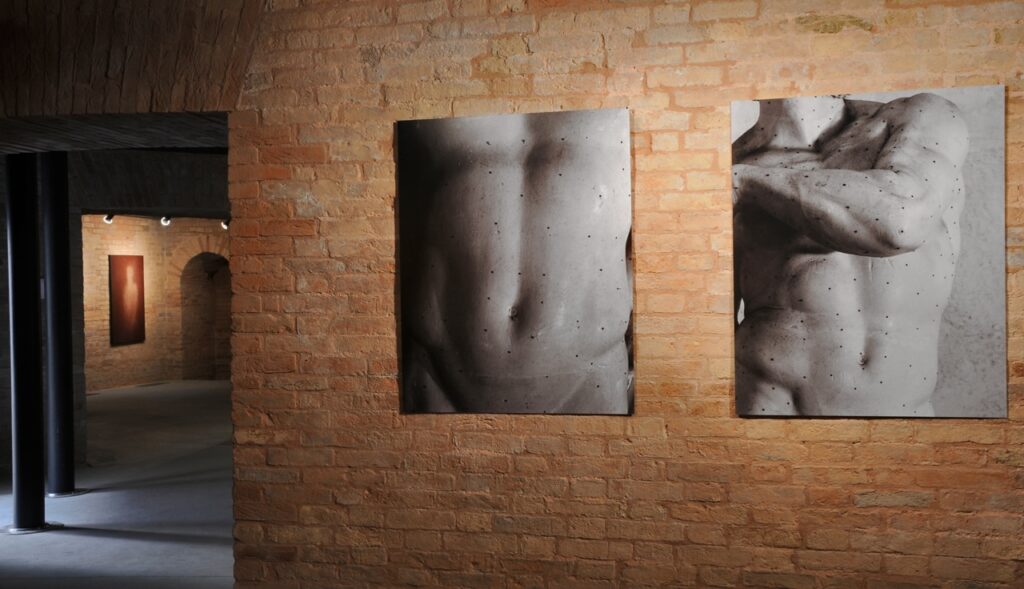
The triptych presents three frontal views of Antonio Canova’s Pietà, from gipsoteca series (1994) each captured from a slightly shifted angle. The plaster casts—marked by bronze reference points used to transfer canonical proportions—become metaphors of measurement, codification, and the transmission of beauty from neoclassical idealism to today’s visual culture. The work engages a double genealogy: the persistence of sacred archetypes and their migration into cinematic and media imaginaries.
Situated within the conceptual horizon of Hollywood—understood, in Debord’s sense, as the society of the spectacle—The Main Show reveals the continuity between devotional imagery and mass-media persuasion. Formally, the subtle shifts between the three images generate a proto-cinematic effect: a horizontal oscillation that animates la Pietà through the viewer’s gaze, breaking its traditional stasis. Suspended between photography and cinema, icon and spectacle, the work operates as both homage and critical displacement, inviting reflection on how pathos and meaning are endlessly reproduced across the visual regimes of history.
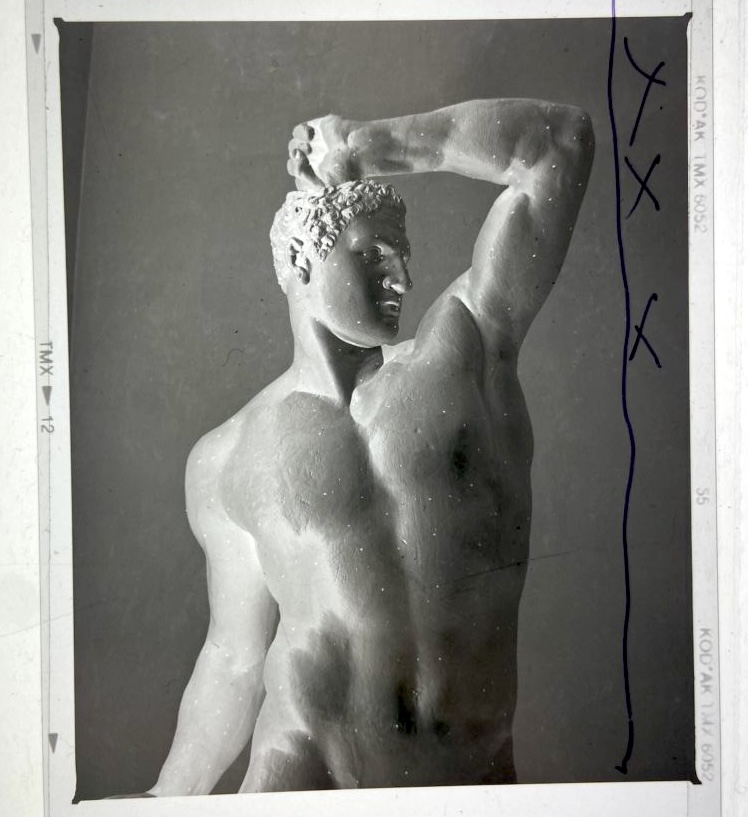
In his photographic project Gipsoteca (1994) – from which the photographs used for the triptych The Main Show were taken – Morucchio explores sculptural form through a refined interplay of light and shadow that reveals both structural and emotional depth. Like a sequence in slow motion, the progressive variation between frames allows him to focus on the emotional and compositional “nodes” of Canova’s masterpieces—expressing despair, pain, complicity, and harmony in works such as LAPietà, Le Grazie, and Amore e Psiche stanti. Through a masterful use of perspective, Morucchio also creates subtle visual connections among the sculptures, binding them within an invisible web of silence and imperceptible dialogue.
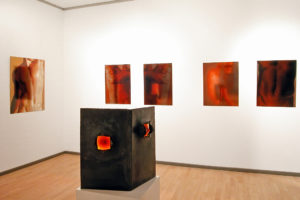
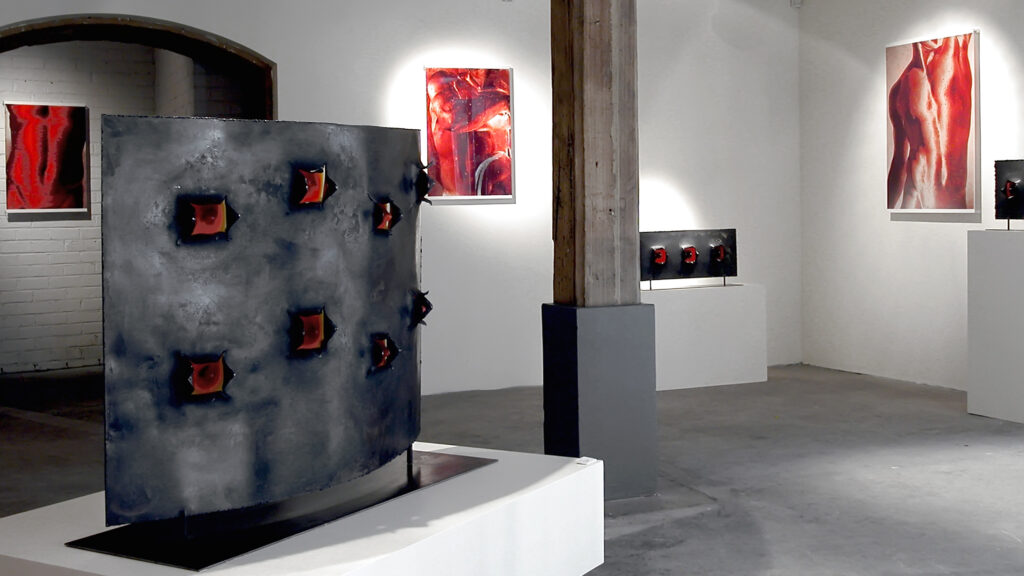
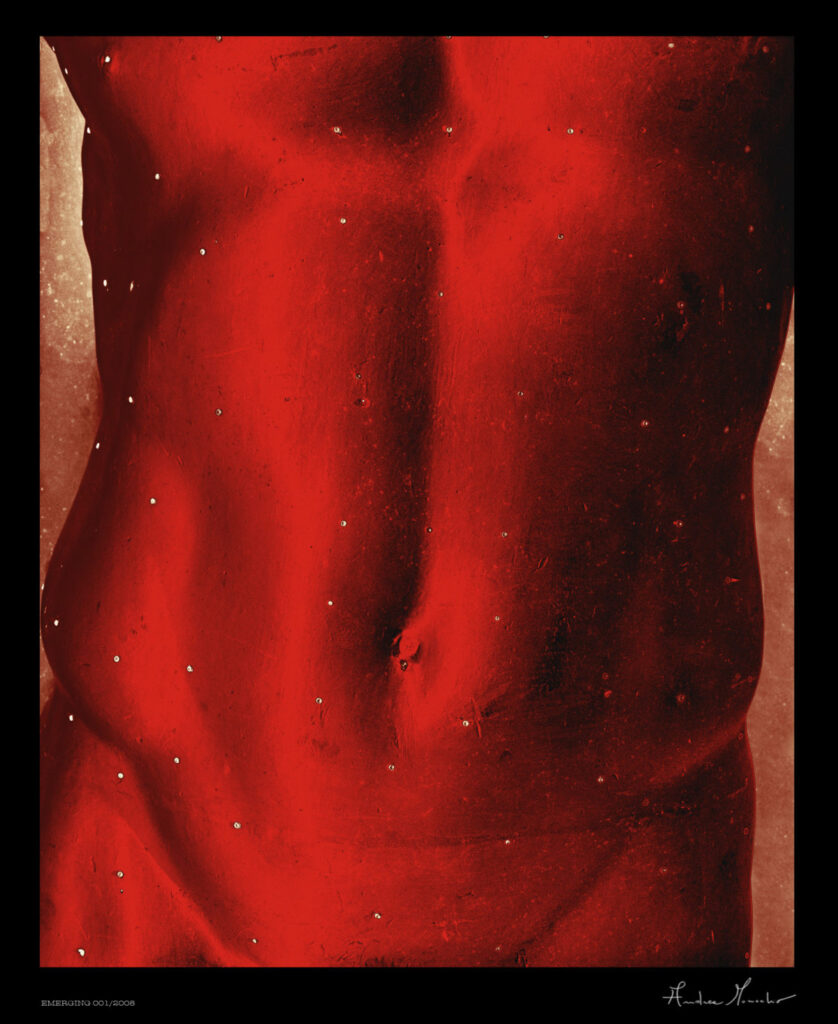
A year later, the images of Canova’s bodies re-emerged as both inspiration and transformed protagonists in prints Emerging, (2006) which, together with the new sculptural series Offshoots, (2006) converge and interact within the exhibition project Emerging Code — a double solo exhibition presented at Despard Gallery, Hobart, and Galerie Rossella Junck, Berlin. These almost twin exhibitions mark a pivotal moment in Andrea Morucchio’s artistic practice, where his long-standing engagement with materiality, form, and the photographic image coalesces into a single, immersive vision.
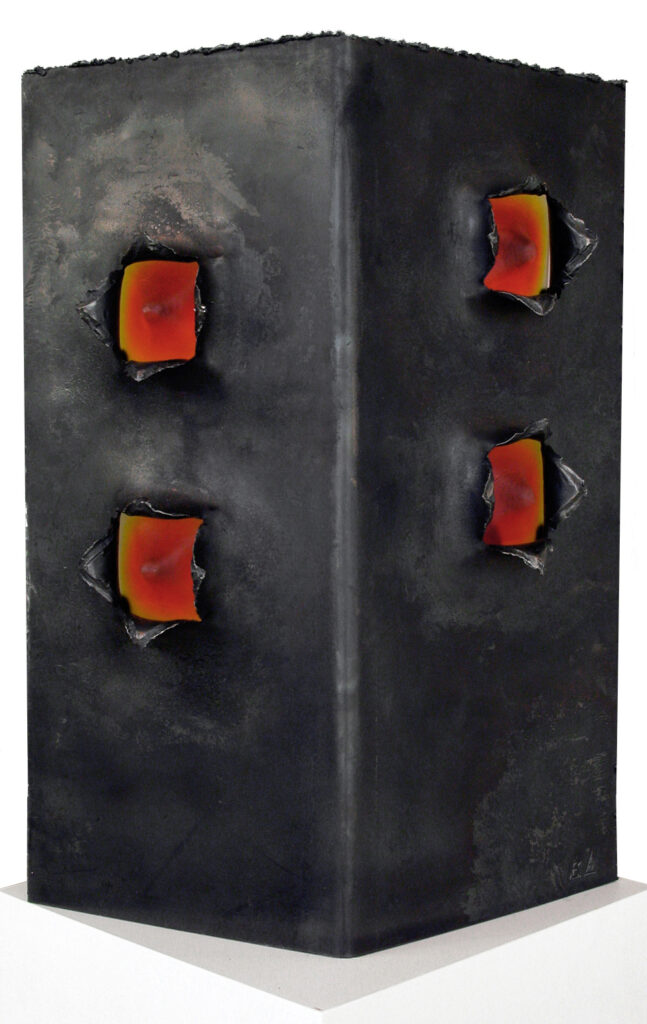
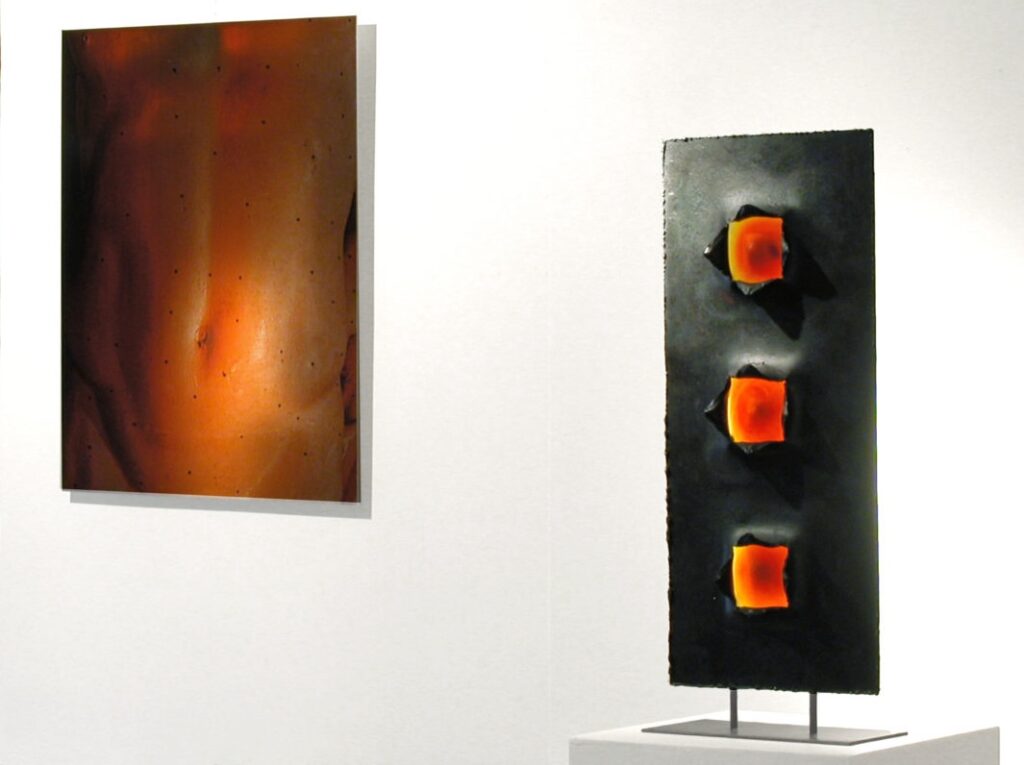
Conceived as a dialogue between sculpture and photography, Emerging Code intertwines two interrelated bodies of work: Offshoots, a sculptural series composed of forged and perforated iron sheets filled with red-orange glass inserts, and Emerging, a sequence of digitally manipulated photographic prints on reflective silver film derived from Antonio Canova’s plaster models. The conceptual roots of the project trace back to a photographic series GIPSOTECA (1994). Over the following decade, this early photographic exploration matured into a broader reflection on the transition from classical figuration to contemporary abstraction. Through EMERGING CODE(A)&EMERGING CODE (B) Morucchio reinterprets Canova’s ideals not through imitation but through transfiguration, translating the sculptor’s search for proportion, harmony, and ideal beauty into a contemporary visual language grounded in matter and light.
EMERGING CODE| 2006, Solo Show, Despard Gallery, Hobart.
In the Offshoots sculptures, the glass inserts become three-dimensional transpositions of Canova’s points de repère—the small bronze markers used to “encode” classical beauty and to transfer the exact proportions of plaster models into marble. These glowing glass modules act as both structure and metaphor: condensed sources of energy that pierce and illuminate the opaque iron surfaces, transforming solid matter into a vessel of pulsating luminosity.
OFFSHOOTS n°9| 2006, Forged iron, ground and satin glass, 70.5x52x18 cm.
The Emerging series (2006) on the other hand, translates analog photographic negatives from the 1990s into digitally reworked images, printed on reflective silver film. This marks Morucchio’s first exploration of digital art, a key moment in his evolution from analog process to digital manipulation. By merging tactile and virtual, mechanical and computational, the artist bridges centuries of artistic evolution—from Canova’s neoclassical perfection to the dematerialized aesthetics of the digital age. Exhibited together, the two series create an immersive environment where sculpture and image resonate in a play of reflection and transparency. The installation invites the viewer into a space of perceptual tension—between the visible and the invisible, the static and the dynamic—where beauty emerges not as fixed form but as a living process.
As Marco Baravalle observes in his essay Sampling Canova (2006), EMERGING CODE(A)&EMERGING CODE (B) can be read along two intertwined trajectories. On one hand, it reflects Canova’s own passage from material to thought—a movement toward abstraction that Morucchio echoes through the interplay of plaster, iron, and glass. On the other, it embodies a contemporary postproduction practice, in which pre-existing materials and images are recombined to generate new meanings. Avoiding both nostalgic imitation and empty formalism, Morucchio situates his work in a lineage that runs from Canova to Lucio Fontana, using incision, light, and transparency as tools to reveal the inner vitality of matter itself.
EMERGING CODE| 2006, Solo Show, Despard Gallery, Hobart.
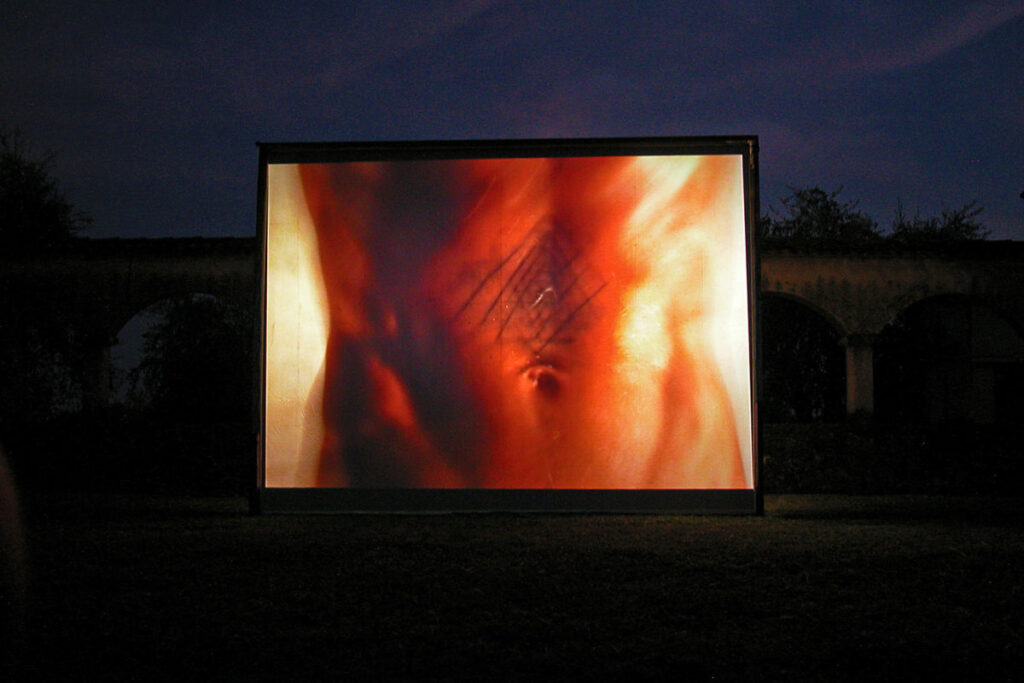
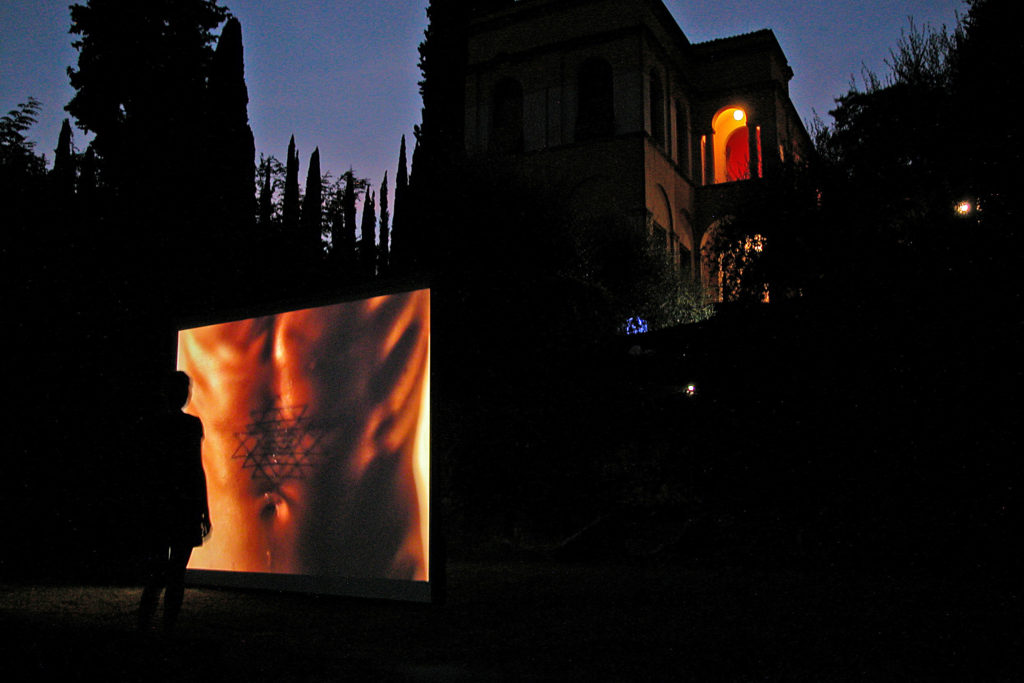
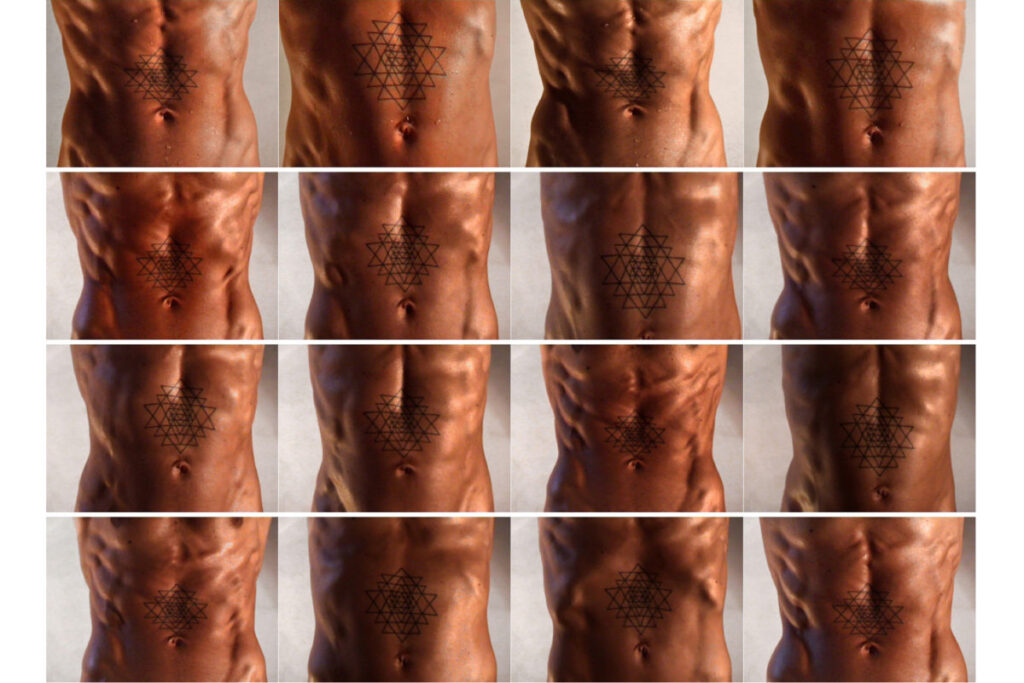
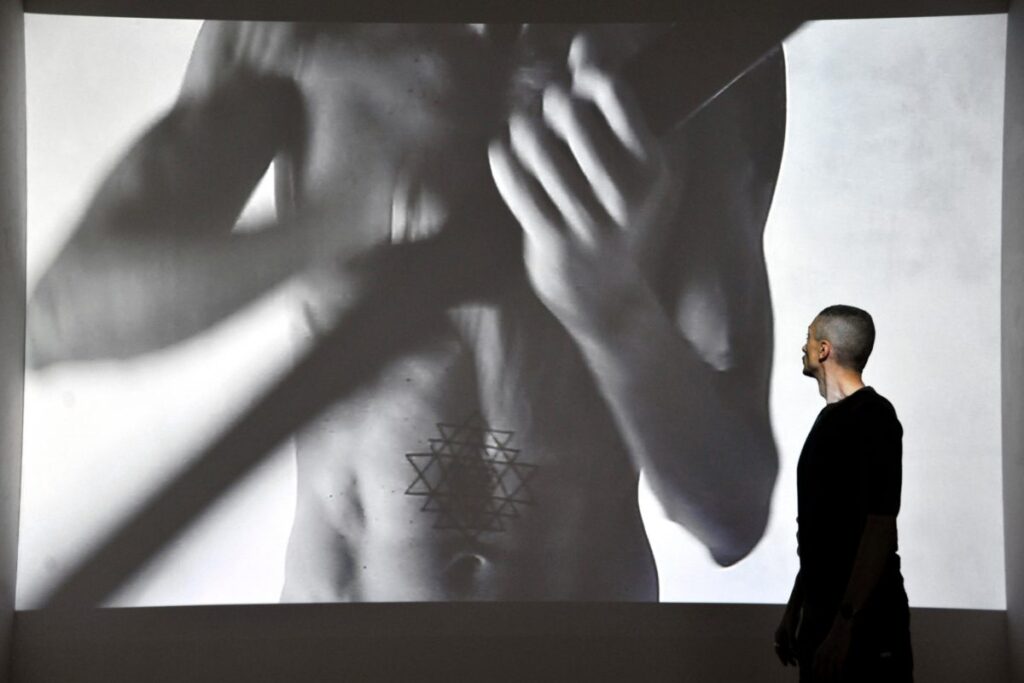
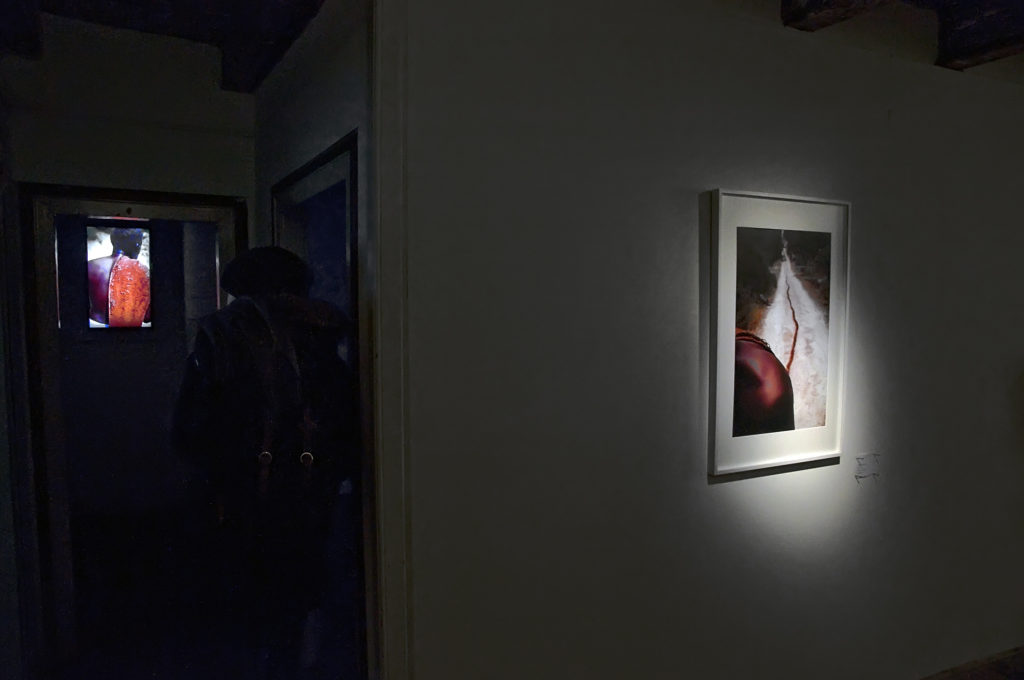
The red torsos derived from Canova’s plaster figures evolve further in Sri Yantra (2008), where the torso depicted is the artist’s own. Through a performative action driven by the movement of his abdomen and chest, Morucchio turns his body into both medium and message. The video focuses on his red-toned torso, centered on a Sri Yantra symbol tattooed onto his skin. This ancient Hindu diagram—evoking the union of masculine and feminine, order and chaos—embodies the synthesis of opposites central to Morucchio’s practice.
Here, it anchors the dialogue between the physical and the transcendental, acting at once as sacred geometry and personal mark. The torso’s movement follows a sound composition built from radically altered Tibetan mantras, producing a pulse that is both unsettling and meditative. Through these rhythmic expansions and contractions, the body becomes an elastic, ever-shifting surface. Anatomy dissolves, suggesting a return to primordial androgyny and a reconciliation of dualities through breath and motion.
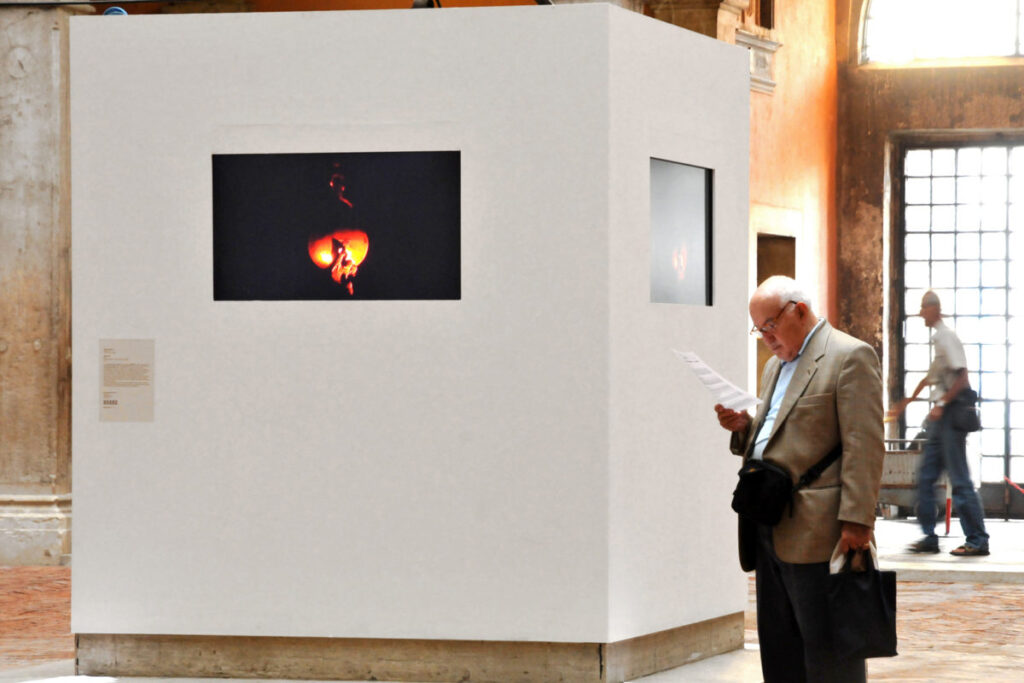
Created for the exhibition Notturni dannunziani– Man Between Eros and Nature (2008) at the Vittoriale degli Italiani, Sri Yantra engages directly with Gabriele D’Annunzio’s aesthetics. The piece echoes his vision of art as a fusion of sensuality, mysticism, and nature. By blending erotic and spiritual dimensions, Morucchio reflects D’Annunzio’s pursuit of unity between body and cosmos. The gesture—rooted in rhythm, vibration, and breath—embodies Eros as a vital force linking human and natural energies. The installation, featuring a looped rear-projected video and the accompanying sound piece tibetangranularsintesisritual by Alessandro Ragazzo, creates a meditative environment. Morucchio’s body becomes a catalyst in which movement, tattooed symbol, and rhythmic tension merge into a continuum between matter and energy, presence and transcendence.
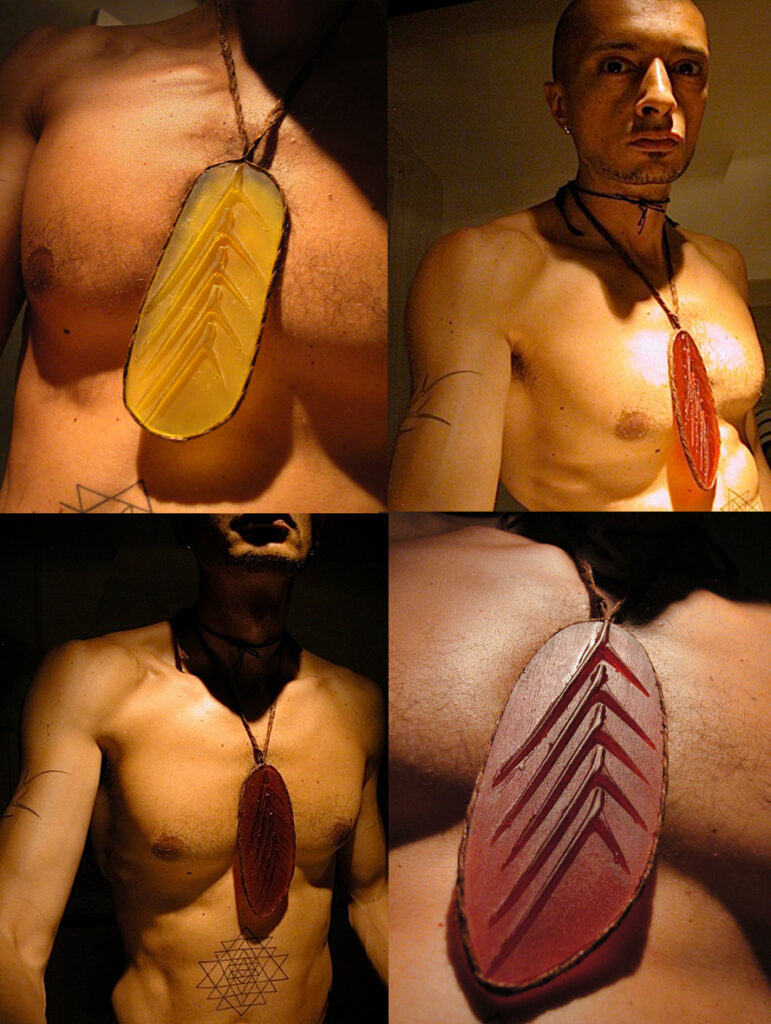
For the exhibition Glass Dressing (2006), held at the Museo di Ca’ Rezzonico in Venice and the Museo Revoltella in Trieste, Andrea Morucchio created, for the first time, a series of wearable objects. The exhibition was organized by Trieste Contemporanea and curated by Giuliana Carbi and Eva Fabris. Entitled Signatura Rerum, These works consist of glass plates featuring raised thorn forms obtained from casts of thorns collected by Morucchio near the furnace where the objects were produced in murano island. Starting from casts taken directly from the thorns, Morucchio obtained glass forms that, like fossils, faithfully reproduce the shape and volume of a living organism. Conceived specifically for Glass Dressing, these objects transform natural elements into wearable artifacts suspended between sculpture, ritual object, and personal ornament.
SIGNATURA RERUM| 2006, Cast, ground, frosted glass elements, hemp, 14×5.5×0.8 cm each
The title Signatura Rerum refers to the concept articulated by Jacob Böhme, according to which the corporeal nature of things bears an external imprint through which their inner, spiritual essence becomes perceptible to human senses. Corporeality thus functions as an anagogical medium, capable of revealing the spiritual dimension. In line with this principle, medieval alchemists sought to read the healing properties of plants through their forms and colors, tracing them back to an invisible formative force expressed through physical characteristics. In Morucchio’s work, the glass thorn becomes a pendant that embodies the immaterial, energetic essence of the original plant. When worn, it establishes a symbolic and sensorial contact with the function and energy of which the thorn itself is the bearer.
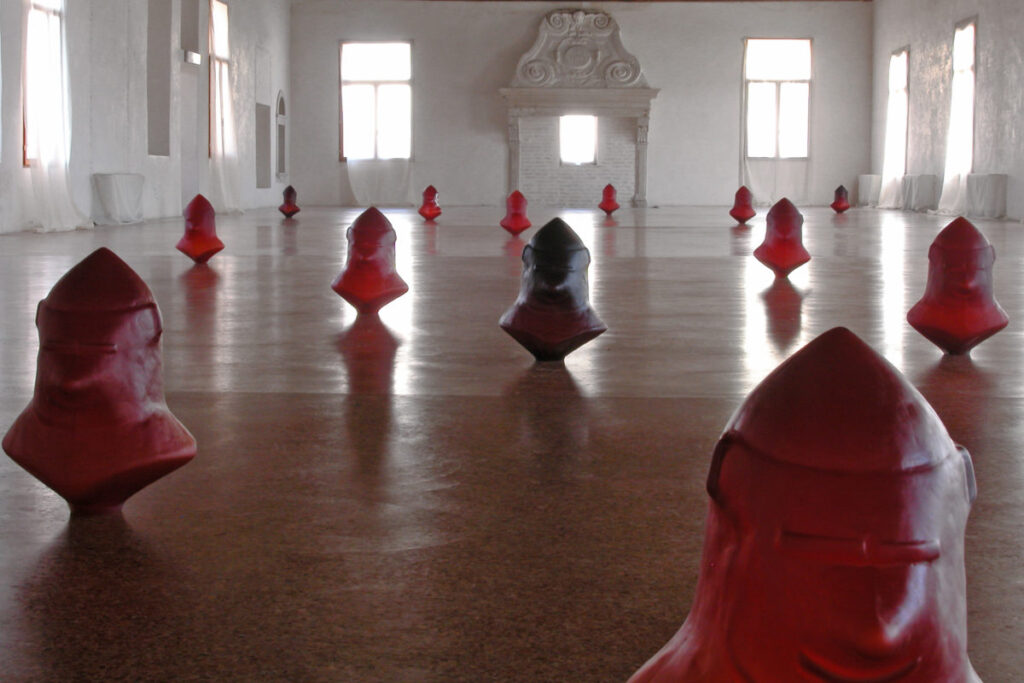
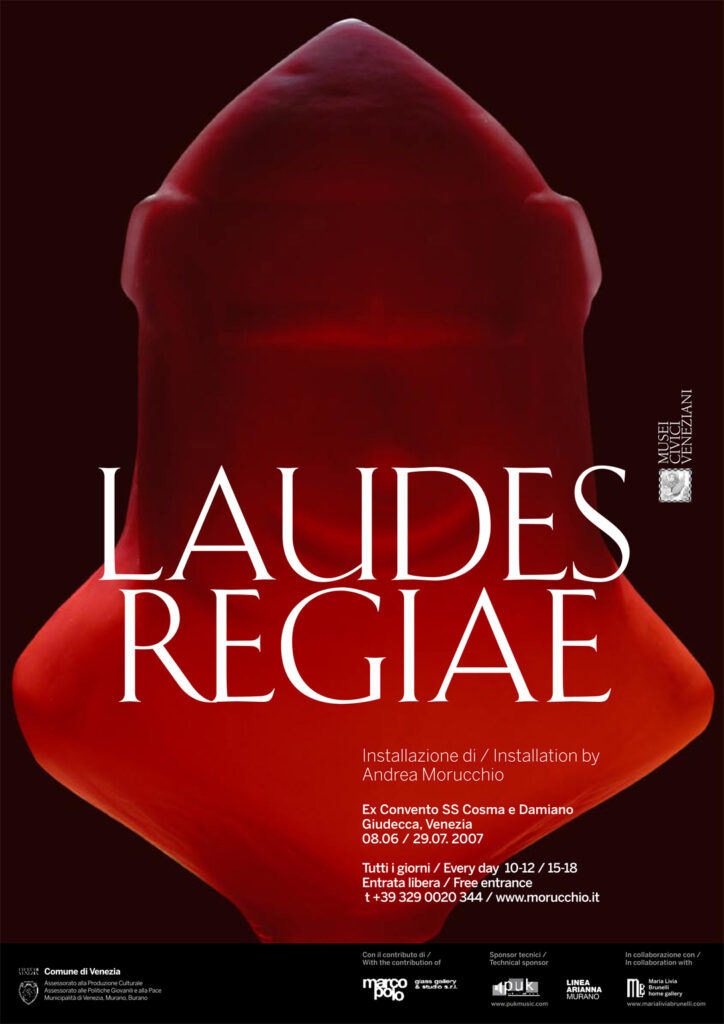
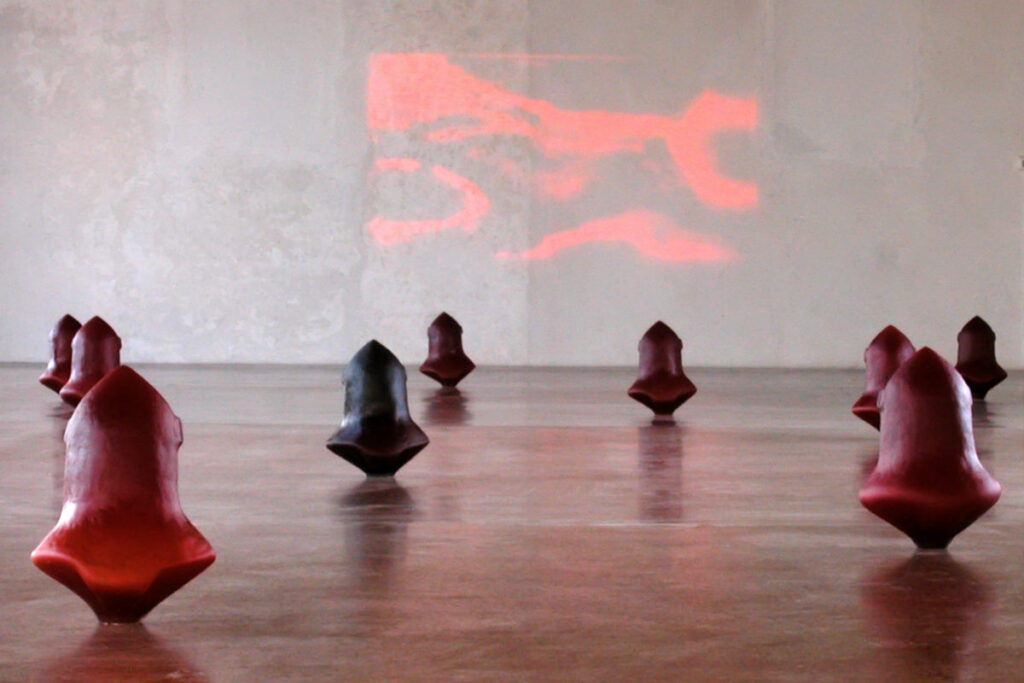
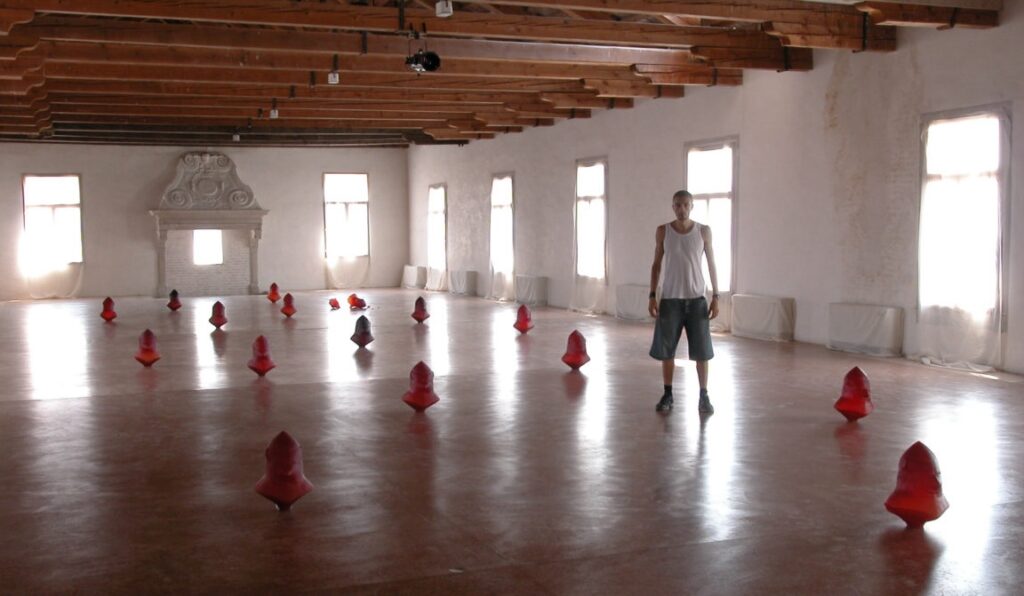
ANDREA MORUCCHIO’S LAUDES REGIAE (2007) IS AN INSTALLATION THAT BRIDGES HISTORY, SPIRITUALITY, AND CONTEMPORARY SOCIO-POLITICAL THEMES. PRESENTED IN THE FORMER CONVENT OF SANTI COSMA E DAMIANO, THE WORK FEATURES 17 FROSTED BLOWN-GLASS HELMETS INSPIRED BY A 14TH-CENTURY celata/SALLET, ALONG WITH PROJECTED IMAGERY OF THE WOLF OF PASSAU—AN EMBLEM punched onto certain MEDIEVAL SWORDS—AND AN AUDIO TRACK OF THE LAUDES REGIAE, A LITURGICAL CHANT FROM THE 11TH CENTURY. THE INSTALLATION’S SETTING IS MINIMALIST, ILLUMINATED ONLY BY NATURAL LIGHT FILTERED THROUGH WHITE VEILS, CREATING A UNIFORM AND CONTEMPLATIVE ATMOSPHERE. MORUCCHIO EMPLOYS A REFINED AESTHETIC TO PROVOKE DEEP REFLECTION ON POWER AND ITS HISTORICAL MANIFESTATIONS.
LAUDES REGIAE, 2007, Convento Santi Cosma e Damiano, Venezia
The installation unfolds as “a visually austere, rigorous path of great formal purity,” where past and present, spirituality and secularism are tightly woven together. This minimalism heightens the symbolic force of the helmets—“red helmets that hieratically tear apart the hall”—transforming the space into a site where political and temporal power silently confront each other. The title Laudes Regiae refers to acclamatory prayers used during the coronation of rulers, designed to reinforce the divine legitimacy of sovereign authority. Historically, these chants were sung “to support the earthly power and supremacy of those who were appointed vicars,” exposing how spiritual ritual was mobilized to legitimize power rooted in very earthly interests. Drawing from Kantorowicz’s studies of medieval political theology, the work underscores how these mechanisms have not disappeared but continue to structure contemporary forms of authority.
LAUDES REGIAE, 2007, Convento Santi Cosma e Damiano, Venezia
GIORGIO AGAMBEN’S ANALYSIS OF GLORY AND PUBLIC ACCLAMATION FURTHER ILLUMINATES THIS CONTINUITY: MODERN POWER, LIKE ITS MEDIEVAL COUNTERPART, RELIES ON SPECTACLE, CONSENSUS, AND THEATER—NOW MAGNIFIED BY MEDIA AND TECHNOLOGY. The installation channels this dynamic, revealing the disturbing link between ancient history and contemporary politics. This resonance extends to broader global tensions. Today’s geopolitical scenarios echo earlier intersections of spirituality, ideology, and violence: the critique observes how the rhetoric of justice and moral urgency can justify conflict, recalling that preventive war may “in many ways recallthe Christian Crusades,driven by forms of demagogy not unlike the acclamatory function of theLaudesthemselves.
LAUDES REGIAE | 2007, Convento Santi Cosma e Damiano, Venezia.
AS SARAMICOL VISCARDI WRITES IN THE CATALOGUE several contemporary artists—such as Santiago Sierra with Los Anarquistas or Maurizio Cattelan with La Nona Ora—address these entanglements of power and ritual, Morucchio engages them through a dialogue with classical art and regional historical imagery. This approach elevates the work beyond direct political commentary: It is the reference to classical works of art and historical imagery… which transforms his works into something beyond a pure criticism of the system. Such a dialogue is central to Morucchio’s artistic language. Works like The Main Show or Le Nostre Idee Vinceranno similarly originate from moments of historical narration, reflecting on the persistent need for martyrs and the cyclical reappearance of ideological conflict. In Laudes Regiae, this perspective crystallizes in the projected figure of the Wolf of Passau—“the symbol of the ars bellica [that] continues running… an ideal link between what we were and what we still are.” Laudes Regiae shows how modern democracy remains deeply entangled with the dramaturgy of power. Through the interplay of ritual sound, historical symbols, and refined formal restraint, the installation reveals political authority as an ongoing system of representation, in which acclamation, visibility, and spectacle continue to play decisive roles.
LAUDES REGIAE, 2007, Convento Santi Cosma e Damiano, Venezia
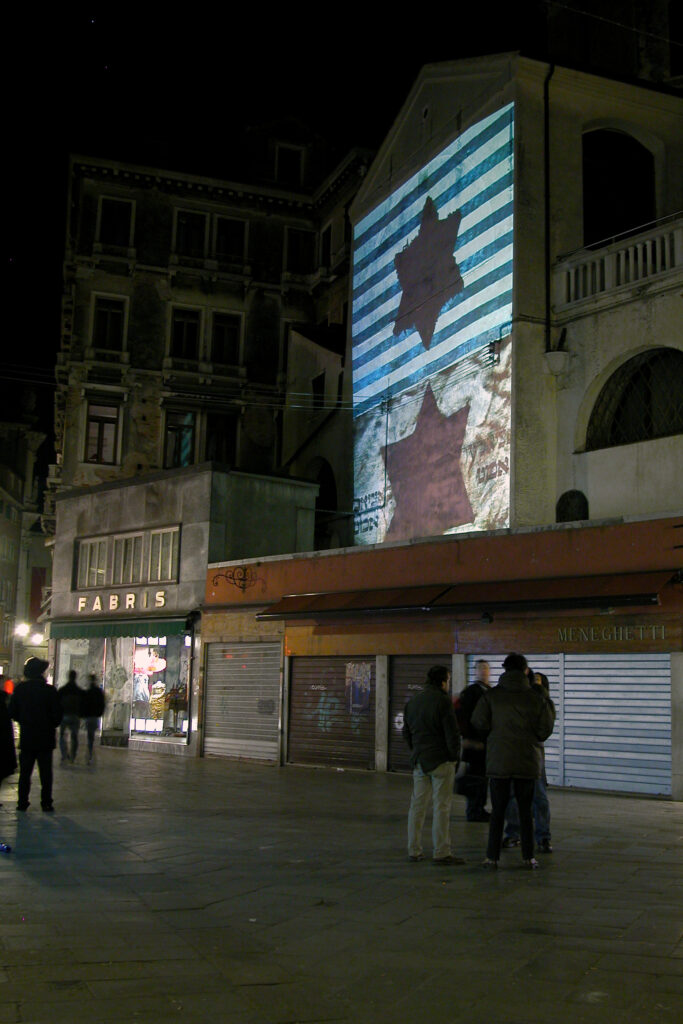
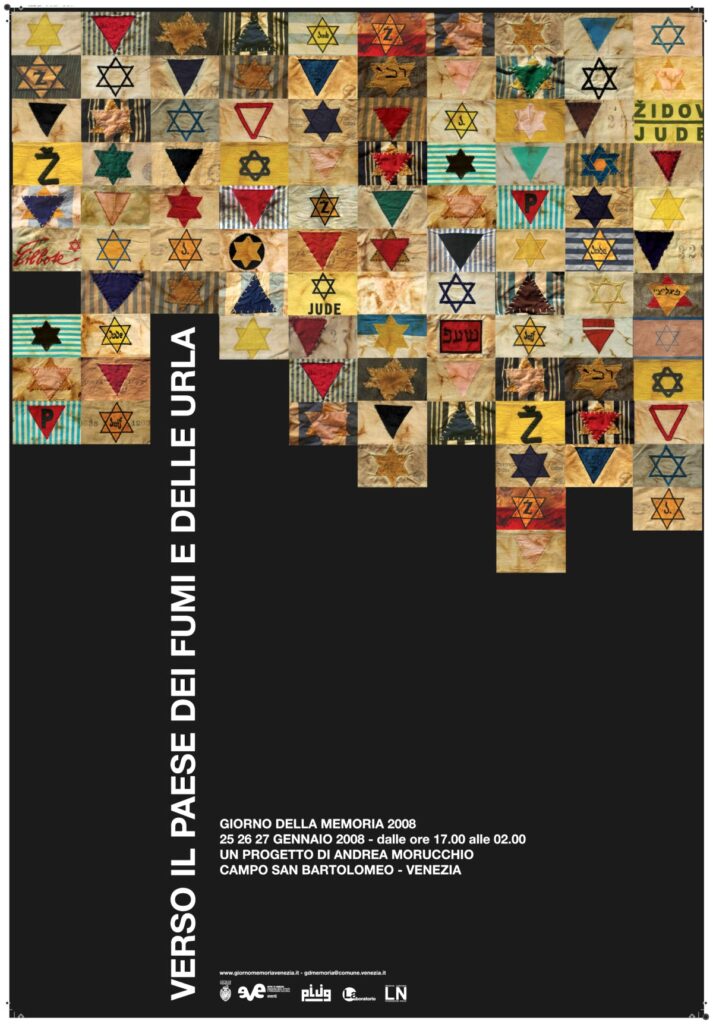
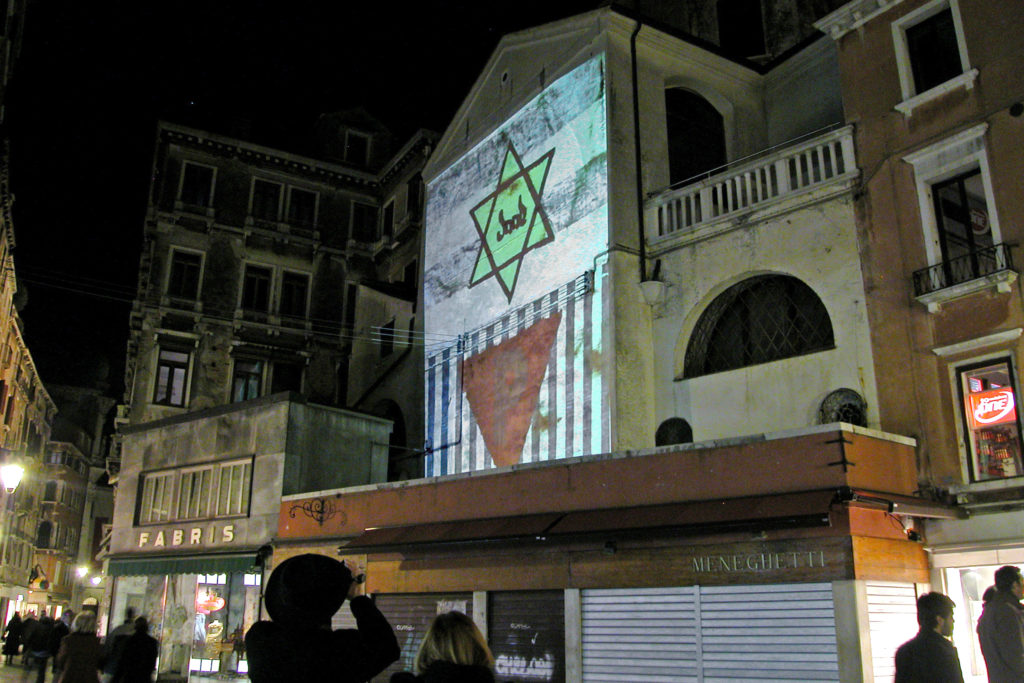
Conceived for Shoah Remembrance Day and commissioned by the Municipality of Venice, VERSO IL PAESE DEI FUMI E DELLE URLA, Towards the Land of Smoke and Screams (2008) is a public art project by Andrea Morucchio that confronts collective memory through direct engagement with the urban fabric of Venice. The project unfolded through three interconnected components: a public video–sound installation in Campo San Bartolomeo, the posting of 200 posters across the city, and the distribution of 5,000 postcards featuring a text by Gadi Luzzatto Voghera. Together, these elements created a dispersed and pervasive presence, integrating historical reflection into the rhythms of everyday life.
At the core of the project is a double slide projection composed of photographic images of the identifying symbols sewn onto the clothing of Nazi concentration camp prisoners: Stars of David and colored triangles used to mark Jews, homosexuals, political prisoners, Roma, and other persecuted minorities. The soundscape, diffused through downward-facing speakers, is drawn from Luigi Nono’s Die Ermittlung, composed for Peter Weiss’s theatrical investigation into the interrogations of Nazi defendants at the Frankfurt trial.Through extensive online research, Morucchio sourced high-resolution color photographs of fabric fragments—scraps of cloth and armbands bearing these symbols, often circulating today as collectible objects. Seen in close-up, their textures, chromatic intensity, and meticulous stitching can initially appear visually compelling. This attraction is immediately disrupted by a profound sense of shock, as the viewer becomes aware of the historical violence inscribed within these artifacts.
By reassembling these symbols as readymades—across projections, posters, and postcards—Morucchio constructs a minimal yet powerful allegory of absolute evil, treating it not as a closed chapter of history but as a persistent and unresolved presence. Conceived as a form of urban visual communication, the project adopts the strategies of attraction and immediacy typical of contemporary media, only to subvert them through critical revelation. As Luzzatto Voghera observes, these stars and triangles are not black-and-white images of the past, but a colored patchwork of contemporary memory. Toward the Land of Smoke and Screams invites viewers to pause and reflect on the enduring power of symbols, and on the ease with which mechanisms of exclusion, racism, and discrimination can resurface—making remembrance not a ritual of the past, but an urgent ethical responsibility in the present.
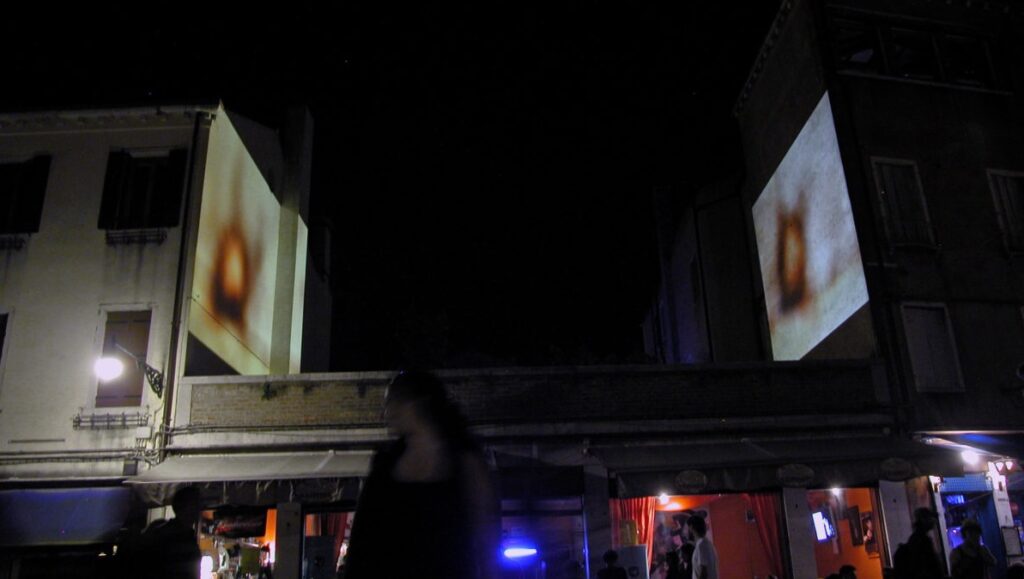
that same year morucchio once again engaged with a work of VIDEO public art, tracciati esistenziali / EXISTENTIAL PATHS (2008) Conceived for C_art. Artisti in Campo, the public art intervention featured a double video projection on the façades of two buildings overlooking Campo Santa Margherita. The work consists of blurred sequences depicting a continuous, cyclical motion—small dark forms rotating over a luminous background, converging around an empty center. At intervals, the images briefly sharpen, revealing the nature of the dark forms: ants, tirelessly moving in circles, a metaphor for our thoughtless, externally directed paths of existence.
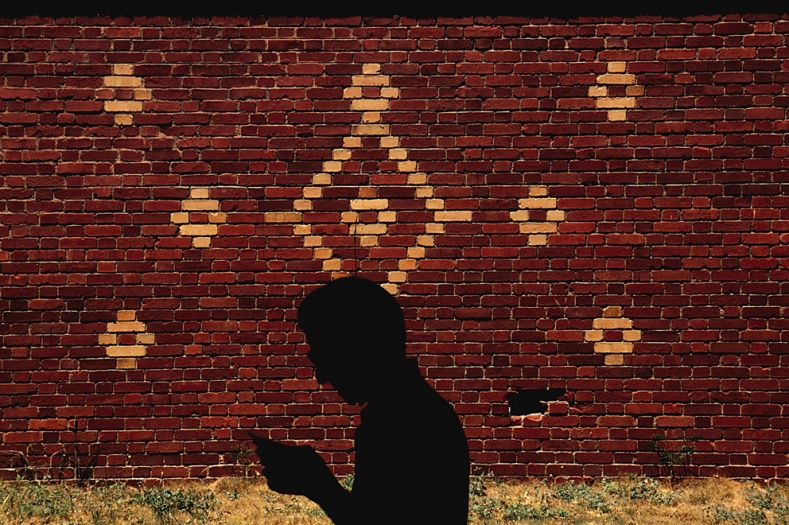
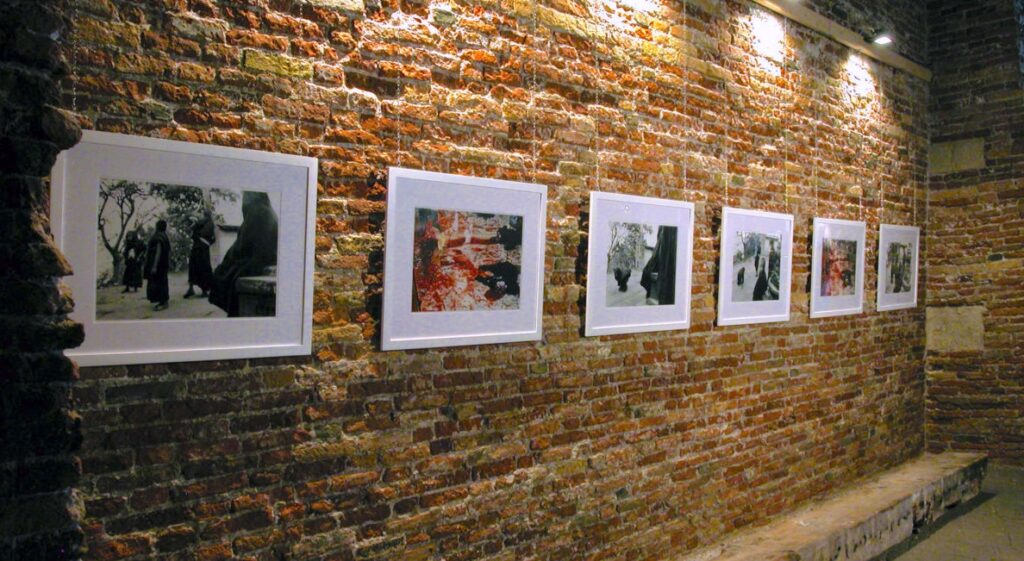
Photography has remained a central medium in Morucchio’s artistic practice; since the 1990s, much of his work has developed from extended stays in Cuba, Nepal, and closer to home, where his ability to empathize deeply with different contexts allows his images to suggest narratives—real or imagined—beyond the single frame. His approach balances emotional engagement with formal rigor: a precise sense of composition, strong visual organization, and expressive use of color often lend his works an almost painterly quality, while never abandoning the essential photographic link to reality.
EL LECTOR | CUBANOSseries, Santiago de Cuba | 1995, print from slide 24×36, ed. of 7.
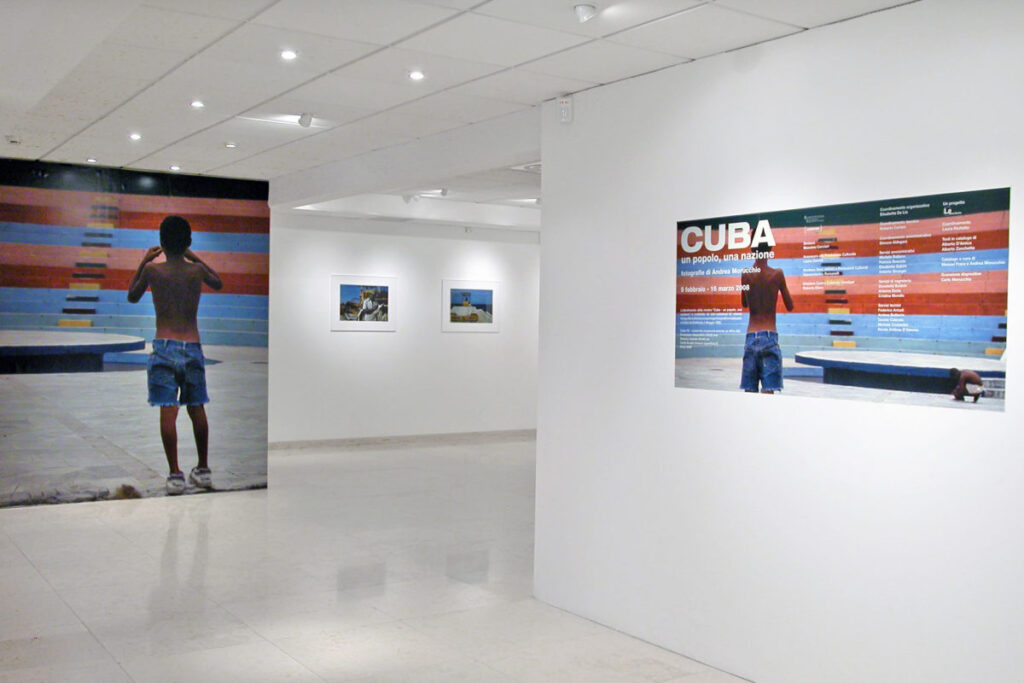
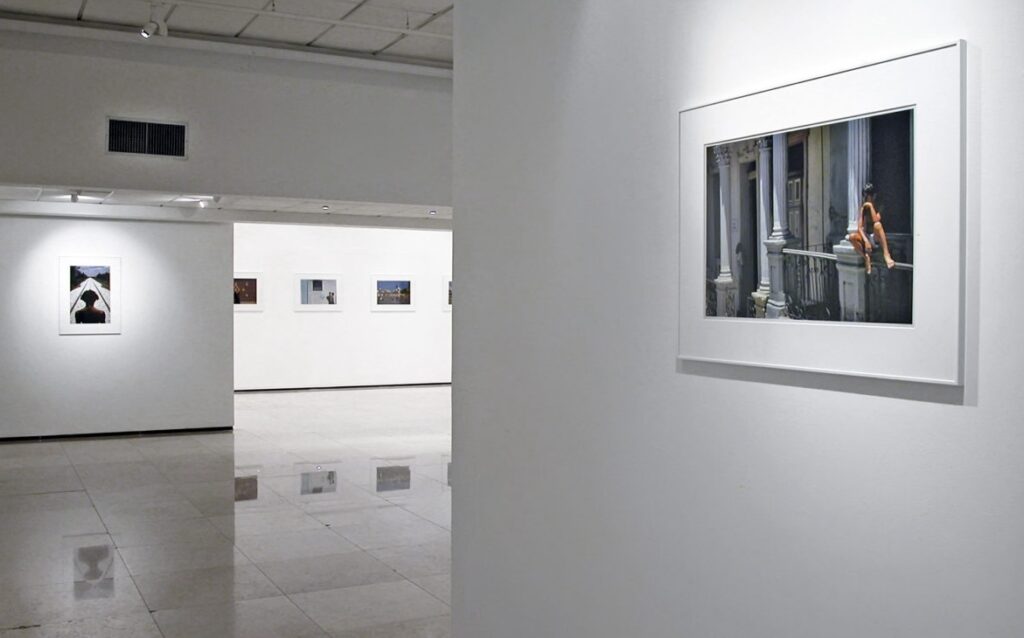
This vision reached a wide audience with his acclaimed solo exhibition CUBA Un Popolo Una Nazione / CUBA A People, A Nation (2008), presented at the Candiani Centre, MESTRE, which vividly portrayed the island’s complex and multifaceted daily life. Andrea Morucchio’s solo exhibition marked a milestone in both the artist’s career and the institution’s history. Produced by the Municipality of Venice and inaugurated by Mayor Massimo Cacciari, it was among the most visited exhibitions ever held at the Candiani and one of the largest solo projects realized there, featuring over eighty photographs displayed in the centre’s main gallery.
Drawing on a photographic reportage carried out in Cuba in the late 1990s, Morucchio renders the island’s social and cultural landscape with empathy and precision. As Alberto Zanchetta notes in the exhibition catalogue, for Morucchio photography is far more than a simple means of communication: it is an experiential practice, a “participatory gaze” that establishes a relationship of transmission with the world. Through this humble yet rigorous approach, Morucchio moves beyond the limits of reportage, transforming his Cuban images into a psychogeographic postcard capable of capturing contradictions, dreams, and hopes, and affirming photography as a space of encounter, empathy, and shared presence.
Since 2005, Morucchio has been invited to take part in various group exhibitions of contemporary art with purely photographic works, mostly reportage and Canova sculptures PORTRAITS, created before he began to devote himself to contemporary art. This is rather unusual, considering that by that time Morucchio had already developed a solid body of work explicitly situated within the field of contemporary art. Nevertheless, several curators chose to recontextualize his earlier documentary and sculpture photographs — such as those depicting life in Cuba or Nepal or Neoclassical sculptures “portraits”. — by presenting them in dialogue with contemporary artworks. On a couple of group exhibition occasions, Morucchio presented some Canovian shots:HOLLYWOOD. La Fabbrica dello Spettacolo /The Spectacle Factory (2005) Galleria Contemporaneo, Mestre and ANTI-CORPI (2011) Torre Massimiliana, Venezia.
Within this curatorial framework, even Morucchio’s photojournalistic works transcend their original documentary purpose. They cease to operate merely as factual testimonies and instead unfold as complex visual constructs imbued with layered meanings and conceptual resonance. Detached from their initial temporal and geographical contexts, these images are re-situated within a broader artistic discourse that interrogates and redefines the porous boundaries between documentary practice and contemporary art.
This dynamic becomes particularly evident in a series of collective exhibitions of contemporary art in which Morucchio has participated, presenting photographic prints drawn from his substantial reportage projects on Nepal and Cuba, realized in the latter half of the 1990s AMONG THESE, THE MOST SIGNIFICANT EXHIBITIONS ARE:Open Space Centro Culturale Candiani, Mestre (2006), abbiamo-fatto-bene-ad-uscire Villa di Toppo Florio, Udine (2007) anD MULTIVERSITY S.a.l.e. Docks, Venezia (2008).
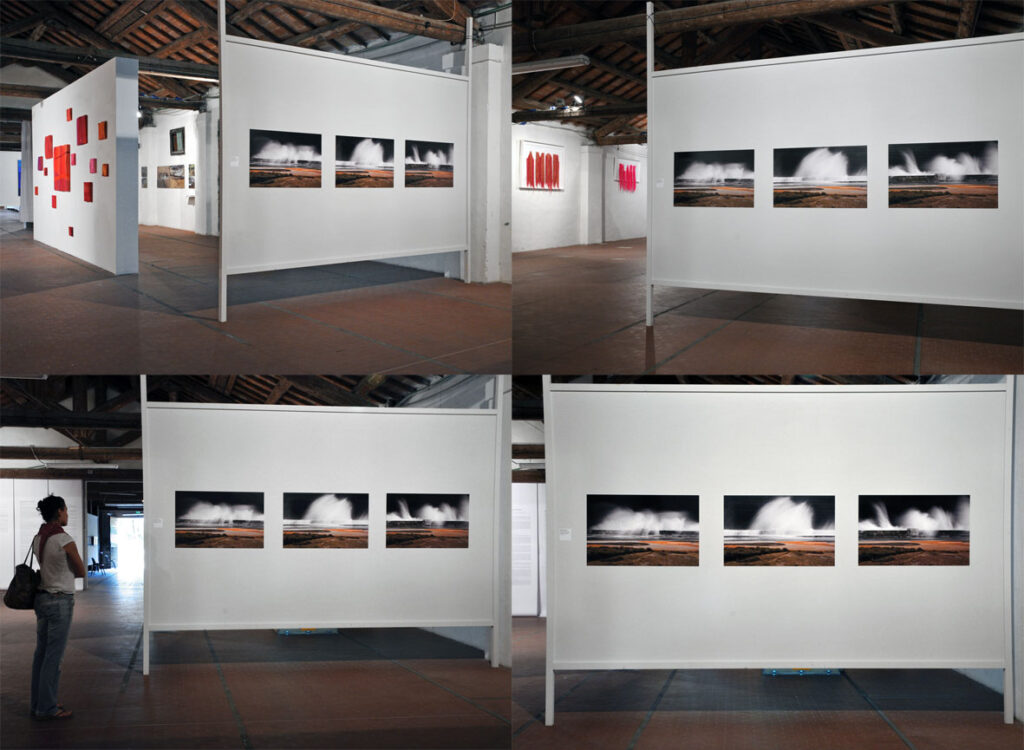
On the occasion of Krossing, Forte Marghera, Mestre (2009) a collateral event of the 53th Venice Biennale curated by Orsola Casagrande , Andrea Morucchio presented his photographic triptychImprovviso terrore mi sospende il fiato e allarga nella notte gli occhi / A sudden terror halts my breath and widens my eyes in the night. Inspired by a verse by POET Camillo Sbarbaro, the triptych captures the Havana seafront during a stormy night, where the sea shifts between water and mist, light and darkness, evoking a moment of suspended perception. As Marina Castrillo notes, “Andrea Morucchio is able to seize ambiguous paths of perception from well-known landscapes such as that along the Malecón – a nighttime picture postcard of Havana, a city of reddish earth, water and air daunting like spirits immersed in an ancestral fury.” In this visual spell — where sound, water, and silence merge — the world begins with the image and ends in the observer, turning Havana’s nightscape into a poetic meditation on vision and transformation.
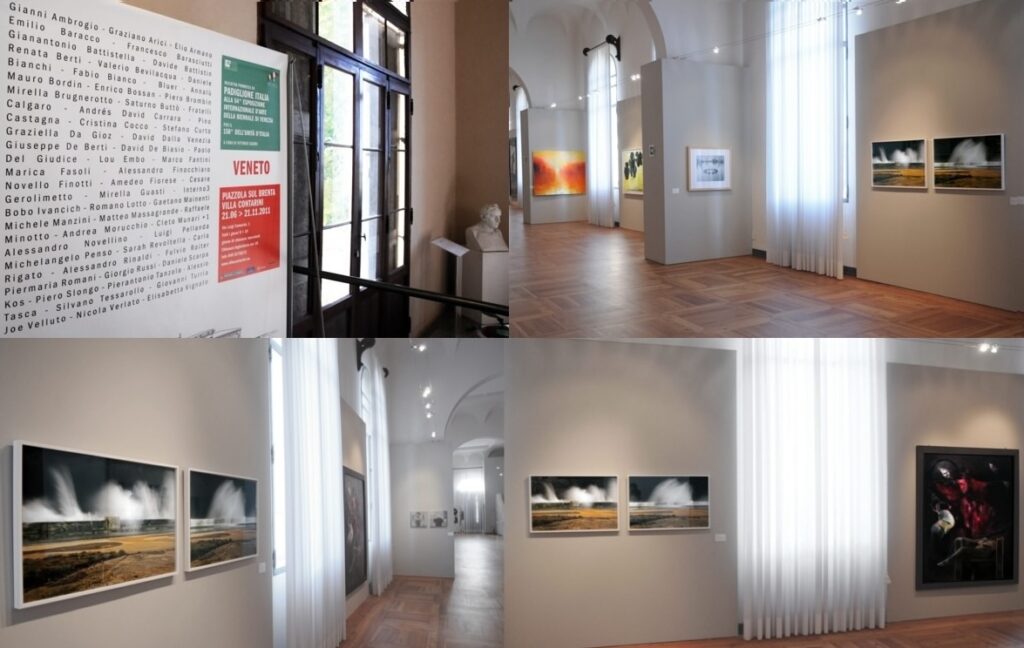
With the same subject, reinterpreted as a diptych, Morucchio also took part in the following Biennale within the controversial exhibition project Lo Stato dell’Arte (2018) — a nationwide initiative of the Italian Pavilion at the 54th Venice Biennale. Selected to represent the Veneto region, he exhibited the diptych at Villa Contarini. The curatorial concept behind the Veneto Pavilion, as part of the broader Italian Pavilion, focused on contemporary artistic production in Italy from 2001 to 2011.
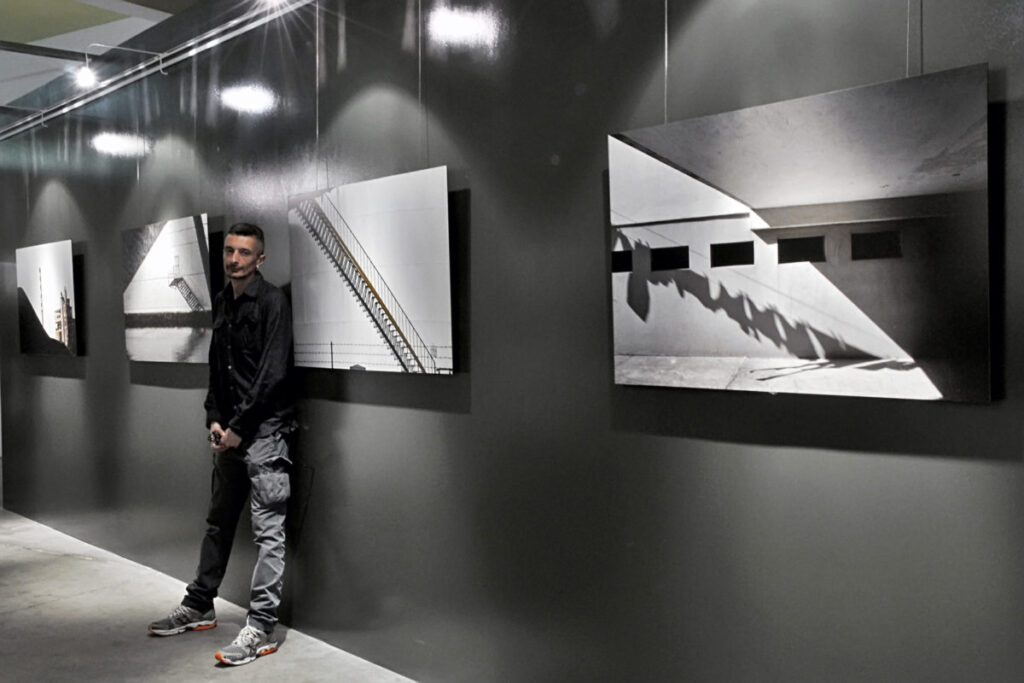
At the same time, however, Morucchio has never abandoned his nature as a pure photographer. Over the following years, he continued to explore photography in its most direct and autonomous form, presenting a series of solo exhibitions devoted entirely to the medium. Among these, Cuba: Un Popolo, Una Nazione stands out as a project firmly rooted in the reportage tradition. Other exhibitions by Morucchio are devoted to urban and industrial landscape photography — beginning with his participation in the first edition of MIA Milan Image Art Fair (2011) and continuing, within the same thematic framework, through a series of group shows such as GLOCAL (2012) CANDIANI, MESTRE, Enjoy the Silence (2012) shots gallery, bergamo, ἘΚΛΕΚΤΙΚΌΣ / EKLEKTIKOS (2013) BAG Art photo gallery, Pesaro, IMMAGINE (2014) GALLERIA MICHELA RIZZO, VENEZIA, VenetianS Galleries & Photography (2015) CASA DEI TRE OCI, VENEZIA, RomA (2022) NOEMA GALLERY, Roma.
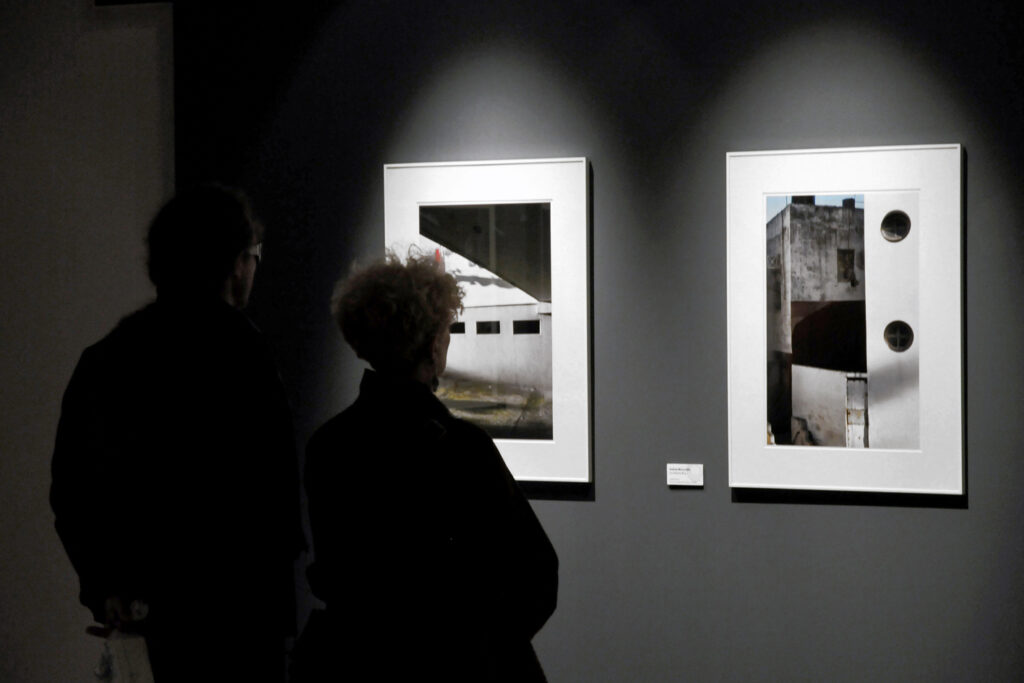
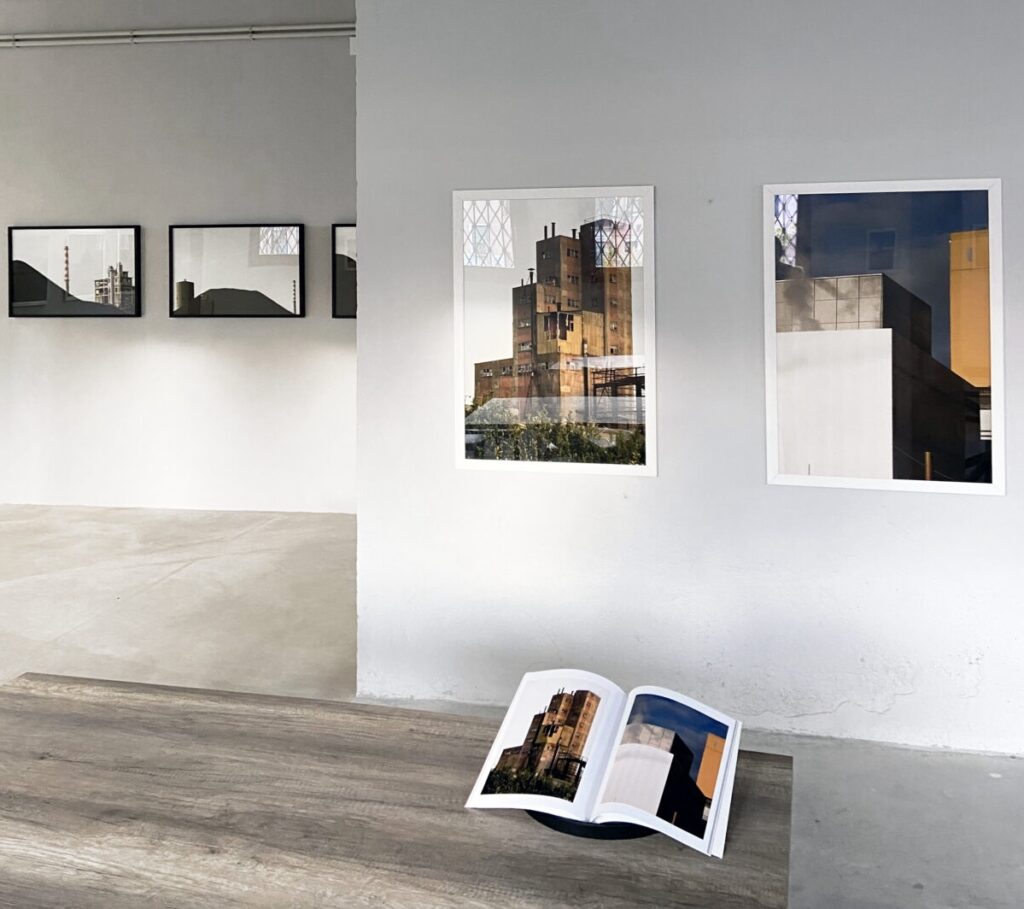
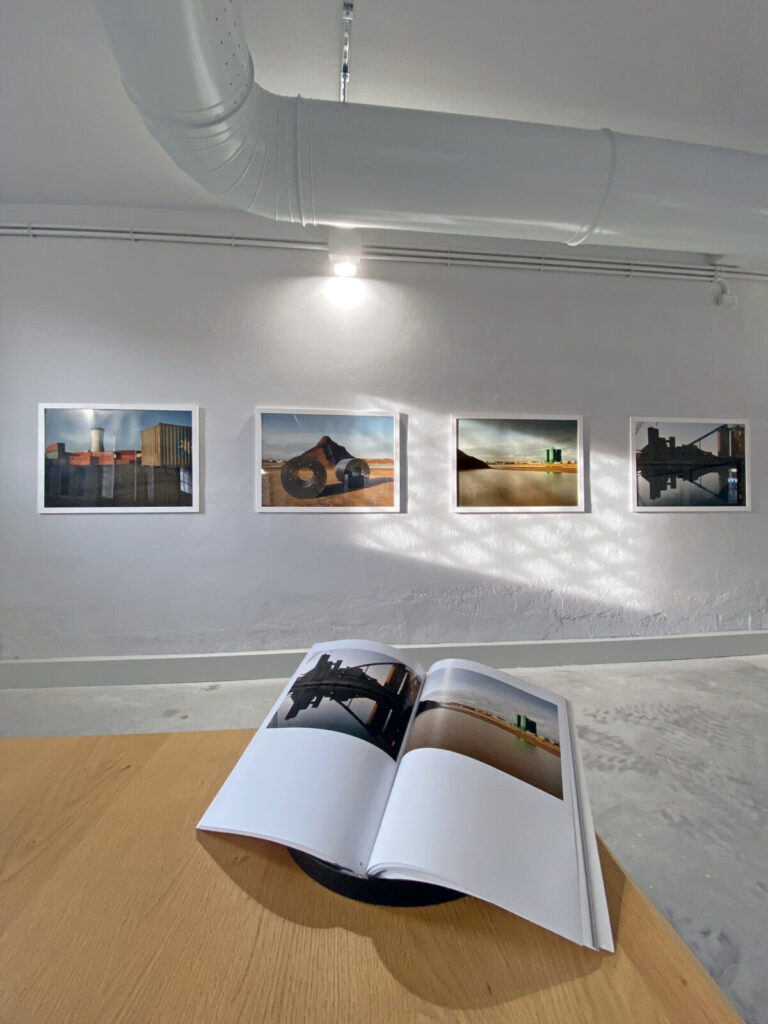
in 2014, Andrea Morucchio also participated in a group photography show IMmAGINE, at the Michela RizzoGallery in Venice. the exhibition brings together the viewpoints of four photographers who investigate the landscape and contemporary architecture. Hamish Fulton, Mauro Ghiglione, Francesco Jodice and Andrea Morucchio show their personal visual journeys which wind their ways through places of their daily lives that move on to an exploration of the reality of environmental and industrial landscapes. For this exhibition project, Morucchio traces his itinerary through the outskirts and “no-progress” zones of the industrial area of Porto Marghera, Venice, presenting a triptych from his PTM Project.
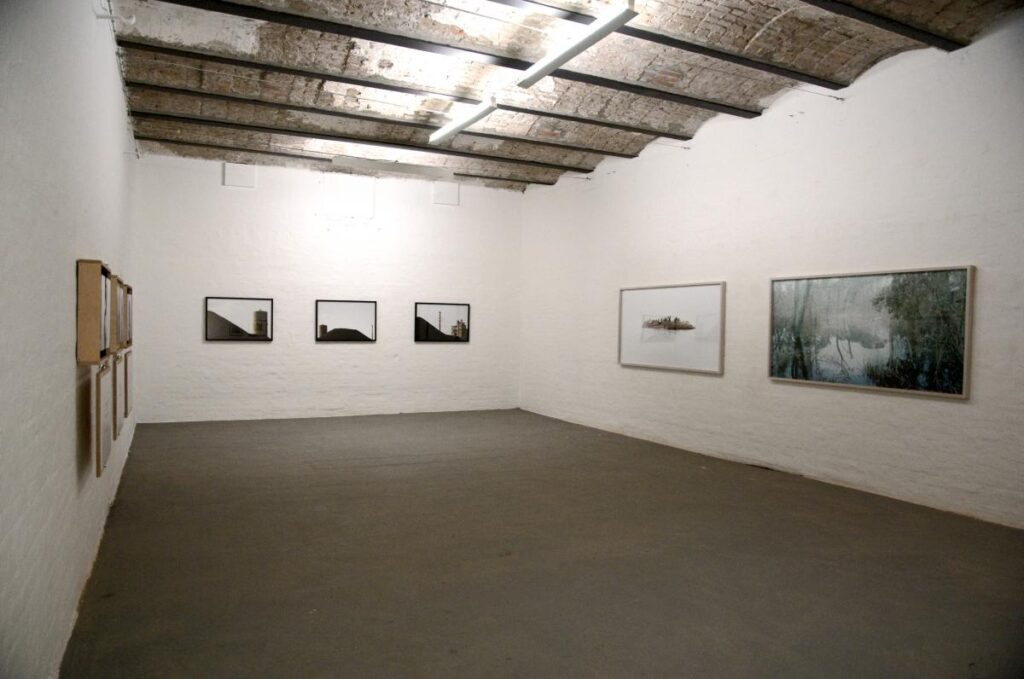
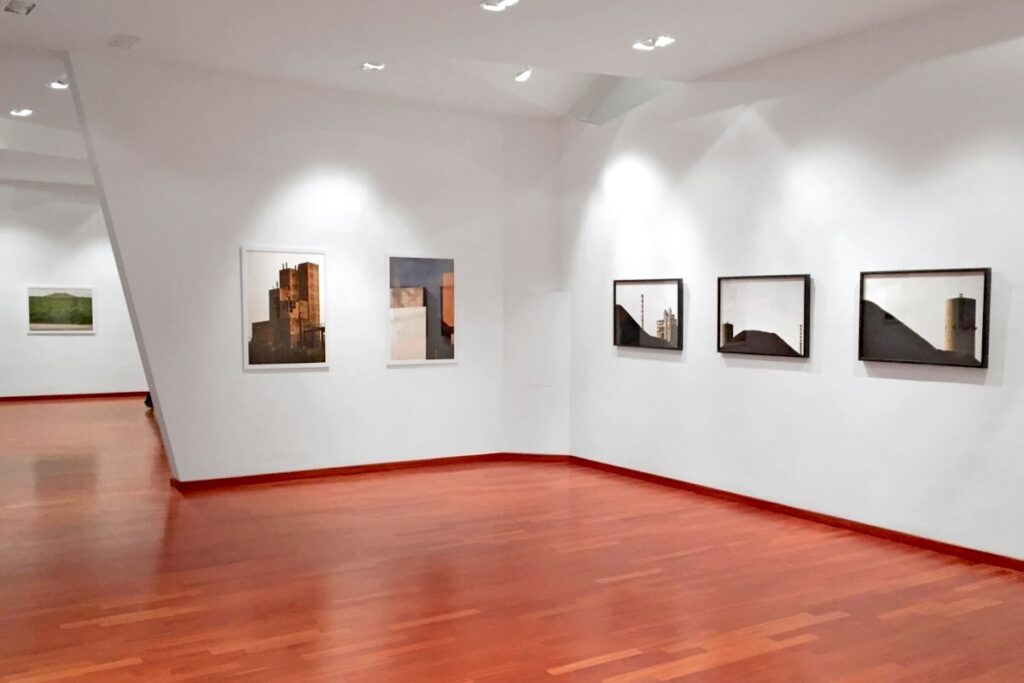
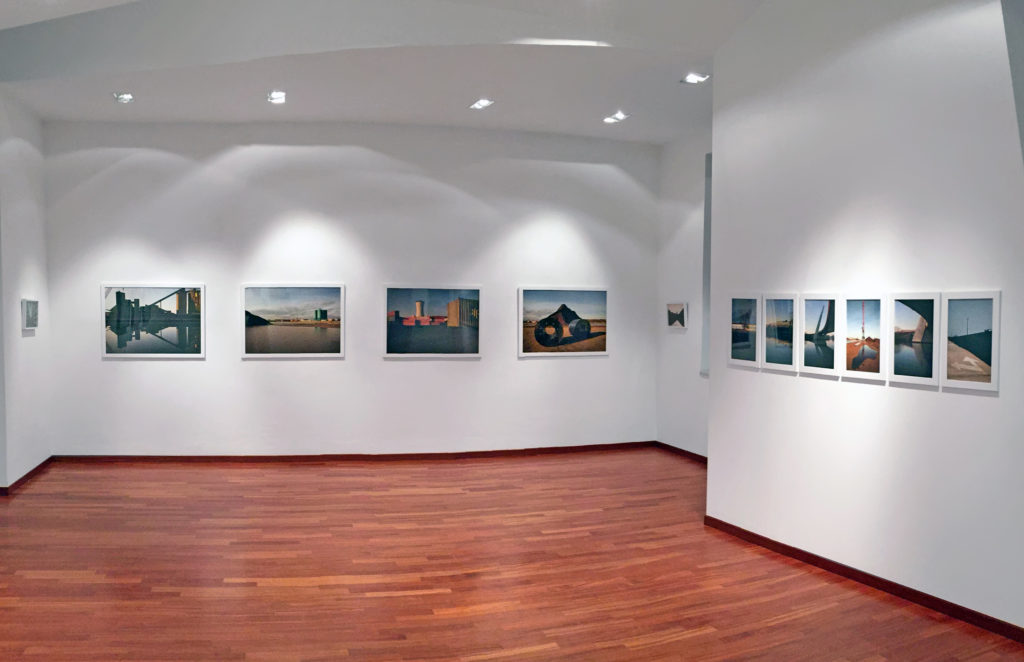
This line of research culminated in the artist’s two solo exhibitions focused on the industrial landscape of Porto Marghera: PTM Project – Porto Marghera: Fermo Immagine (2017) MUPA Museo del Paesaggio, Torre di Mosto and L’estetica del tempo sospeso (2024) Docks Cantieri Cucchini, Venice. In these projects, photography functions as a tool of critical observation and temporal sedimentation, capable of conveying the layered complexity of a territory emblematic of industrial and post-industrial modernity.
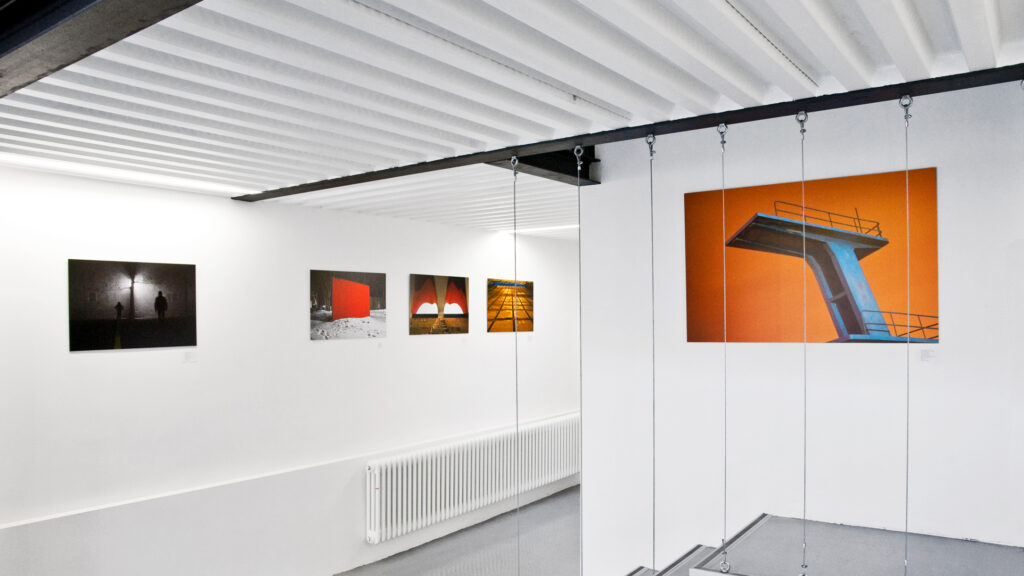
In a number of other solo photography exhibitions, Morucchio blends the genres of reportage and landscape, resulting in Visually striking and eclectic exhibition setup. In these projects, the documentary image opens onto a broader and more layered dimension, where the observation of reality intertwines with a conscious formal construction and a reflection on the exhibition space itself. Significant examples include Endless Journey (2013), Modern Gallery, Stockholm, Ant(rop)ologica (2013) rossosegnale, milano, and I AM – Andrea Morucchio Fotografia(2016) Galleria talenti, portobuffolè. Together, these exhibitions convey the eclectic nature of his photographic research and his ability to move across genres and visual codes without adhering to fixed or univocal definitions.
ANT(rop)OLOGICA| 2013, Solo Show | 3001Lab Rossosegnale, Milano.
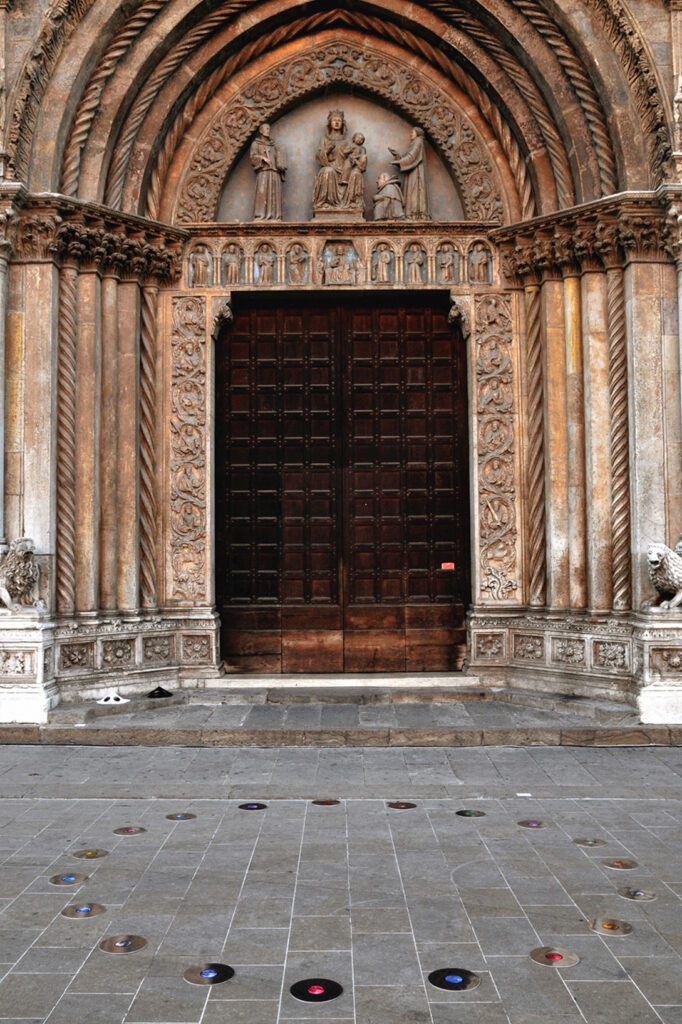
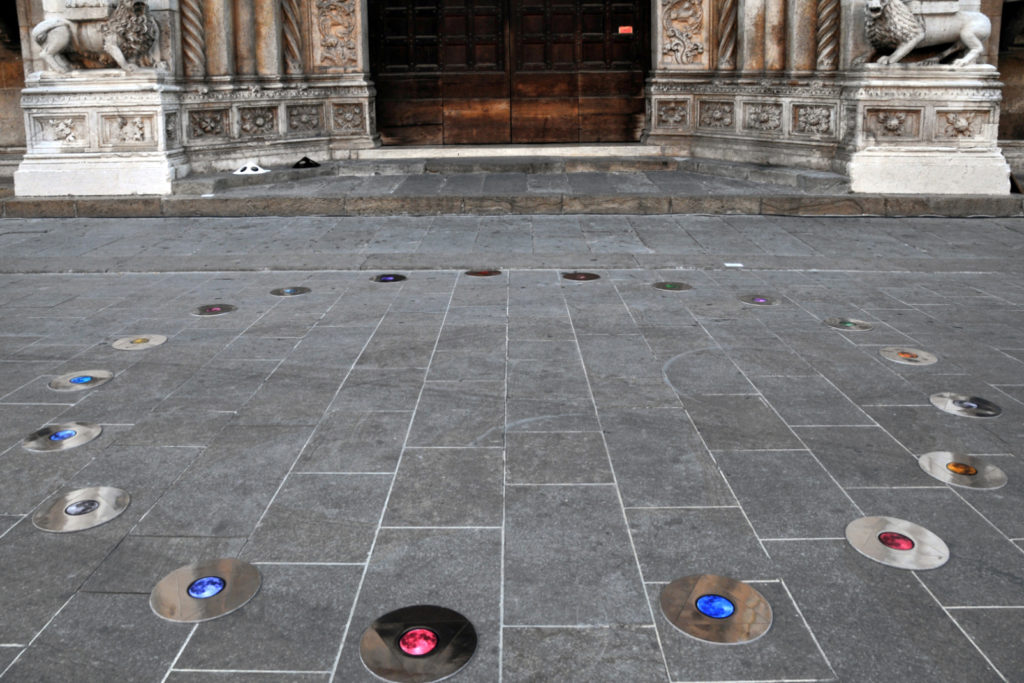
EFFIMERO. Sistemi di contemporaneo (2009) CURATED BY ALBERTO ZANCHETTA invited a group of artists to reinterpret Bruno Munari’s Aconà Biconbì modular structure. Each artist received the same set of modules, transforming them into a unique site-specific installation temporarily placed in Piazza San Lorenzo, Vicenza. Andrea Morucchio’s “moon landing” took place there on July 20, 2009, with his installation DISCO MOON, created in homage to the 40th anniversary of the so-called “first landing on the Moon” — for those persuaded that it actually occurred. For Morucchio, that historic event belongs less to factual history than to the realm of collective imagination. His work thus became not a commemoration, but a reflection on belief, myth, and perception. Revisiting Munari’s Aconà Biconbì structure, Morucchio created a constellation of nineteen circular elements made of cardboard, wood, and photographic prints—moons set into silver discs and arranged radially across Piazza San Lorenzo.
DISCO MOON| EFFIMERO. Sistemi di contemporaneo | 2009, Piazza San Lorenzo, Vicenza.
Suggesting orbiting spheres, they reflected both the sky and the ornate façade of the adjacent temple, merging the cosmic and the earthly in a single luminous gesture. As the artist explains, DISCO MOON sought to trigger iconographic short-circuits between Catholic and pagan symbols, evoking the origins of religious sentiment while questioning humanity’s fascination with celestial forces and their supposed influence. As zanchetta writes More than a tribute to space exploration,DISCO MOON emerged as a meditation on the circle as a timeless symbol—at once cosmic and spiritual, Platonic and ritual.Here, it is not destiny inscribed by the heavens, but the presence of the passer-by that animates the work. Through reflection and movement, Morucchio transformed Piazza San Lorenzo into a sacred threshold, a temenos where art, belief, and perception converge.
DISCO MOON | EFFIMERO. SISTEMI DI CONTEMPORANEO | 2009, Piazza San Lorenzo, Vicenza.
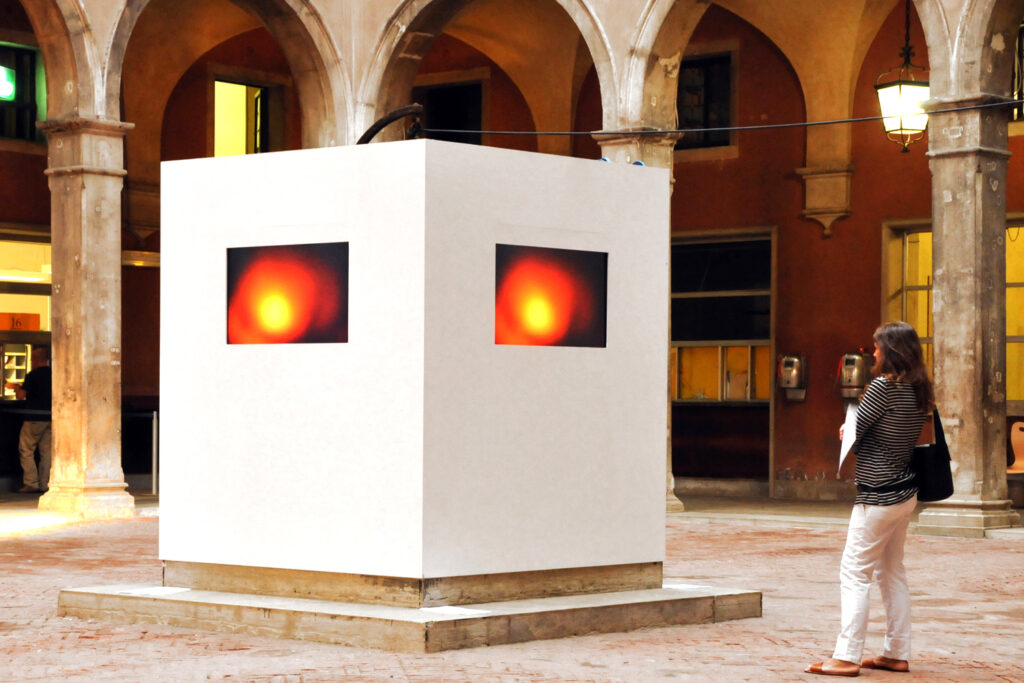
PULSE RED (2009) is a video installation by Andrea Morucchio, conceived for OUTDOORS project. Installed in the courtyard of the Fontego dei Tedeschi in Venice, the work consists of four video monitors embedded in white wooden panels forming a glowing rectangular structure. Each monitor displaying footage from Morucchio’s PULSE RED (2004). According to curators Conti and Musella, PULSE REDestablishes direct communication between artist and public, functioning as a public art intervention rather than a mere installation.
PULSE RED | OUTDOORS | 2009, Fontego dei Tedeschi, Venezia.
It operates as a “meta-piece,” where every visual element refers back to a specific creative moment; The work revisits Morucchio’s 2004 action at Punta della Dogana, where a red light beam was projected toward the golden globe atop the Dogana da Mar, symbolically questioning boundaries and media communication. PULSE RED was “reinterpreted” at the Fontego dei Tedeschi—then still the headquarters of Venice’s Central Post Office and soon to be closed for its conversion into a luxury shopping mall for tourists. As the last artistic intervention before this transformation, the work acquires a heightened socio-political resonance. The GLOBE red pulse becomes, IN THIS CONTEST, an alarm signal, reflecting on the processes of privatization, touristification, and the broader cultural metamorphosis of Venice.
PULSE RED | OUTDOORS | 2009, Fontego dei Tedeschi, Venezia.
♣ 2 0 1 1 – 2 0 1 5 ♣
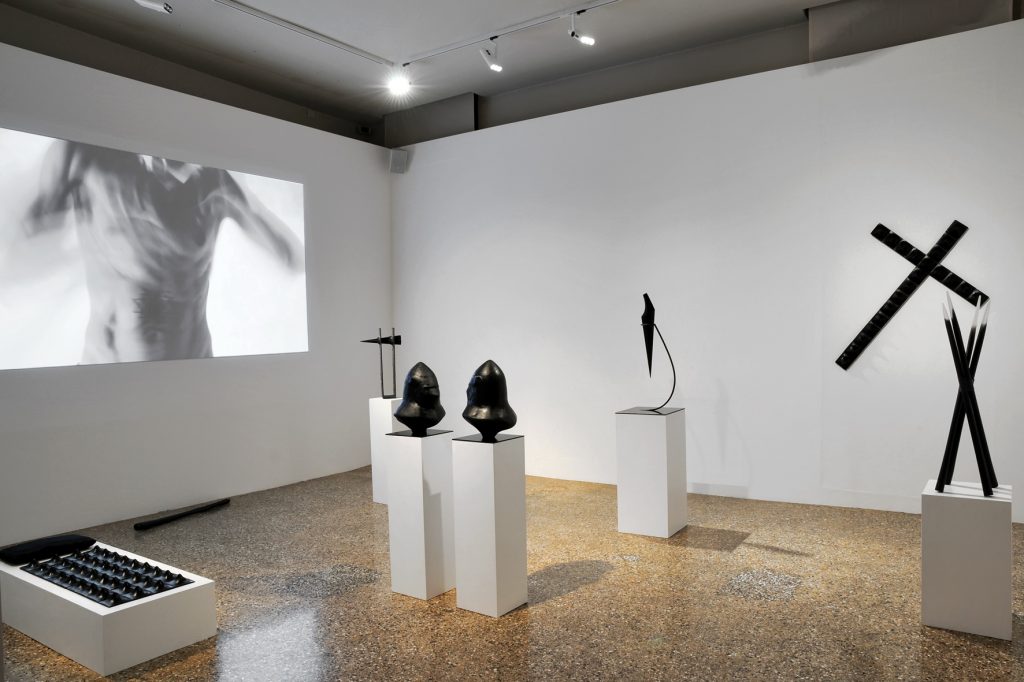
Presented in September 2011 during the Venice Biennale, Back in Black stands as one of Andrea Morucchio’s most significant solo exhibitions. Hosted at Ca’ Pesaro – the International Gallery of Modern Art in Venice – the show coincided with a major retrospective of Pier Paolo Calzolari, establishing a striking dialogue between contemporary visions. Conceived as an anthological overview of the artist’s first decade of practice, Back in Black gathered sculptures, prints, and videos under a single unifying principle: the color black.
BACK IN BLACK|2011, Ca Pesaro, Musei Civici, Venezia.
As curator Stefania Portinari observes These fetish-presences – ascetic and essential – move toward a ground zero of vision,” synthesizing the artist’s exploration of form in monochrome black. After photography and journeys to places “where black is the brilliant background – deep and unknown,” Morucchio returned to sculpture and installation, to what Portinari calls “an opaque and seductive black; polished; the almost medieval spirit of many of the works bordering on a menacingly defiant appearance and a fragility declared through the specificity of glass.
BACK IN BLACK |2011, Ca Pesaro, Musei Civici, Venezia.
This exhibition unfolds as a meditation on darkness as resistance and revelation. Works such as B[æ]d Time confront memory and violence, while Cross Shoots, Celata, Blade, and Accumulo explore fractured identity and the dual nature of glass as both weapon and wound. As Portinari notes, black here becomes “the absence of color, pure signifying form, infernal color but also magical, generating protean chaos from which everything originates.” In this sense, Back in Black operates as an alchemical passage: a return to matter, to darkness, to the origin of form itself.
BACK IN BLACK |2011, Ca Pesaro, Musei Civici, Venezia.
Anticipating the turbulence of the coming decade—war, crisis, populism, ecological collapse, and media spectacle—Morucchio’s “return to black” reveals an artist attuned to the shadows of the contemporary. Its radical chromaticism resonates today with renewed urgency, inviting viewers to confront darkness not as void, but as the threshold of transformation.
BACK IN BLACK |2011, Ca Pesaro, Musei Civici, Venezia.
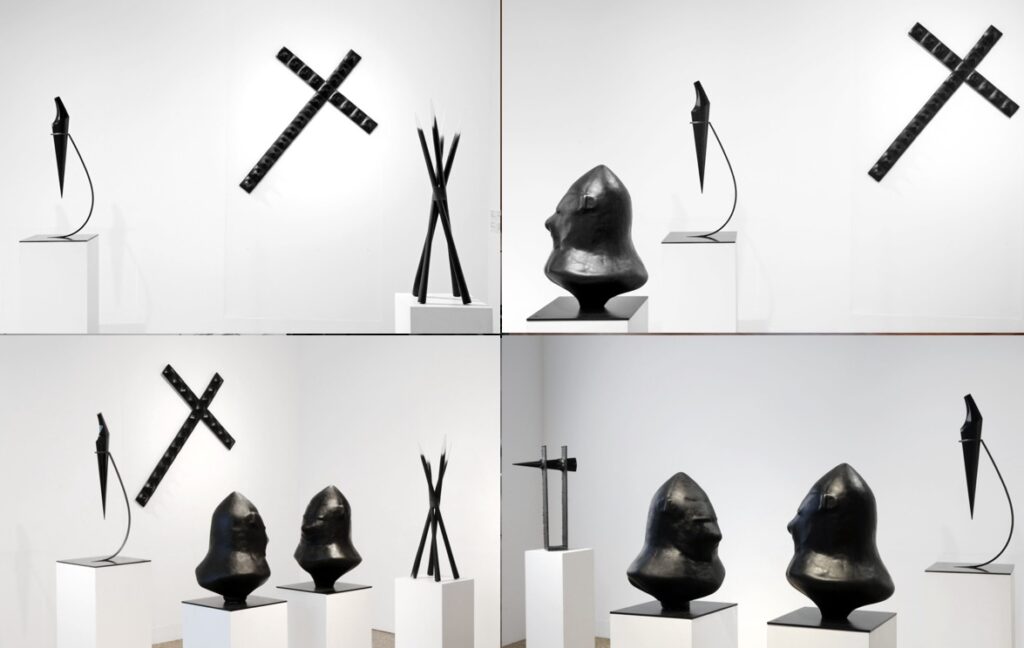
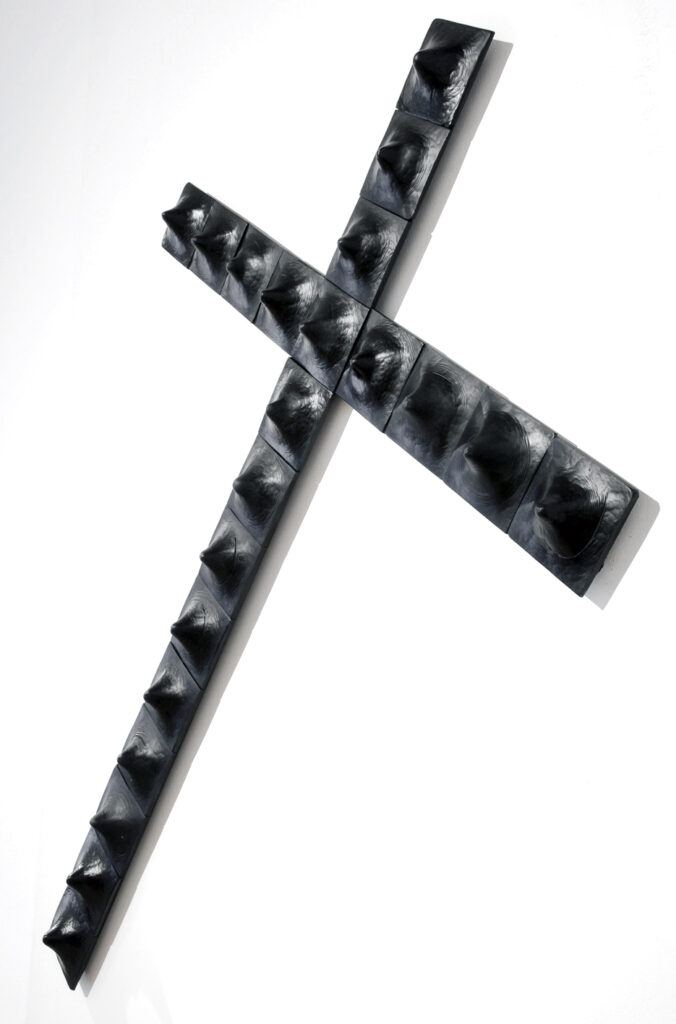
A significant part of the works presented in the exhibition were created specifically for this project. Among the pieces featured in Back in Black, one of the most visually striking is the wall sculptureCROSS SHOOTS (2011) composed of black frosted and molded glass elements mounted on a wooden cross structure installed diagonally on the wall. Morucchio reinterprets this ancient and universal form as a reflection on the loss of direction and symbolic certainty in contemporary life. Rather than reaffirming the stability of the cross as a sacred symbol, Cross Shoots questions its meaning in a world where traditional points of reference have become unstable.
CROSS SHOOTS | 2011, 21 cast, ground, frosted black glass elements, painted wood, 150x92x7 cm.
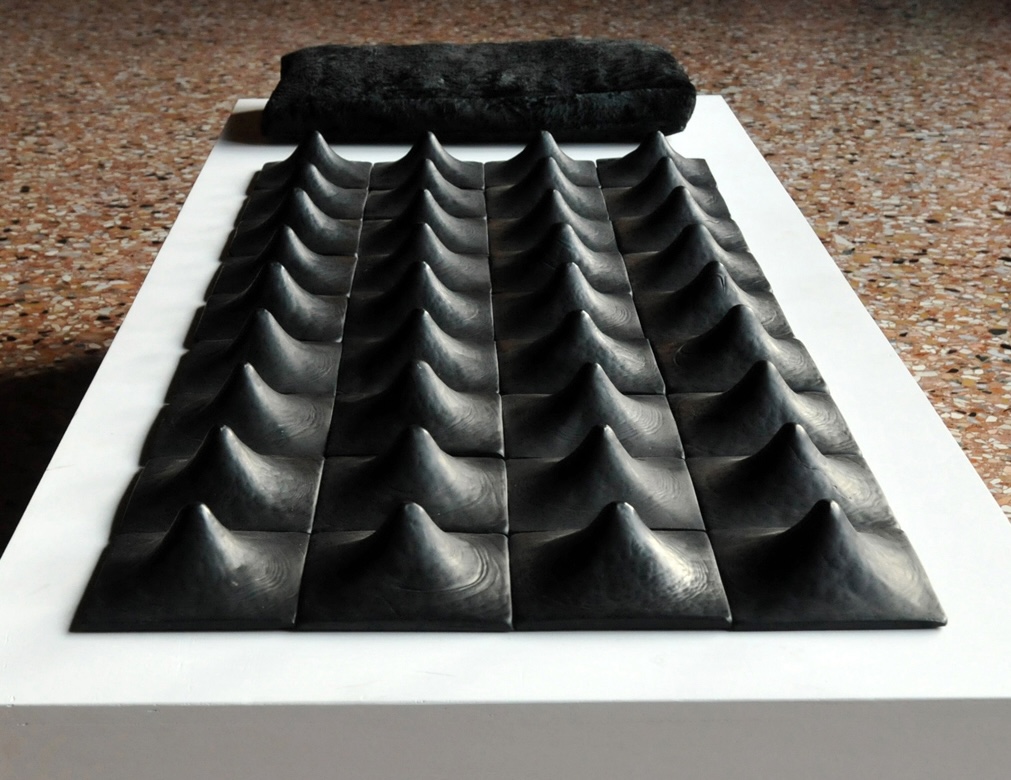
Also on display is B[æ]d Time, (2011) perfectly embodies the spirit of the project, in which black functions as both a material and a metaphor—an exploration of opacity, density, and psychological depth. The work’s ironically allusive title plays on the phonetic overlap between “bad” and “bed.” Composed of thirty-six black frosted glass tiles arranged in four rows and accompanied by a black velvet cushion, the piece uses the same pointed glass modules as Cross Shoots, transforming them into a metaphor for discomfort and fragile repose. As Daniele Capra writes in catalogue Morucchio overturns the traditional idea of the bed as a place of rest and intimacy, transforming it into a site of passion, torment, and physical torture. The seductive precision of the object conceals a latent unease, mirroring the overall tone of Back in Black—a reflection on darkness, vulnerability, and the instability of comfort in both material and existential terms.
B[æ]D TIME| 2011, 36 cast, ground, frosted black glass elements, treated velvet pillow, 122x44x5 cm
Celata, a pre-existing work originally presented in fourteen red glass editions within the Laudes Regiae (2007) installation, has been chromatically revised and produced in black glass for the BACK IN BLACK exhibition. Displayed at Ca’ Pesaro as two opposing exemplars, the sculpture draws on the form of the 14th-century sparrow-beaked helmet (Elmo di Attila) from the Doge’s Palace Armoury. The black helmets evoke the archetype of the “black knight,” a figure symbolizing darkness, mystery, and ancestral fear. As Giovanni Bianchi notes, these knights “face each other boldly,” embodying a tension between two identical forces—an encounter that symbolizes the dialectic between the ego and its double. Concealed behind lowered visors, they recall Italo Calvino’s Non-Existent Knight, whose “voice came metallic from inside the closed helmet,” emphasizing presence through absence. Through their austere and essential form, the two blown and satin black glass helmets suspend the viewer in a state of primordial tension—a metaphor for cyclical recurrence, identity, and the perpetual confrontation of opposing forces transcending time and place.
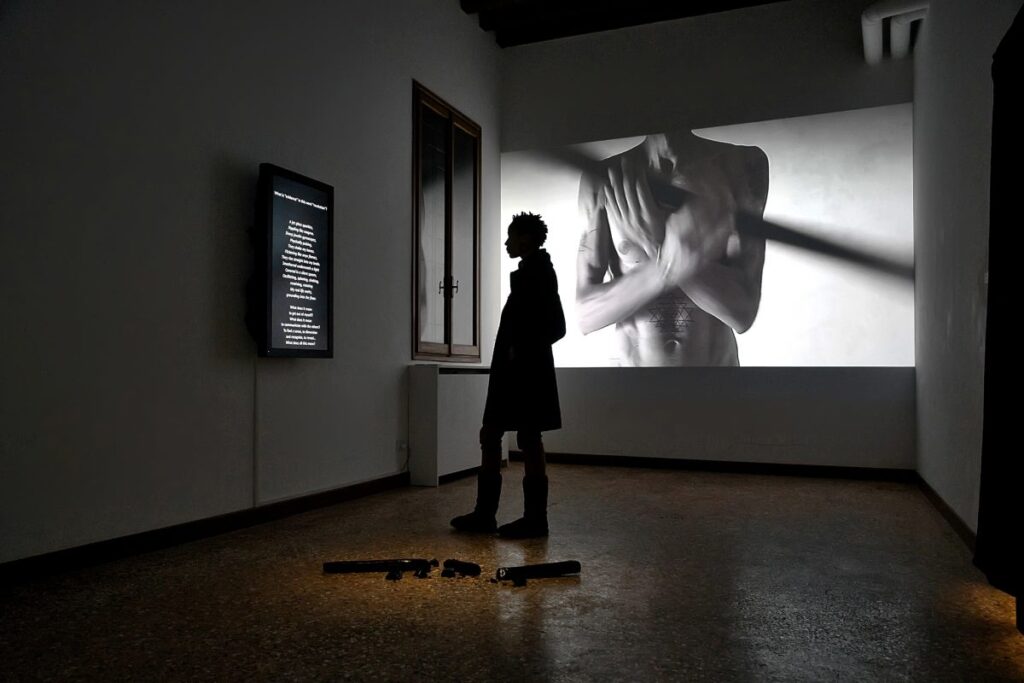
during the first Venice International Performance Art Week – Hybrid Body – Poetic Body (2012) curated by VESTANDPAGE,Palazzo Mora, venezia, Andrea Morucchio presented the video installation RIVOLUZIONI.The work shows the artist rotating a polished glass rod, its rhythmic movement and sound projected out of sync on opposite walls. At the center of the room, the rod lies shattered and illuminated, surrounded by fragments, while Pagnes’ poetic text What is “evidence” in this word “revolution” scrolls on a vertical monitor. Originally created for Morucchio’s 2011 exhibition BACK IN BLACK, the video arose from his desire for a unifying gesture across a decade of diverse works. The simple circular motion of the glass rod embodies an ancestral, ritual movement.
Morucchio reimagined the piece as a site-specific installation, transforming the isolated exhibition space into a multisensory environment where video, sound, text, and fragments interact. The inclusion of Pagnes’ poem adds a lyrical and rhythmic dimension, complementing the physicality of the gesture and reinforcing its conceptual resonance. As Stefania Portinari notes, the rotating rod “alludes to the cosmogonic spinning of the planets” and its cyclic shattering suggests aneternal return, a renewal emerging through the liberation of energy. RIVOLUZIONIthus becomes a meditation on creation and destruction, fragility and transformation, where a simple, instinctive act unfolds into a poetic reflection on the cycles of matter, time, and consciousness.
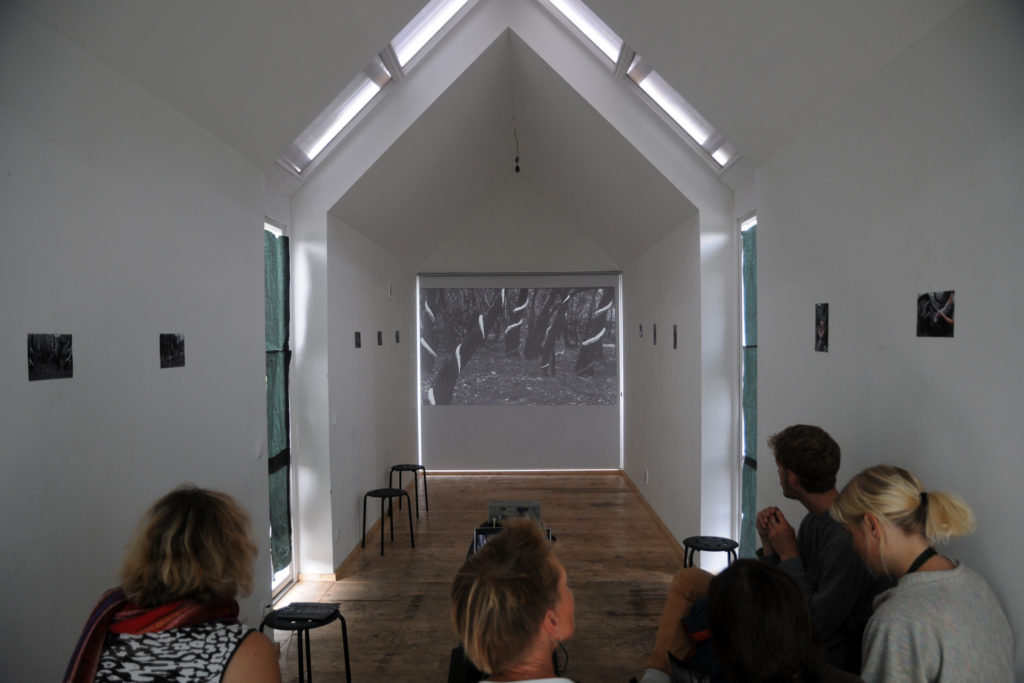
On September 11, 2012, duringdOCUMENTA (13)in Kassel, Andrea Morucchio presentedEIDETIC BUSH(2012) at Space 42, Hauptbahnhof, invited by Critical Art Ensemble as part of the curatorial project Winning Hearts and Minds, which featured one hundred artists presenting daily interventions throughout the exhibition’s hundred days. The work reinterprets EIDETIC BUSH(2003) project first realized in 2003 at Plimsoll Gallery, Hobart inspired by the devastating bushfires that swept through Australia in 2002–03. the charred landscape becomes both stimulus and surface for ritual gestures—a site where destruction and creation intersect. Presented in the neutral, transitory environment of Kassel’s Hauptbahnhof, the installation takes on a universal dimension: from a personal journey through Australia’s devastated terrains, it transforms into a collective document of memory, evoking loss, resistance, and the regenerative power of art.
EIDETIC BUSH| 2012, dOCUMENTA, Space 42, Hauptbahnhof, Kassel.
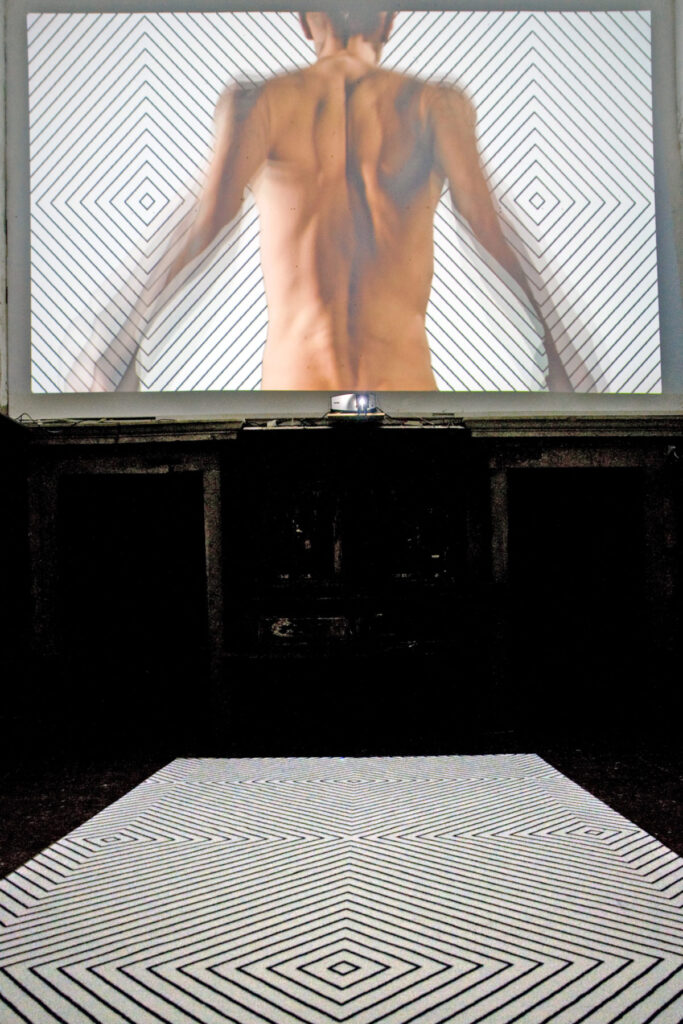
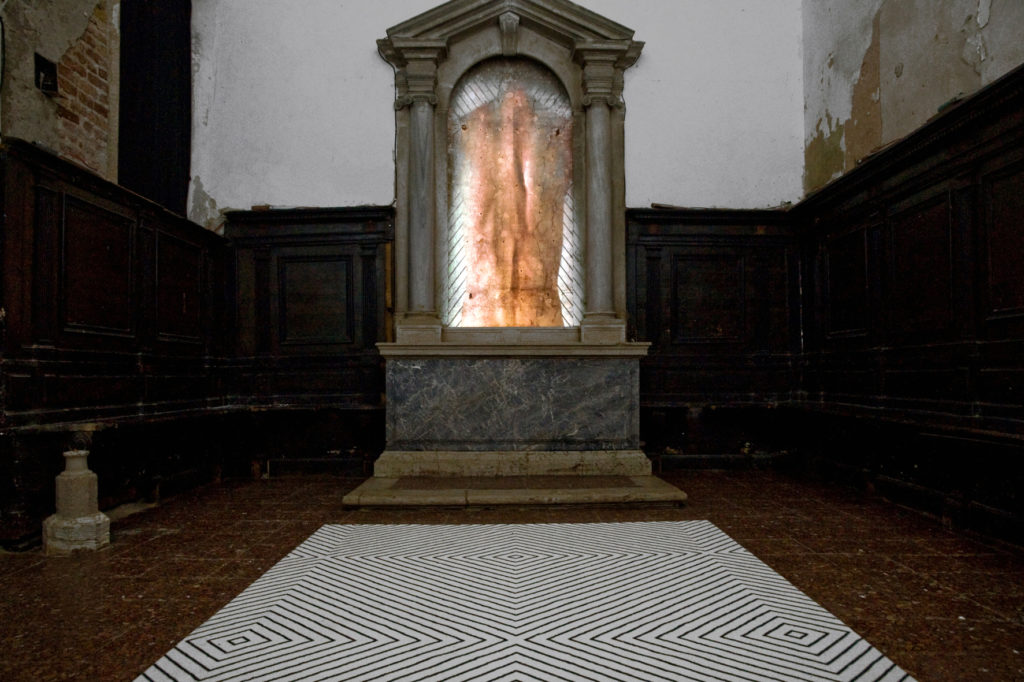
Identity and otherness are two elements constantly at play in Andrea Morucchio’s work and the environmental context of site-specific work favours the plan itself and it’s conceptual nature. This is the case with PLAY GOD(2014) an installation produced by nuova icona and curated by vittorio urbani & elisa genna, created specifically for the Oratory of San Ludovico Church in Venice in May 2014, where the artist takes up some of the basic ideas of his artistic career and develops them inside the allure of a holy space that transmits a sense of mysticism. In PLAY GOD, Andrea Morucchio transforms the Oratorio into an immersive environment where sight, sound, scent, and movement converge into a contemplative ritual.
PLAY GOD| 2014, Oratorio San Ludovico, Nuova Icona, Venezia.
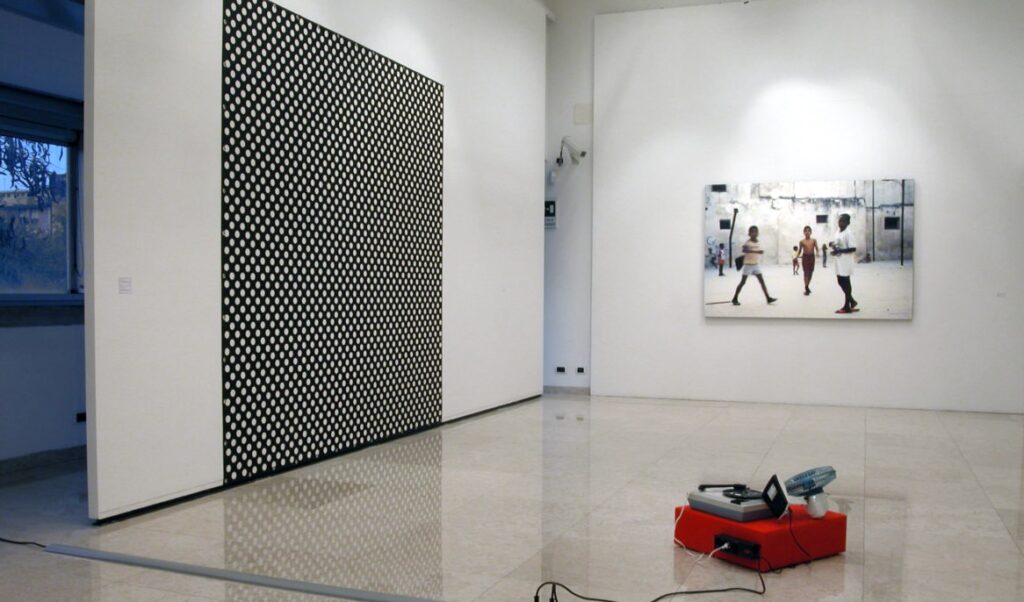
Two video projections mirror the artist’s body in rhythmic, repetitive motion, framed against a geometric black-and-white pattern inspired by Frank Stella. Between these visual poles, a patterned carpet, continuous wind-based sound, and the fragrance of bay leaf create a subtle network of correspondences, blurring the boundaries between body and space, presence and reflection, origin and echo. The work unfolds as a meditation on duality, circularity, and the act of creation itself. The cycle of six minutes of continuous sound followed by one minute of silence structures a ritual rhythm, while the symbolic references—from the sacred bay leaf to the carpet woven in a Tibetan refugee workshop—root the installation in personal and spiritual experience. PLAY GOD invites the viewer into a liminal space where geometry meets gesture, repetition meets stillness, and the human impulse to“play god”is reflected through the transformation of the sensorial world into a place of reflection, transcendence, and ritualized presence.
PLAY GOD| 2014, Oratorio San Ludovico, Nuova Icona, Venezia.
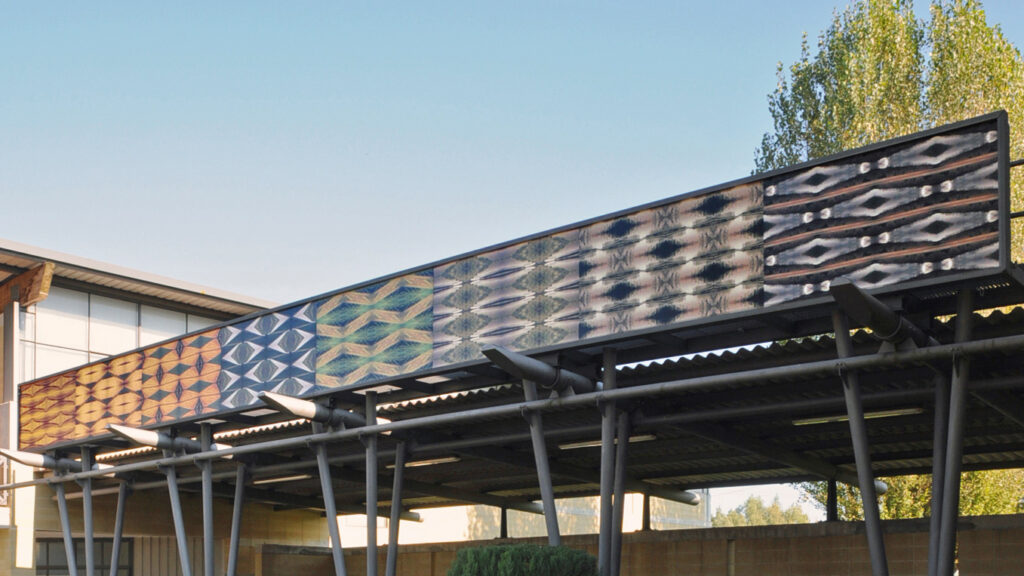
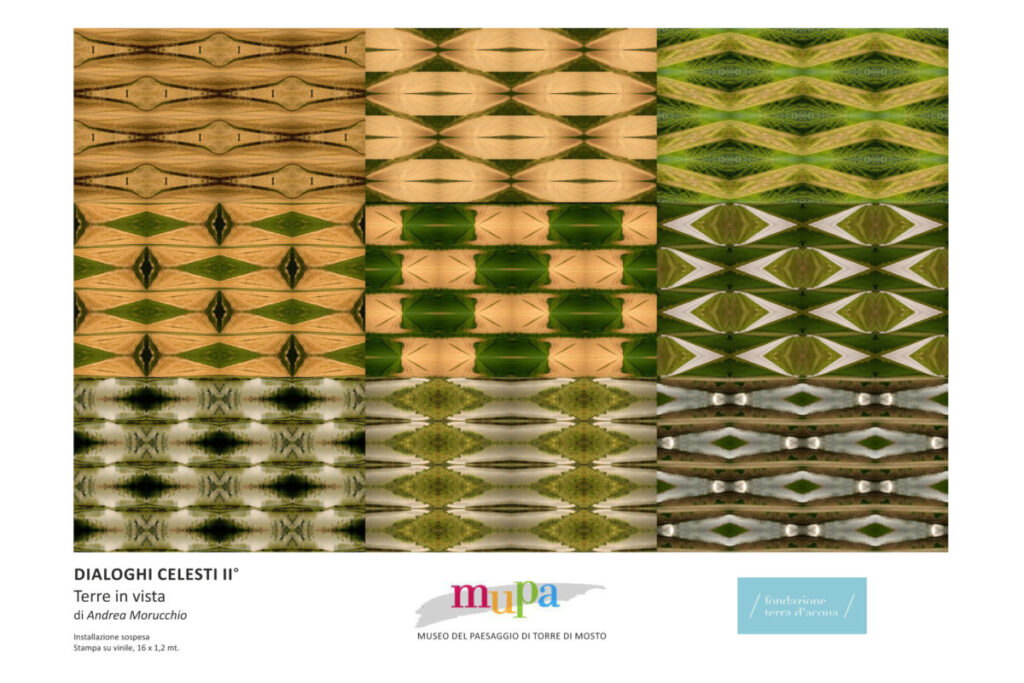
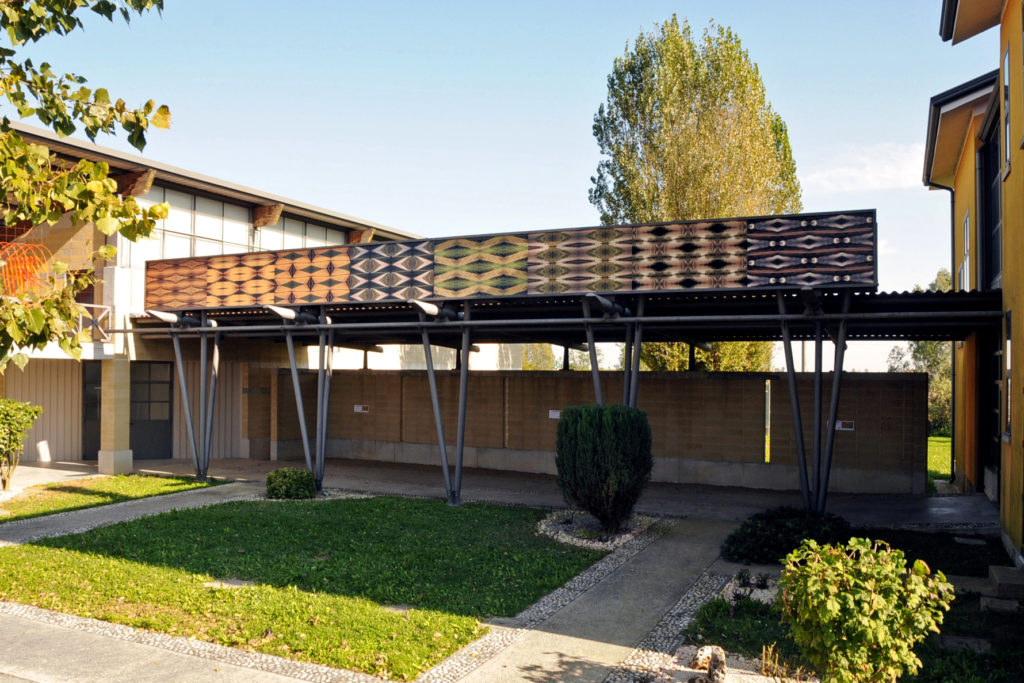
TERRE IN VISTA(since October 2014) is a site-specific installation by Morucchio at MUPA – Museo del Paesaggio,Torre di Mosto, Venice, consisting of eight printed panels extending across a total length of 16 meters and a height of 1.2 meters. The work is part of Dialoghi Celesti / Celestial Dialogues, a project by the Landscape Museum that commissions artists to create works capable of activating a dialogue between earth and sky. In this “suspended” zone, land and atmosphere encounter one another, mirror each other, and enter into a silent exchange. In terre in vista, Morucchio assigns the leading role to the land itself; The earth reveals itself wholly to the sky, offering its textures, chromatic variations, and structural rhythms, while the sky becomes a space of observation and interpretation. The resulting installation hovers between the two realms, transforming the surrounding landscape of the Museum—the countryside of Boccafossa—into a concrete abstraction: a visual thought translated into image.
TERRE IN VISTA | DIALOGHI CELESTI | 2014, Museo del Paesaggio, Torre di Mosto.
Over the course of a year, from spring to winter, Morucchio photographed an extensive range of landscapes: plowed and fallow fields, grassy expanses, rows of buds and emerging plants, flat horizons crossed by ditches, tree lines and light poles, as well as the silvery threads of canals and the Brian and Livenza rivers. From this prolonged observation emerged what Giorgio Baldo, director of MUPA, describes as: An atlas of visual perceptions. The land of Boccafossa appears as a landscape of geometric entities, presiding over its materials and governing its forms. At the same time, human intervention generates a delirium of geometries and abstract perfection, from which Morucchio extracts spatial and chromatic ideas.
Through a meticulous and immersive process, scrutinizing surfaces, and tuning himself to the genius loci, Morucchio distilled hundreds of photographs into eight synthetic “portraits of the earth.” By cropping, mirroring, and recombining fragments along orthogonal axes, he constructs images that are at once analytical and abstract. These compositions evoke analytic Cubism and the optical and kinetic experiments of the 1960s, producing works that oscillate between representation and transformation. Each panel remains faithful to the photographic source while simultaneously transcending it, forming a hyperkinetic collage of geometric landforms. Installed in sequence along the Museum’s façade, the eight panels form a continuous “flying carpet” of the earth. As Baldo further notes: The carpet flies above the land, filtering its purity, its decorative qualities, and its sensory dimensions, transforming them into mosaics and offering them for contemplation beneath the dome of the sky—like an inlay on the floor of a basilica. The real of the earth: its idea.
TERRE IN VISTA | DIALOGHI CELESTI | 2014, Museo del Paesaggio, Torre di Mosto.
♦ 2 0 1 5 – 2 0 2 5 ♦
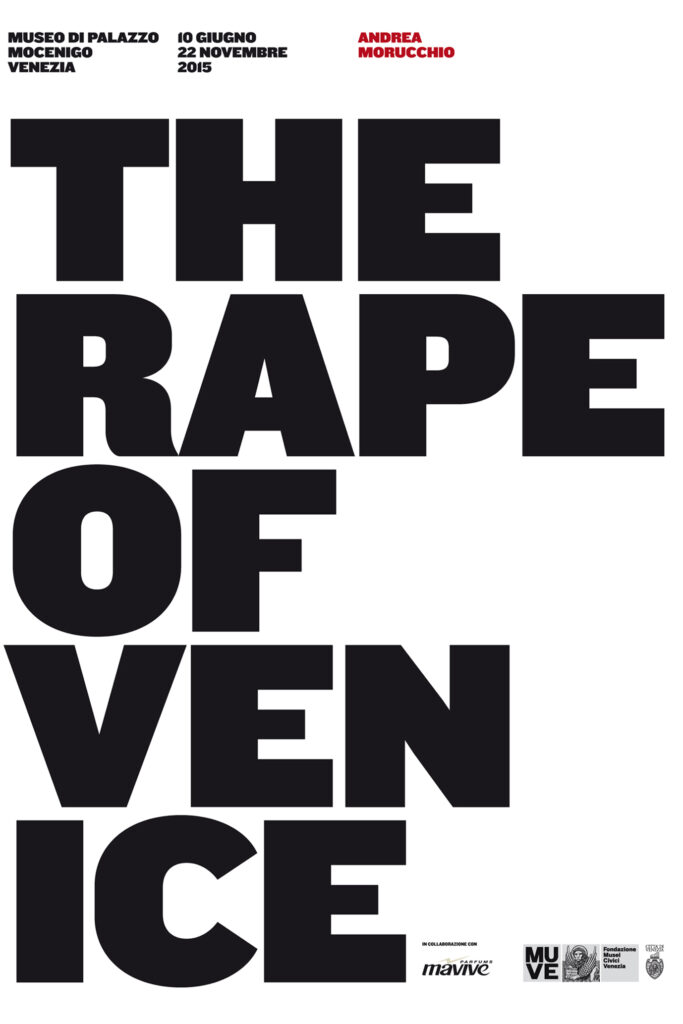
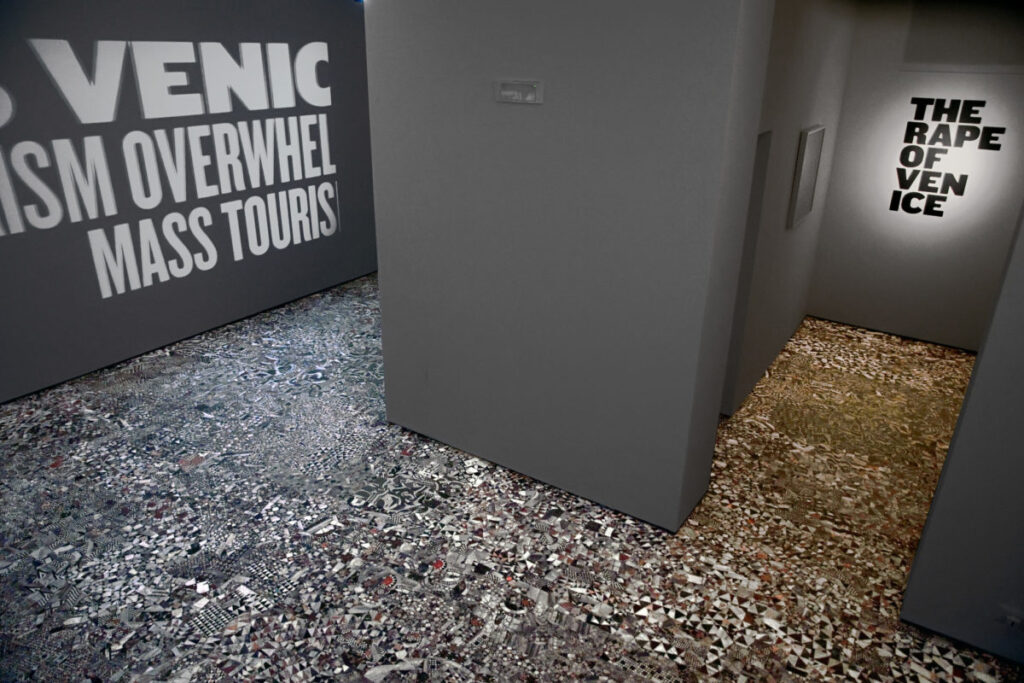
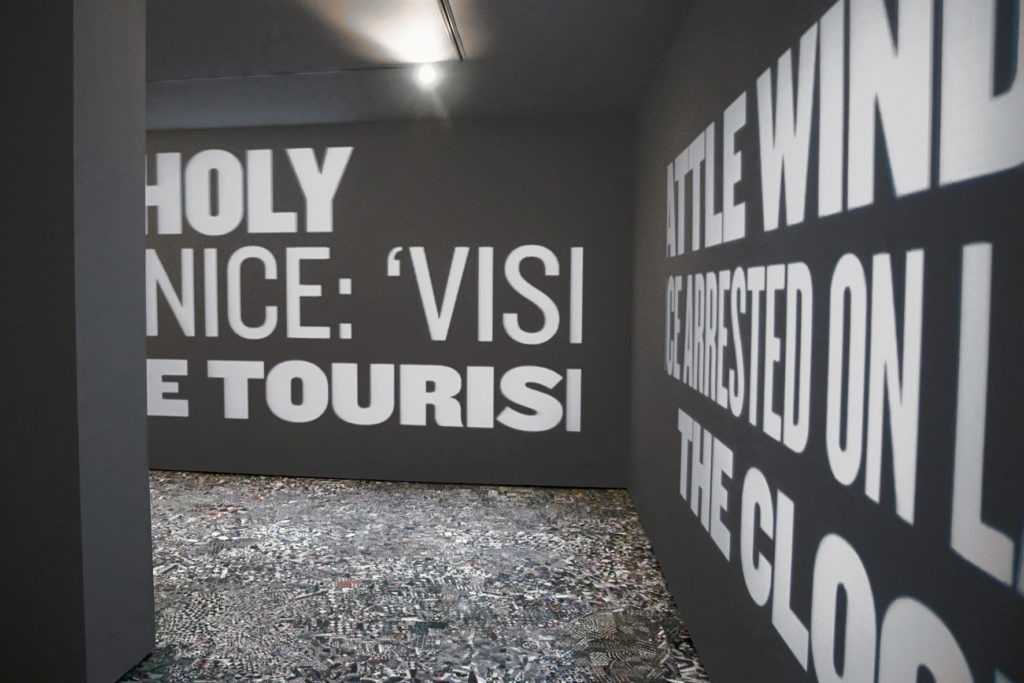
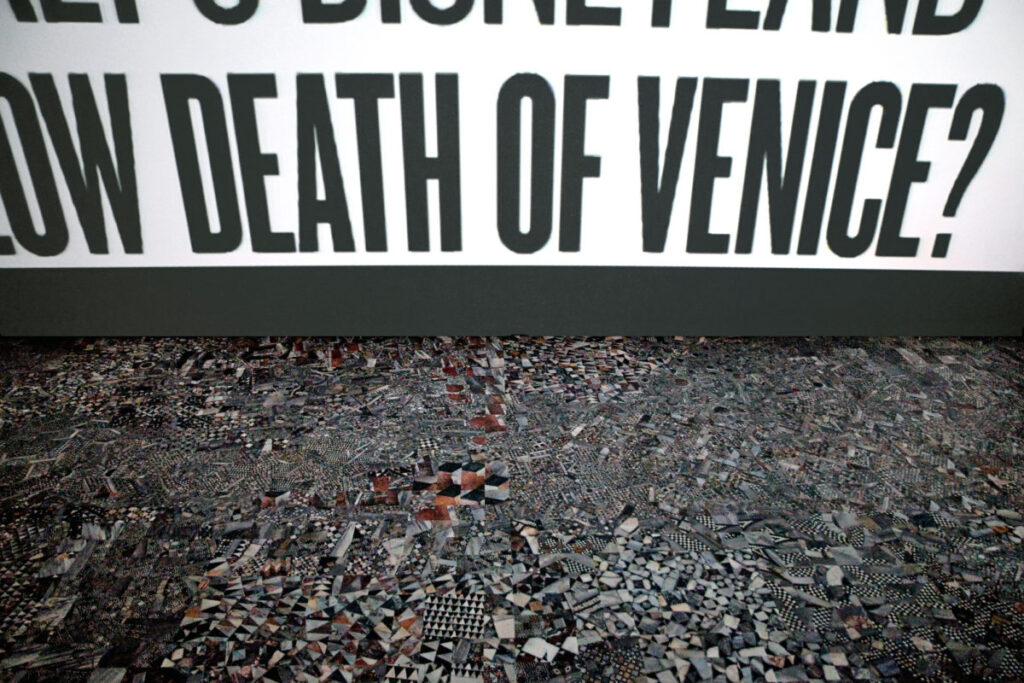
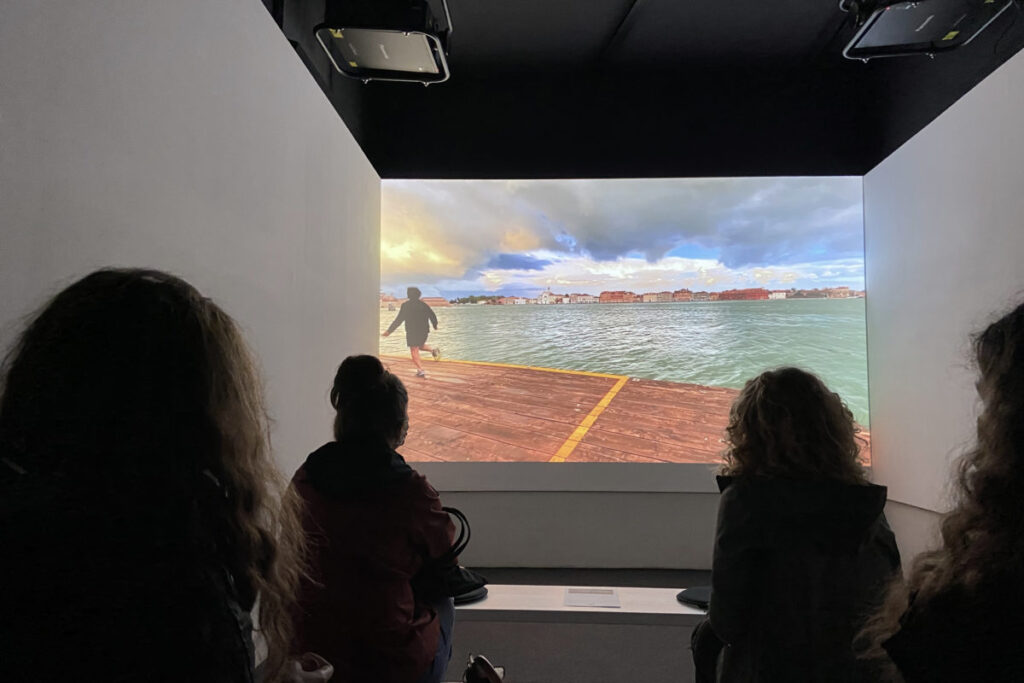
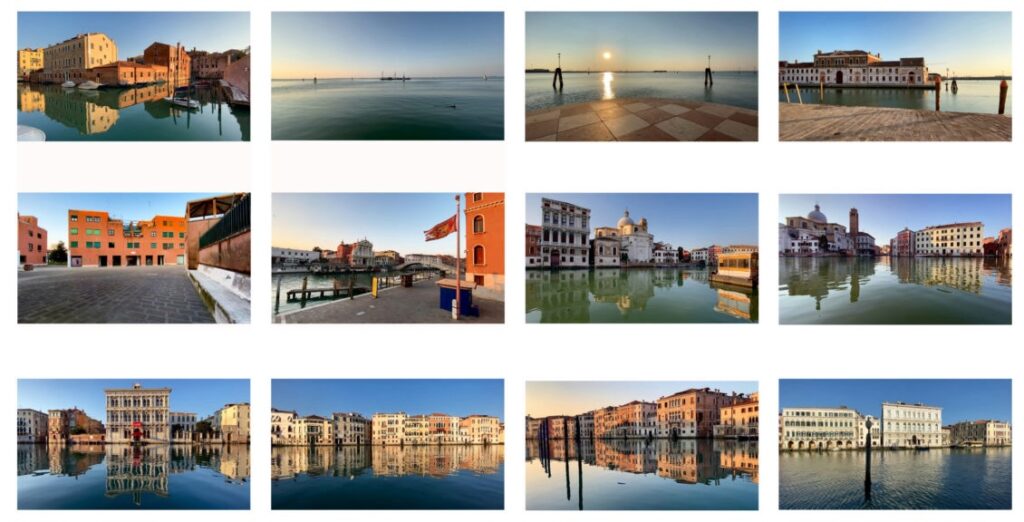
THE RAPE OF VENICE is a large-scale multimedia installation by Andrea Morucchio, presented at the Museo di Palazzo Mocenigo in Venice from June 5 to November 22, 2015, as part of MUVE Contemporaneo for the 56th Venice Biennale – All the World’s Futures. The project produced in collaboration with Marco vidal (mavive) was curated by Vittorio Urbani (Nuova Icona) and Matteo Bertelè. It involved a multidisciplinary team including Francesco Gibaldi (sound design), Emanuele Basso (video), Maurizio Cerizza (Atelier Fragranze Milano, fragrance creation), Sebastiano Girardi Studio (graphic design), and We Exhibit (multimedia set-up).
Installed in the White Room of Palazzo Mocenigo, the work immerses viewers in a total multisensory environment that reflects on the fragile identity of Venice — a city suspended between beauty and decay, heritage and exploitation. At the center of the installation lies afloor composition made of thousands of printed tiles, a fragmented reinterpretation of the mosaics of St. Mark’s Basilica. Once symbols of sacred and civic splendor, these deconstructed tesserae evoke the disintegration of the city’s cultural and material fabric. Walking across this surface, visitors physically experience Venice’s own fragility. The soundscape, composed of underwater recordings from the Venetian lagoon, captures the deep resonance of boat propellers and engines — a sonic metaphor for the invasive traffic that endangers the lagoon’s ecosystem. Along the walls, video projections display continuously scrolling headlines from international media, flooding the room with light and information and situating Venice’s crisis within a global context.
THE RAPE OF VENICE |MUVE CONTEMPORANEO | 2015, Palazzo Mocenigo, Venezia.
The olfactory dimension, fills the space with the icy, seaweed-like scent of the lagoon, a subtle poetic counterpoint inspired by Joseph Brodsky’s Watermark. Through the interplay of visual, sonic, tactile, and olfactory media, Morucchio transforms perception into critical awareness. THE RAPE OF VENICE does not reproduce the city but translates its vulnerability into an immersive sensory and civic experience, merging protest and poetry. The work stands as a radical intervention within Venice’s contemporary cultural landscape, perfectly aligned with the spirit of the 2015 Biennale — an invitation to confront, through art, the fragile beauty and complex contradictions of the city itself.
THE RAPE OF VENICE | MUVE CONTEMPORANEO| 2015, Palazzo Mocenigo, Venezia.
Matteo Bertellè reads Morucchio’s The Rape of Venice as an immersive total installation that makes the viewer experience the city’s progressive disappearance. Echoing Joseph Brodsky’s warning about Venice’s ongoing “rape,” the work confronts both natural and human-made threats—climate change, depopulation, mass tourism, and environmental degradation—through a multisensory environment of fragmented images, text, sound, and fragrance. Drawing on Ilya Kabakov’s concept of the total installation, Morucchio transforms the Palazzo Mocenigo’s White Room into a space where Venice’s fragility becomes palpable. Instead of celebrating the city’s artistic treasures, the installation foregrounds the vulnerability of the city itself. Morucchio’s deconstruction and reassembly of the San Marco Basilica floor tiles create a sense of “estrangement,” while underwater sound recordings and multilingual textual projections challenge viewers to perceive Venice differently. Rather than replicating Venice—as global copies do—the work emphasizes its potential absence. Through this synesthetic reconstruction, The Rape of Venice crystallizes the fear of losing the city while simultaneously revealing its essence and urging a renewed responsibility toward its future.
THE RAPE OF VENICE | MUVE CONTEMPORANEO | 2015, Palazzo Mocenigo, Venezia.
Andrea Morucchio’s video installation RED TRACK (2016) was presented at Palazzo Mora, Venice as part of the third edition of the Venice International Performance Art Week, curated by VestAndPage and dedicated to the theme Fragile Body – Material Body. This participation marked Morucchio’s second appearance in the project, following his work RIVOLUZIONI at Palazzo Bembo in 2012. The installation revisits a performative action realized by the artist in Puglia in 2003. In the video, projected vertically within a narrow space whose floor is covered with fine red powder, an African man walks under the blazing sun, dragging behind him a long jute sack filled with red earth.
The friction of the sack leaves a continuous trace — the “red track” — marking his passage through the landscape. It is the red line that reconnects him to his native land like holy scripture with no words, as he moves forward, leaving behind all the exasperation and pain which his story recounts. Through this essential yet poignant gesture, Morucchio reflects on migration, displacement, and endurance, transforming a solitary action into a universal metaphor for human struggle and belonging. Combining image, space, and poetic symbolism, RED TRACK testifies to Morucchio’s continued engagement with the political and existential dimensions of the body as a site of meaning and memory.
RED TRACK | VIPAW III | 2016, Palazzo Mora, Venezia.
MUPA, the Museum of Landscape in Torre di Mosto has hosted from 2013 various types of works by the Venetian artist in various prestigious group shows: TABULA RASA (2013) –DYNAMIC(2016) – FABULA INCROCI – including different media: digital art, sculpture, and since 2013 TERRE IN VISTA the permanent installation which surmounts the entrance to the Museum since 2014, and thesolo photographic exhibition FERMO IMMAGINE(2017). “Pure” photography, in this case industrial photography, regularly returns to Morucchio’s research and artistic path. Between 2012 and 2017, Andrea Morucchio photographed the industrial landscape of Porto Marghera, on the edge of the Venice Lagoon.
FERMO IMMAGINE brings together a selection of these works, offering a contemplative journey through the transformation of a once vital industrial area. FERMO IMMAGINE transforms Porto Marghera into what critic Stefano Cecchetto describes as a space of suspended time—a landscape that seems to detach itself from reality to inhabit a metaphysical elsewhere. Through a painterly use of color, light, and shadow, Morucchio’s photographstranscend documentation to evoke emotion and reflection. They reveal a fragile, almost dreamlike vision of an industrial world on the verge of disappearance—a quiet before the storm where the visible becomes a gateway to the invisible.
Since 2016 Morucchio creates a series of digital works entitled PUZZLING RENAISSANCEcomposed of thousands photographic “tiles” reproducing parts of the mosaic flooring of the Basilica of San Marco in Venice. The same tiles were used, randomly arranged by Morucchio, to create the flooring for the installation THE RAPE OF VENICE (2015) at Museum of Palazzo Mocenigo. In PUZZLING RENAISSANCEProject, Andrea Morucchio reinterprets the masterpieces of the Italian Renaissance through fragments of geometric, vegetal, and animal motifs drawn from his PHOTOS of the mosaic floors of St. Mark’s Basilica.
PUZZLING IL PARADISO | RENAISSANCE SERIES | Revisiting Tintoretto’s Il Paradiso, 2018, detail.
By digitally reordering these patterns, the artist seeks a dialogue with the great painters of the past—Leonardo, Botticelli, Giorgione, and Titian—exploring how their legacy can resonate in contemporary visual language. Through this personal ars combinatoria, Morucchio fuses historical reference and digital experimentation, offering a refined meditation on time, memory, and the enduring power of images. Toni Toniato writes in his critical text puzzlingThe immage is other, also: What the artist is focusing on is not so much the electronic reproduction of historical pictorial figurations but the very essence of the image as such, the problematic if not inexplicable nature of its duplicity, of its symbolic appearance of itself and of something else, in concrete terms its admirably becoming idea and thing, substance and reason, form and sense, precisely the true “enigma” of art. And of its illuminating truth.
PUZZLING LA TEMPESTA | RENAISSANCE SERIES | Revisiting Giorgione’s La Tempesta, 2018, detail.
Engagement Acts is a video installation presented for the group show The Scent of Time in Venice in 2019 for the first edition of Majhi International Art Residency organized by DBF in collaboration with Lightbox and later in the same year in Dhaka supported by the Embassy of Italy for the 15th Italian La Giornata del Contemporaneo/ Contemporary Art Day by AMACI. It consists of a series of videos documenting the artist’s actions created in a desolate, barren seascape; a specific alienating atmosphere from control shots, to significant contrasts and to a limited color spectrum.
These are actions in which Morucchio interacts with the elements of this environment: tree trunks, rocks and sand; cathartic actions, liberating vent but also manifestations of an instinctual and primitive expression of creativity – rituality that over the years has characterized some of Morucchio’s installation projects. in 2024, Morucchio expands the project with ENGAGEMENT ACTS – STILLS, selecting frames from each performative action videos capturING the essence of each performance. Each piece, presented as a horizontal sequence of nine photographic prints, freezes time to reveal moments of heightened intensity.
ENGAGEMENT ACTS| Action n° 04 | Stills sequence series, 2024, 32X57×3 cm, Edition of 3.
Venezia Anno Zero is a 13-minute shor–t film by Andrea Morucchio, created during the 2020 spring PSICOPANDEMIC lockdown and presented at the video space of Fondazione Giorgio Cini in Venice. Filmed over two months when mass tourism came to a sudden halt, the work captures a profoundly transformed city — silent, deserted, and unexpectedly radiant. Composed from thirty hours of footage and accompanied by a soundtrack by Claudio Rocchetti, which blends original ambient sounds with new compositions, the film reveals a Venice suspended in time, rediscovering its metaphysical and dreamlike beauty. In continuity with earlier works such as Pulse Red (2004, 2009), and The Rape of Venice (2015), Morucchio reflects on the fragility and exploitation of his native city while envisioning the possibility of renewal. Awarded at the 17th Pasinetti Video Competition (Venice Film Festival, 2020), the project has since expanded to include photographic works as VAZ STILLS.
Venezia Anno Zero is not a mere act of documentation. It is a critical reflection on the city of Venice, on its relationship with mass tourism, and on its cultural and environmental identity. The image of a suspended city — temporarily freed from the overwhelming pressure of tourist flows — becomes a powerful device through which the viewer is invited to reflect on Venice’s fragility and on the uncertain future that lies ahead. Yet Morucchio’s work has nothing to do with the reassuring and seductive images of a silent Venice that circulated widely on smartphones and television screens during the lockdown period. Venezia Anno Zero deliberately distances itself from any form of nostalgic or complacent aestheticism. Instead, it seeks to penetrate the city’s deeper essence. The title itself, explicitly referencing Roberto Rossellini’s neorealist masterpiece Germany, Year Zero, signals a precise intention: to confront a moment of historical rupture not as spectacle, but as ethical and existential inquiry. Morucchio directs his gaze toward the soul of Venice, toward its genius loci — a spirit long concealed beneath layers of superimpositions and disguises.
As the artist suggests, these masks have been imposed over time by human greed on the one hand, and by indifference on the other. Through an austere visual language and an atmosphere of suspension and tension,VEnezia Anno Zero strips the city of its decorative surfaces and confronts us with what remains when the spectacle collapses: a vulnerable, yet still profoundly alive organism. In doing so, the work transforms the exceptional condition of the pandemic into an opportunity for radical reflection, urging us to reconsider our responsibility toward Venice — not as an image to be consumed, but as a living city whose future is inseparable from our choices.
In accepting the invitation to participate in the exhibition, Beyond the Face, the Contemporary portrait at the Art Centre Les Bernardes in Girona, Spain, From November to January 2021, Morucchio began a new line of research focused on portraiture, enriching THE Puzzling PROJECT with a new series of works entitled Puzzling warhol; instead of the tiles that reproduce the floor of the Basilica of San Marco the artist has collected thousands of images of butterfly wings that he uses to revisit a selection of works by Andy Warhol. The development of the Puzzling project in reinterpreting subjects of Renaissance pictorial art has stimulated Morucchio to expand the range of action by confronting the artistic movement which, since the end of the 1950s, has introduced a new figuration and first investigated the standardized and standardizing communication system of the nascent consumer society.
VENERE| Puzzling Pop series | Revisiting Andy Warhol’s Venere di Botticelli, 2020, digital print on aluminium, 120 × 150 cm.
The curator Laura Cornejo Brugés reserves an entire room for the works of the Puzzling WARHOLseries, created especially for this exhibition, whose walls have been painted in relation to the colours of the works on display. According to Cornejo Bruges, Puzzling warholrevisits the legacy of Pop Art, updating its critical stance toward mass communication and consumer culture. Through strategies of citation and revision, Morucchio intervenes on Andy Warhol’s iconic portraits of media figures, digitally deconstructing their faces by means of collages composed of butterfly wing fragments. This process alters both morphology and color, restoring a sense of individuality and visual complexity to the subjects. Puzzling WARHOLultimately redefines portraiture as a mutable and unstable form, rejecting fixed identities and emphasizing alterity, transformation, and plurality as essential conditions of uniqueness, both visually and symbolically.
PUZZLING WARHOL | BEYOND THE FACE| 2020-21, Centre d’art contemporain Les Bernardes, Girona.
Re-Flooringis an extremely innovative and original project that lasts throughout the 59th Venice Biennale 2022. Starting from the mosaic floor of St. Mark’s Basilica Morucchio elaborates Re-Flooring a AR Augmented Reality site-specific “PHYGITAL” NFT installation project in an evocative space, a church built in the early twentieth century in Romanic style no longer place of worship located on Isola delle Rose in the Venice Lagoon now the site of JW Marriott Venice.
The work consists of nine printed panels hanging on the walls of the Church. The different images printed on the single panels reproduce the initial stills of the corresponding video animation. The nine different animations correspond to as many NFTs entitled Re-Flooring nftvideo. The work is experienced through the use of a free downloadable augmented reality app; the visitors by framing the panels with a smartphone “transform” them through Augmented Reality into monitors that transmit videos with relative sounds
With his solo exhibition PUZZLING IDENTITIES, presented at Bugno Art Gallery in Venice from June 10 to July 7, 2022, Andrea Morucchio offers a comprehensive overview of his ongoing PUZZLING PROJECT, here focused on the theme of portraiture. The exhibition brings together sixteen works from three interconnected series —Fantastic Portrait – Puzzling warhol – Puzzling Renaissance. The exhibition explores themes of identity, transformation, and the dialogue between image, material, and technology.
Far from being mere quotations, the “figures” staged by the artist through carefully constructed poses challenge our perceptual certainties. As Toni Toniato writes in the catalogue, they do not present themselves as univocal images, but as duplicated, double-sided, or even multidimensional images, capable of capturing the viewer’s gaze and holding it, almost ensnaring it within a web of visual references and layered meanings. From this emerges a complexity of resonances and echoes activated by these mirror-images—processes not unlike those of neural activity. When observed closely, they also reveal deeper references: from the archetype of the hermaphrodite, concealed within Leonardo’s celebrated female portraits, to the commodified and regressive polysemy of certain mass “myths,” obsessively anticipated and amplified by Warhol’s work.
For this exhibition, Morucchio has also developed interactive works that integrate digital and physical media. Through an app, visitors can access video and audio animations corresponding to NFT artworks directly connected to the tangible pieces. These NFTs (Puzzling Pop _ NFT _ video) were created using the same original photographs that Andy Warhol employed for his silkscreens, reimagined through Morucchio’s digital process. This collection consists of nine video NFTs created as sequences of still images from the Puzzling Warhol – NFT Stills series. Using the same archive of approximately 4,000 photographic tiles depicting butterfly wing details—previously employed to produce the physical works of the Puzzling Warhol series—the artist developed short video animations in which some of Warhol’s iconic subjects are dynamically reworked. Each animation is generated from different compositional matrices and highly variable color combinations, resulting in a continually shifting selection of wing fragments that form the individual images within each sequence.
L’Estetica del Tempo Sospeso / The Aesthetics of Suspended Time is a photographic exhibition by Andrea Morucchio, presenting a collection of twenty photographic prints distinguished by their intense, evocative atmospheres—rich in warmth, shadow, and emotional depth. As noted by Francesca Orsi in an interview with Morucchio published in FotoCult, Porto Marghera emerges like a painting by Giorgio de Chirico: a disorienting, desolate, almost psychoanalytic landscape. Born and raised in Venice, Andrea Morucchio reclaims and reinterprets the notion of “landscape” within this industrial environment, transforming it into a space of introspection and symbolic resonance.
From this vision emerged L’Estetica del tempo sospeso , a long-term project developed over a decade (2009–2019) and presented in the winter of 2024 in Venice at Docks Cantieri Cucchini. The exhibition represents an evolution of Morucchio’s earlier show Fermo Immagine, held at MUPA in 2017. Indeed, for the 2024 exhibition the artist created the audiovisual work The Beauty of Time Suspension, conceived as a synthesis and expansion of the photographic research. The video is composed of a montage of hundreds of photographs of Porto Marghera taken between 2009 and 2019. It unfolds through thematic sequences, interwoven with poetic verses by Marina Castrillo and accompanied by original musical compositions from the Unfolk Collective Project.
In Spring 2024, to coincide with Morucchio’s solo exhibition The Puzzling Classics Show and the start of the 60th Venice Biennale, theRe-Flooring project is presented again in the spaces of Tesa 2 by _docks_cantieri_cucchini. On this occasion compared to the first installation of Re-Flooring the installation space is completely different; in 2020 in isola delle rose church the set of panels were conceived in order to create a sitespecific installation. With Re-Flooring 2we find ourselves in a space of a former boatyard and nevertheless the installation elements as a whole dialogue perfectly with this new context giving new meaning and artistic dignity to the repurposing of the multimedia work.
At just a few meters’ distance, Andrea Morucchio stages two closely related yet distinct projects: the multimedia installation Re-Flooring 2 and the solo exhibition The Puzzling Classics Show. Both are conceived using the same “material” — the digital photographic tiles of the mosaic floor of St. Mark’s Basilica in Venice — yet they give rise to two profoundly different artistic operations that remain in dialogue with one another. Presented in the area adjacent to the Venice Biennale during the opening months of the 2024 edition, these projects highlight the conceptual and aesthetic coherence of Morucchio’s practice. In The Puzzling Classics Show, produced in collaboration with Bugno Art gallery e dbf foundation, the artist employs the same mosaic fragments to create works from his Puzzling Renaissance series, digitally reimagining paintings by Tintoretto, Giampietrino, TiZIANO, Palma IL VECCHIO, Veronese, Giorgione, and Leonardo DA VINCI.
SAS Secret Apartment Show is an independent, exhibition curated by Vanya Balogh for the 2024 Venice Art Biennale. Hosted in a “secret” apartment facing the Biennale’s Arsenale entrance, it runs during both the opening (April 16-20) and closing (November 18-24) weeks. Featuring seven international artists, the exhibition explores biology, waste, violence, technology, displacement, media manipulation, and power politics, offering a surreal, thought-provoking experience in a transformed tourist apartment. For SAS, Andrea Morucchio debuted History Already Absolved Me, a digital collage portrait series crafted from butterfly wing fragments. This work builds on his Puzzling Pop project, which began with Puzzling Warhol in 2019.
SAS I| 2024, View of Part of the Show 2024, Venezia.
The first portrait, depicting Vladimir Putin, references Fidel Castro’s famous quote, “Condemn me. It does not matter. History will absolve me.” The artwork features Putin’s portrait alongside a brass plaque engraved with this phrase, all within an ornate black and gold classical frame. This neo-pop aesthetic contrasts with its solemn presentation, reinforcing the work’s critical stance on media narratives and political propaganda. Morucchio highlights how Western media has shaped perceptions through demonization and Russophobia, warning about the increasing control of information in modern democracies. History Already Absolved Me ultimately challenges viewers to question mainstream narratives, reflect on media influence, and recognize how history exposes manipulation over time.
Beyond the explicitly pro-Putin work, Morucchio presented a heterogeneous body of artworks distributed throughout the apartment, each engaging—through distinct artistic languages—with the spirit and founding concepts of the SAS project. The selection spanned sculpture (Celata and FP Box Blocks), video/NFT works (Apoti / Making Faces), digital art (Fantastic Portrait) and performance-based video (Engagement Acts)
SAS I| 2024, View of Part of the Show 2024, Venezia.
A couple of Morucchio’s NFT projects, APOTI Making Faces and THE WEST SUICIDE —like History Already Absolved Me—stand in sharp opposition to the conventions of Western contemporary art environment, often aligned with globalist liberal power structures and mainstream narratives. In 2024, Morucchio’s NFT projects received international recognition with double nominations at the 3rd edition of the ftNFT YoCerebrum Awards, held in Malta on November 15, 2024. Morucchio was shortlisted in two categories: “Most Innovative NFT Collection” for APOTI – Making Faces and “Best Phygital Project” for THE WEST SUICIDE: Puzzling Lucrezia Romana.
APOTI – Making Faces is a series of 33 animated NFT portraits, each constructed from intricate digital collages of butterfly wings. Through shifting facial expressions—anger, irony, laughter, embarrassment, surprise—the characters embody raw emotional reactions against the disinformation and cultural conditioning imposed by mainstream Western media and power systems.
THE WEST SUICIDE: Puzzling Lucrezia Romana, part of the artist’s long-running Puzzling Renaissance series, reinterprets a 16th-century painting of Lucretia by Lucas Cranach the Elder. Transformed into a dynamic phygital work through Augmented Reality, the mosaic-like figure of Lucretia moves, her dagger finally striking, unleashing a flood of red tesserae. The piece becomes a powerful metaphor for the “suicide of the West”—a critique of political incompetence, cultural manipulation, and self-destructive geopolitical choices accelerating the civilization’s decline.
Between autumn 2024 and spring 2025, Andrea Morucchio’s Puzzling Renaissance series was presented at two major events: Arte in Nuvola in Rome with Galleria Abscondita, and Milan Design Week 2025 within L’Appartamento at Palazzo Donizetti, curated by Artemest. The works—digital photomosaics of Renaissance nudes composed of thousands of tiles derived from the polychrome marble floors of St. Mark’s Basilica—merge classical iconography with a fragmented visual language exploring identity, memory, and transformation. In Rome, Morucchio’s works entered into dialogue with glass pieces by Vittorio Zecchin, while in Milan they were integrated into an immersive interior by 1508 London, reinforcing the exchange between contemporary art, design, and historical legacy.
Since summer 2025, the entire Fantastic Portraits series from Andrea Morucchio’s Puzzling Pop project has been exhibited together as a public art intervent titled BETWEEN GAZES | FANTASTIC PORTRAITS for the first time in Venice, displayed across the windows of Spazio Gabbiani, a historic former shop once linked to Casanova and facing both a lively canal and a busy calle near Marco Polo’s birthplace. Conceived beyond the conventions of the gallery, the portraits are installed like figures leaning out from the windows, directly engaging the surrounding public space. Their surreal gazes intersect with those of passersby—especially pedestrians crossing the nearby bridge—creating fleeting moments of visual exchange that transform everyday movement into an unpredictable encounter with art.
each portrait is composed of 63 photographic tiles derived from butterfly wing fragments. This pared-down, modular structure heightens distortion and surreal tension, generating figures charged with unsettling energy that echo automatism and resonate with contemporary feelings of fragility, anxiety, and conflict. Through the synergy of place, image, and human presence, the project becomes not only an exhibition but a form of public ritual, embedded in Venice’s architectural and social fabric, inviting moments of confrontation, empathy, and shared reflection.
On the 25th anniversary of his first solo exhibition Dinamiche (2000, Galleria Junck, Venice), Morucchio launches a groundbreaking new chapter of his Puzzling Classics project: Puzzling Tangible Classics. This series marks a decisive shift from digital, two-dimensional compositions to three-dimensional mosaics. Photographic fragments of the Basilica of San Marco’s mosaic flooring—first explored in The Rape of Venice project—are transmuted into physical glass paste tiles.
IN Puzzling Tangible Classicsgaps are filled with gold-painted cotton threads or metallic acrylic, binding the fragments together in a luminous equilibrium. Hundreds of photographic “tiles,” once virtual, are reborn as tangible mosaic elements, inviting both visual and tactile engagement. The process mirrors a material metamorphosis: from ancient marble floor to digital image, from virtual fragment to physical mosaic. Puzzling Tangible Classics. blends historical mosaic tradition with digital experimentation, pushing the boundaries between image and object. By giving enduring form to ephemeral digital fragments, the series redefines the formal language of the project and inaugurates a new, mixed-media direction within Morucchio’s artistic practice.